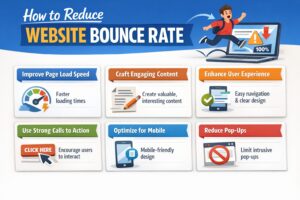
Introduction
In today’s digital marketplace, attracting visitors to your website is only half the battle. The real challenge is keeping them engaged long enough to explore your content, products, or services. Many businesses struggle with a common problem: a high bounce rate.
Bounce rate measures the percentage of visitors who leave your website after viewing only one page without interacting with other content. A high bounce rate can indicate problems such as poor user experience, slow loading speed, irrelevant content, or weak website design.
For businesses aiming to grow online, learning how to reduce website bounce rate is critical. Lower bounce rates often lead to better engagement, higher conversions, and improved search engine rankings.
At IQ BIRDS, we help businesses transform underperforming websites into powerful digital assets through strategic website optimization and user experience improvements.
In this comprehensive guide, you will learn:
What bounce rate is and why it matters
The most common reasons visitors leave websites quickly
Proven strategies to reduce bounce rate
Website optimization tips to improve user engagement
Professional solutions for long-term website success
Let’s explore how to turn your website into an engaging platform that keeps visitors coming back.
Understanding Website Bounce Rate
1.What Is Bounce Rate?
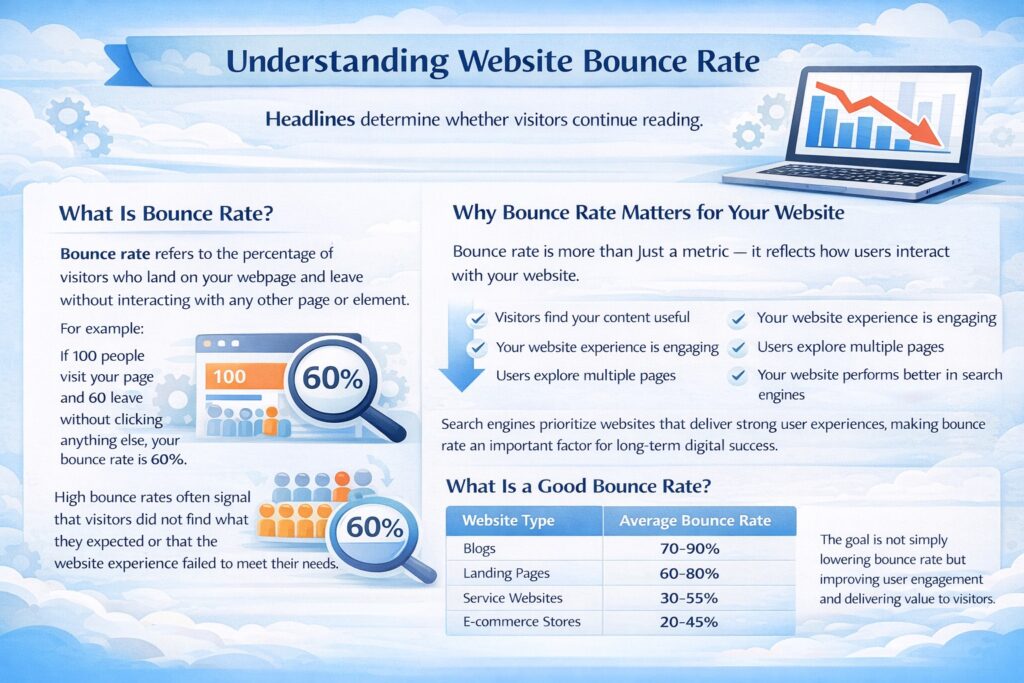
Bounce rate refers to the percentage of visitors who land on your webpage and leave without interacting with any other page or element.
For example:
If 100 people visit your page and 60 leave without clicking anything else, your bounce rate is 60%.
High bounce rates often signal that visitors did not find what they expected or that the website experience failed to meet their needs.
2.Why Bounce Rate Matters for Your Website
Bounce rate is more than just a metric — it reflects how users interact with your website.
A lower bounce rate typically means:
Visitors find your content useful
Your website experience is engaging
Users explore multiple pages
Your website performs better in search engines
Search engines prioritize websites that deliver strong user experiences, making bounce rate an important factor for long-term digital success.
3.What Is a Good Bounce Rate?
Bounce rate varies depending on website type.
Website Type Average Bounce Rate
Blogs 70–90%
Landing Pages 60–80%
Service Websites 30–55%
E-commerce Stores 20–45%
The goal is not simply lowering bounce rate but improving user engagement and delivering value to visitors.
2.Common Reasons for High Bounce Rate
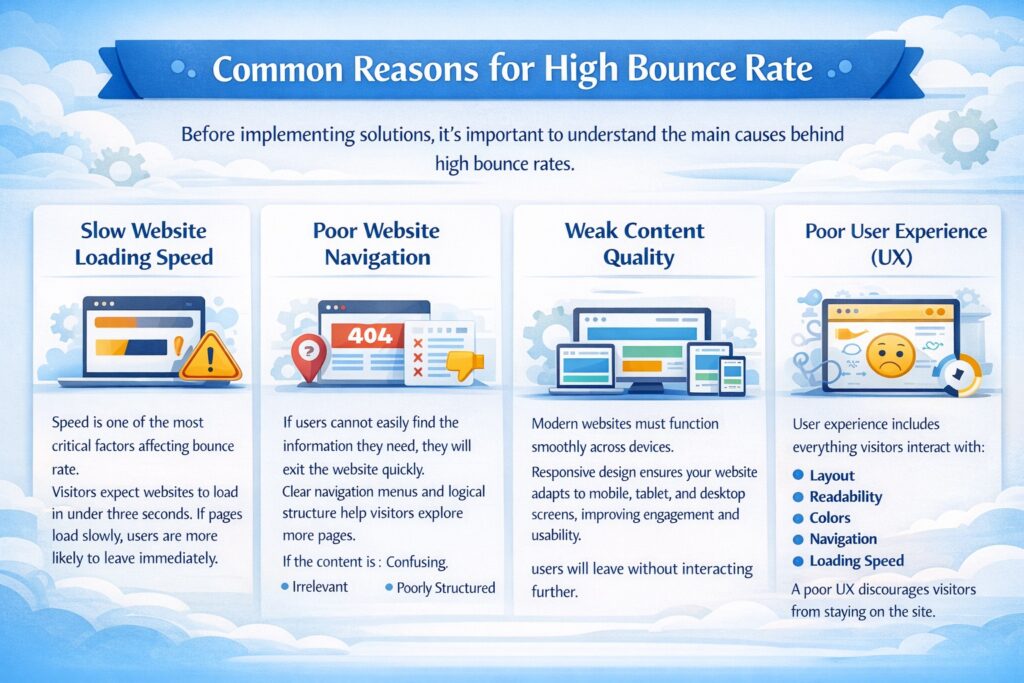
Before implementing solutions, it’s important to understand the main causes behind high bounce rates.
1.Slow Website Loading Speed
Speed is one of the most critical factors affecting bounce rate.
Visitors expect websites to load in under three seconds. If pages load slowly, users are more likely to leave immediately.
2.Poor Website Navigation
If users cannot easily find the information they need, they will exit the website quickly.
Clear navigation menus and logical structure help visitors explore more pages.
3.Weak Content Quality
Content is the primary reason visitors stay on your website.
If the content is:
1.Confusing
Confusing content is information that is difficult for users to understand. It may use complicated language, unclear instructions, or poorly arranged ideas, making it hard for visitors to know what the website is trying to explain.
2.Irrelevant
Irrelevant content is information that is not related to the topic or purpose of the website. It does not help users find what they are looking for and can distract them from the important information.
3.Poorly Structured
Poorly structured content means the information is not organized properly. It may lack headings, clear paragraphs, or logical order, which makes it difficult for users to read and understand the content easily.
users will leave without interacting further.
4.Non-Responsive Design
Modern websites must function smoothly across devices.
Responsive design ensures your website adapts to mobile, tablet, and desktop screens, improving engagement and usability.
5.Poor User Experience (UX)
User experience includes everything visitors interact with:
1.Layout
Layout refers to how different elements of a website are arranged on a page. It includes the placement of text, images, menus, buttons, and other content. A good layout helps users quickly understand the structure of the page and find information easily. It should be organized, balanced, and visually appealing so visitors can navigate the site without confusion.
2.Readability
Readability means how easy it is for users to read and understand the text on a website. It depends on factors like font style, font size, line spacing, and contrast between text and background. Clear headings, short paragraphs, and simple language improve readability and keep visitors engaged.
3.Colors
Colors play an important role in website design because they affect the look, feel, and mood of the site. The right color combination makes the website attractive and supports brand identity. Designers usually use a limited color palette and ensure there is enough contrast so that text and buttons are easy to see.
4.Navigation
Navigation refers to how users move from one page to another on a website. It usually includes menus, links, buttons, and search bars. Good navigation is simple, clear, and consistent across the website so visitors can easily find the information they need without getting lost.
5.Loading Speed
Loading speed is the time it takes for a website page to fully appear on a user’s screen. Fast loading speed improves user experience and keeps visitors from leaving the site. Websites can improve speed by optimizing images, using efficient coding, and reducing unnecessary elements.
A poor UX discourages visitors from staying on the site.
15 Powerful Strategies to Reduce Website Bounce Rate
15 Powerful Strategies to Reduce Website Bounce Rate
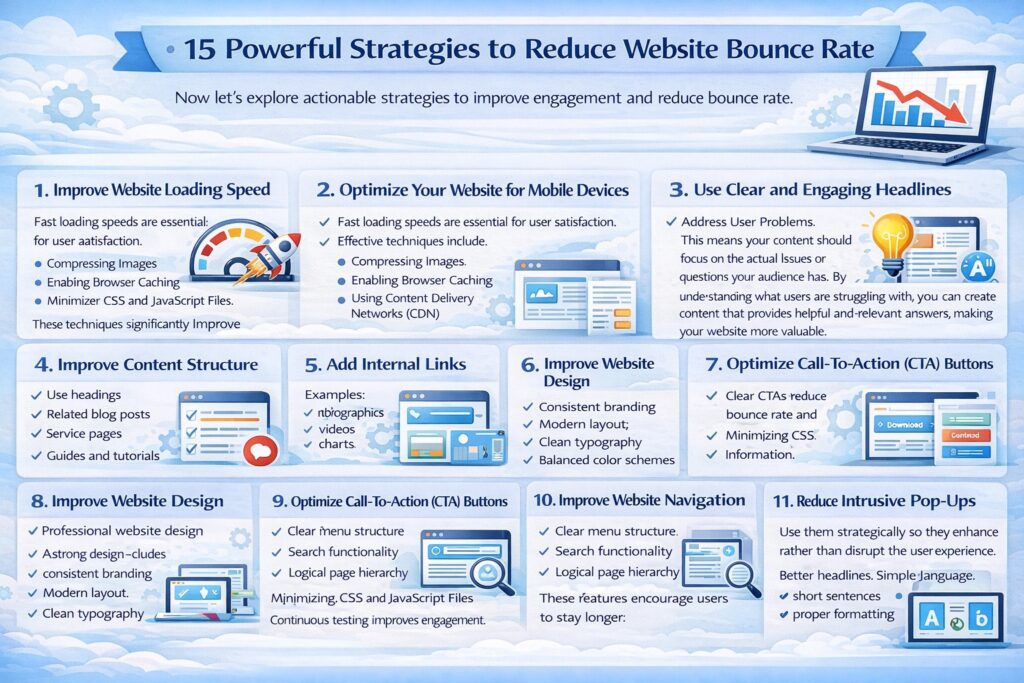
Now let’s explore actionable strategies to improve engagement and reduce bounce rate.
1.Improve Website Loading Speed
Fast loading speeds are essential for user satisfaction.
Effective techniques include:
1.Compressing Images
Compressing images means reducing the file size of images without greatly affecting their quality. Large image files can slow down a website’s loading time. By compressing images, the website loads faster while still displaying clear visuals.
2.Enabling Browser Caching
Browser caching allows a user’s browser to store parts of a website (such as images, stylesheets, and scripts) on their device. When the user visits the website again, the browser loads the stored files instead of downloading them again, which makes the website load faster.
3.Using Content Delivery Networks (CDN)
A Content Delivery Network (CDN) is a network of servers located in different parts of the world. These servers store copies of website content and deliver it to users from the server closest to them. This reduces loading time and improves website performance.
4.Minimizing CSS and JavaScript Files
Minimizing CSS and JavaScript files means removing unnecessary spaces, comments, and unused code from these files. This reduces their size, allowing the browser to download and process them faster, which helps the website load more quickly.
These techniques significantly improve performance and reduce bounce rates.
2.Optimize Your Website for Mobile Devices
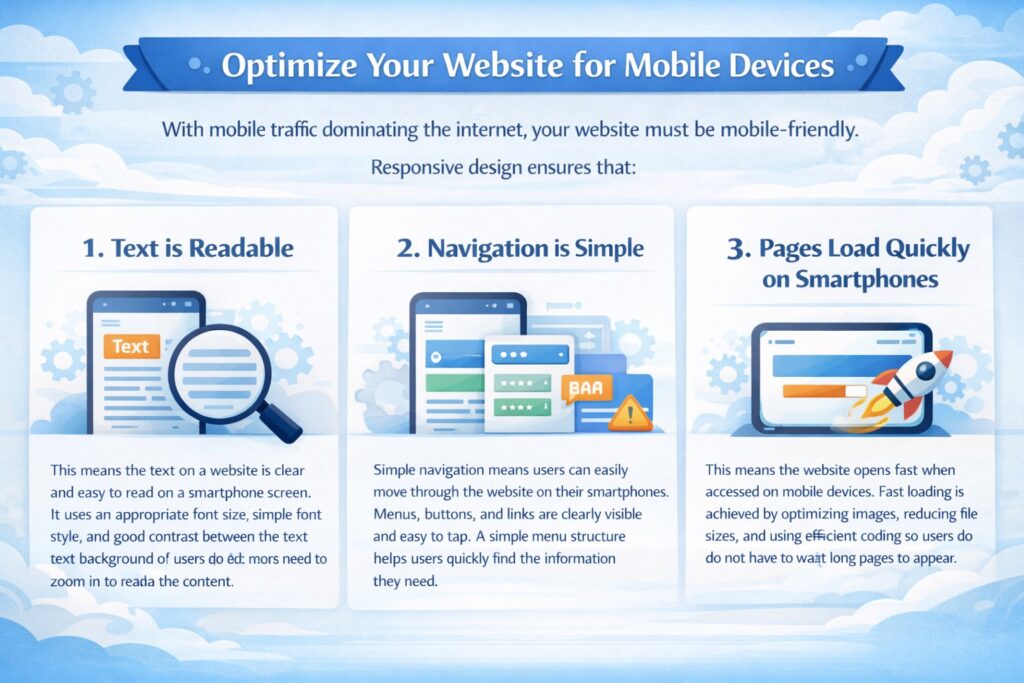
With mobile traffic dominating the internet, your website must be mobile-friendly.
Responsive design ensures that:
1.Text is Readable
This means the text on a website is clear and easy to read on a smartphone screen. It uses an appropriate font size, simple font style, and good contrast between the text and background so users do not need to zoom in to read the content.
2.Navigation is Simple
Simple navigation means users can easily move through the website on their smartphones. Menus, buttons, and links are clearly visible and easy to tap. A simple menu structure helps users quickly find the information they need.
3. Pages Load Quickly on Smartphones
This means the website opens fast when accessed on mobile devices. Fast loading is achieved by optimizing images, reducing file sizes, and using efficient coding so users do not have to wait long for pages to appear.
3. Use Clear and Engaging Headlines
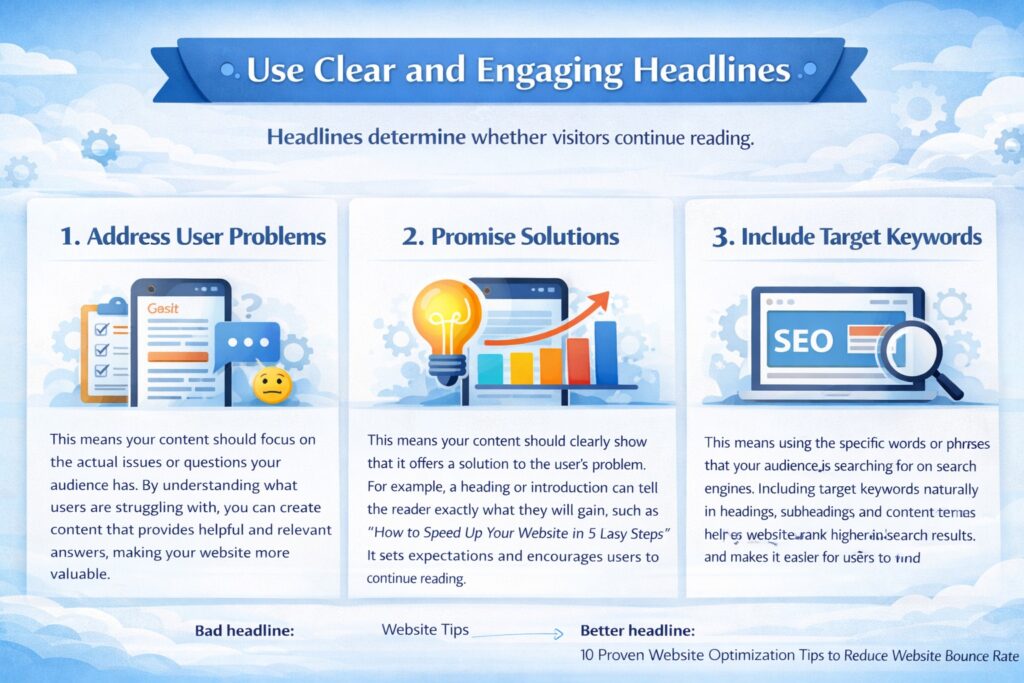
Headlines determine whether visitors continue reading.
Good headlines:
1. Address User Problems
This means your content should focus on the actual issues or questions your audience has. By understanding what users are struggling with, you can create content that provides helpful and relevant answers, making your website more valuable.
2. Promise Solutions
This means your content should clearly show that it offers a solution to the user’s problem. For example, a heading or introduction can tell the reader exactly what they will gain, such as “How to Speed Up Your Website in 5 Easy Steps.” It sets expectations and encourages users to continue reading.
3. Include Target Keywords
This means using the specific words or phrases that your audience is searching for on search engines. Including target keywords naturally in headings, subheadings, and content helps your website rank higher in search results and makes it easier for users to find your content.
Example:
Bad headline:
Website TipsBetter headline:
10 Proven Website Optimization Tips to Reduce Website Bounce Rate
4. Improve Content Structure
Large blocks of text overwhelm readers.
Instead use:
- headings
- bullet points
- short paragraphs
- visuals
This improves readability and encourages visitors to stay longer.
5. Add Internal Links
Internal links encourage visitors to explore additional pages on your website.
Examples:
- related blog posts
- service pages
- guides and tutorials
This naturally reduces bounce rate.
6. Add Engaging Visual Content
Visual content increases user engagement.
Examples include:
- infographics
- videos
- images
- charts
Visual elements make pages more attractive and interactive.
7. Improve Website Design
Professional website design builds trust and credibility.
A strong design includes:
- consistent branding
- modern layout
- clean typography
- balanced color schemes
8. Optimize Call-To-Action (CTA) Buttons
CTAs guide visitors toward the next step.
Examples:
- Read More
- Start Free Trial
- Contact Us
- Download Guide
Clear CTAs reduce bounce rate and increase conversions.
9. Improve Website Navigation
Simple navigation improves user experience.
Include:
- clear menu structure
- search functionality
- logical page hierarchy
This helps users quickly find the information they need.
10. Match Content with Search Intent
Visitors expect content that matches their search query.
Ensure that:
- page titles match content
- meta descriptions accurately describe pages
- content solves user problems.
11. Reduce Intrusive Pop-Ups
Too many pop-ups frustrate visitors.
Use them strategically so they enhance rather than disrupt the user experience.
12. Use Interactive Elements
Interactive content increases engagement.
Examples:
- quizzes
- surveys
- calculators
- comment sections
These features encourage users to stay longer.
13. Improve Website Readability
Readable content keeps users engaged.
Tips include:
proper formatting
simple language
short sentences
14. Use A/B Testing
Testing different versions of pages helps identify what works best.
Test elements like:
- headlines
- images
- CTAs
- page layouts
Continuous testing improves engagement and performance.
15. Track Website Analytics
Use analytics tools to monitor:
- bounce rate
- session duration
- user behavior
- conversion rates
Understanding data helps identify improvement opportunities.
How IQ BIRDS Helps Businesses Reduce Bounce Rate
Many businesses struggle to implement these strategies effectively.
At IQ BIRDS, we provide expert solutions to help businesses optimize their websites and improve performance.
Our services include:
Website Development
We build fast, responsive, and user-friendly websites designed to engage visitors and encourage interaction.
SEO Optimization
Our SEO strategies improve search rankings while ensuring content aligns with user intent.
UX/UI Improvements
We design intuitive user experiences that guide visitors through your website.
Website Speed Optimization
Our technical experts optimize website performance to deliver fast loading speeds and smooth browsing experiences.
Why Choose IQ BIRDS
Businesses trust IQ BIRDS because we focus on measurable results.
Our approach combines:
- data-driven insights
- modern web design
- SEO expertise
- performance optimization
A professional website that is fast, user-friendly, and visually appealing helps attract visitors and convert them into customers.
Frequently Asked Questions
What is the fastest way to reduce website bounce rate?
Improving page speed, optimizing mobile design, and creating engaging content are the fastest ways to reduce bounce rate.
Does bounce rate affect SEO?
Yes. High bounce rates can signal poor user experience, which may negatively affect search engine rankings.
How can content improve user engagement?
Well-structured content with valuable information encourages visitors to stay longer and explore additional pages.
How long should visitors stay on a website?
Session duration varies by industry, but longer engagement generally indicates stronger content and user experience.
Conclusion
Reducing bounce rate is not just about keeping visitors on your website longer — it is about creating meaningful experiences that provide real value.
When visitors arrive on your website, they make instant judgments about your brand, content, and credibility. If your website loads slowly, offers confusing navigation, or fails to provide useful information, they will leave within seconds.
However, when businesses focus on website optimization, engaging content, and strong user experience, they can dramatically improve how visitors interact with their websites.
The most successful websites share several characteristics:
- fast loading speed
- clear navigation
- mobile-friendly design
- valuable and well-structured content
- strong calls-to-action
Together, these elements help reduce website bounce rate, improve user engagement, and increase conversions.
For businesses that want sustainable growth, website optimization should not be a one-time effort but an ongoing strategy.
At IQ BIRDS, we specialize in helping businesses build high-performance websites that attract visitors, engage users, and drive measurable results.
If your goal is to create a website that not only brings traffic but turns visitors into loyal customers, investing in professional website optimization is the smartest step forward.
A well-optimized website is more than just a digital presence — it is the foundation of long-term online success.