
AI Automation
Automating Customer Follow-Ups via SMS & Messaging: A Practical 2026 Playbook
In a modern digital landscape where email inboxes are overflowing and phone calls from unknown numbers are systematically screened by smartphone operating systems, text messaging has emerged as the highest-converting customer communication channel. With open rates exceeding 98% and 90% of messages read within three minutes, businesses that automate customer follow-ups via text message convert significantly more leads, reduce appointment no-shows, and accelerate deal velocity compared to competitors relying solely on manual phone calls or email drip campaigns.
However, running SMS automation in 2026 requires more than sending generic mass promotional texts. Cellular carriers and telecommunications regulators now enforce stringent A2P 10DLC (Application-to-Person 10-Digit Long Code) verification, rigorous opt-in consent mandates, and anti-spam filtering. To succeed, businesses must implement an intelligent, compliant messaging architecture that combines webhook triggers, conversational AI triage, and real-time CRM synchronization. In this playbook, we outline how modern businesses build and scale automated SMS follow-up engines that drive revenue while maintaining pristine carrier deliverability.

Why SMS Automation Outperforms Traditional Follow-Up Channels
Every sales organization understands the concept of “speed-to-lead.” Landmark studies conducted by the Harvard Business Review established that contacting an inbound lead within five minutes increases qualification rates by nearly 400% compared to waiting 30 minutes. In practice, however, human sales representatives rarely achieve sub-five-minute response times during peak operational hours—and after-hours leads often wait 12 to 24 hours for a response.
When you automate customer follow-ups via text message, latency drops from hours to under 45 seconds. The moment a prospect submits a contact form, requests a pricing quote, or downloads a resource, the messaging gateway initiates a personalized two-way conversation directly on their mobile device. The prospect is still sitting at their desk or browsing on their phone with your brand top-of-mind.
Furthermore, SMS eliminates the friction inherent in phone tag and missed calls. Rather than forcing a busy decision-maker to answer an unscheduled phone call, an automated text message initiates an asynchronous conversation where the prospect can confirm appointment times, ask pricing questions, or clarify their timeline in seconds.
The 4 High-Converting SMS Follow-Up Playbooks
Successful messaging automation relies on deploying targeted workflows across specific stages of the customer lifecycle. Here are the four foundational playbooks high-growth companies deploy in 2026:
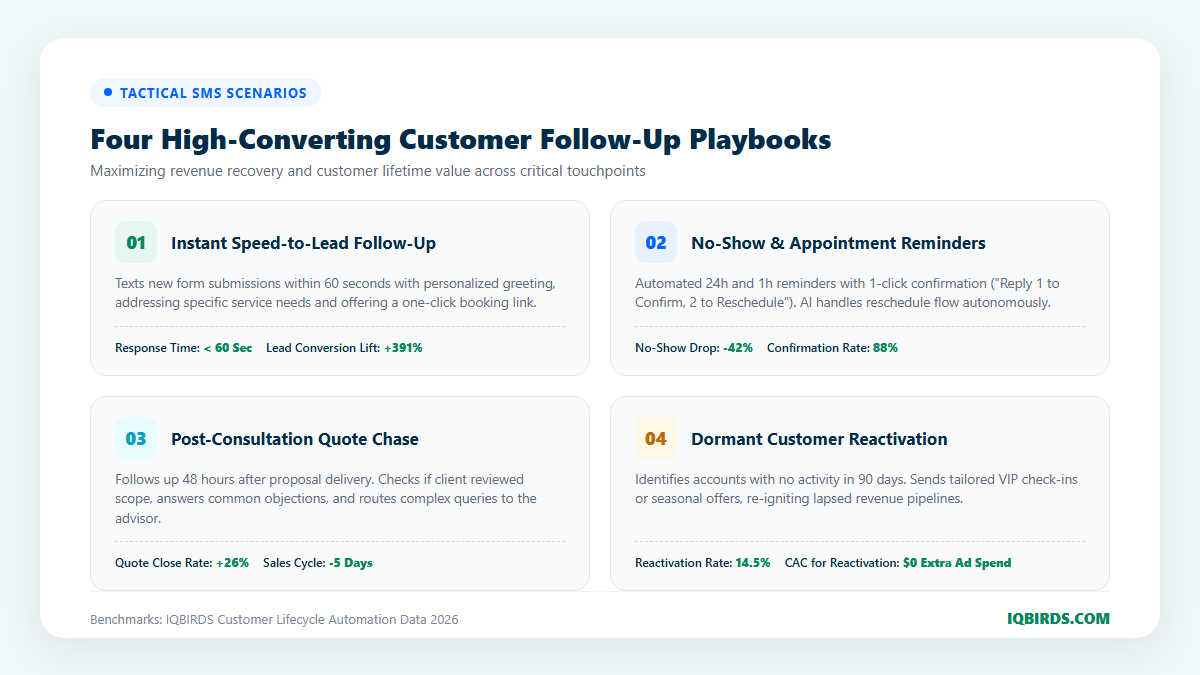
1. Instant Inbound Lead Qualification (Speed-to-Lead)
When a prospect requests a quote or consultation on your website, an automated SMS triggers within 60 seconds. The message greets the prospect by name, acknowledges the exact service they requested, and provides an immediate one-click scheduling link. For example:
“Hi Alex, thanks for reaching out to IQBIRDS regarding our AI automation services! We’re reviewing your requirements now. Would you prefer a quick 10-minute briefing today or tomorrow? You can select a convenient slot directly here: [Short_Link]. Reply STOP to opt out.”
If the prospect replies with a question such as “Do you work with HubSpot CRM?”, the integrated conversational AI agent recognizes the intent and confirms compatibility instantly before guiding them back to the scheduling link.
2. Automated Appointment Confirmation & No-Show Elimination
Appointment no-shows cost professional service firms, healthcare clinics, and B2B agencies thousands of dollars in lost billable hours each month. Email calendar invites are easily buried or forgotten. Automated SMS reminder sequences virtually eliminate no-shows by delivering timely reminders with low-friction confirmation mechanics:
- 24 Hours Before Appointment: “Hi Alex, reminding you of your upcoming strategy session tomorrow at 2:00 PM EST. Please reply ‘1’ to confirm or ‘2’ if you need to reschedule.”
- Intelligent Rescheduling: If the prospect replies ‘2’, the automation responds automatically with the account executive’s calendar link, freeing the sales rep from manual back-and-forth email scheduling.
- 1 Hour Before Appointment: “We look forward to speaking shortly at 2:00 PM! Here is your direct Google Meet link: [Link].”
3. Post-Consultation Quote & Proposal Follow-Up
Following a discovery call or project proposal presentation, deals frequently stall in the evaluation phase. Human sales reps often hesitate to follow up repeatedly for fear of seeming pushy, while automated email follow-ups are easily ignored. An automated SMS sequence scheduled 48 to 72 hours after proposal delivery maintains momentum:
“Hi Alex, following up on the automation architecture blueprint we shared on Tuesday. Did you and the executive team have a chance to review the scope? Happy to jump on a quick call if you have any questions on implementation timelines.”
This informal, conversational touchpoint prompts quick replies from decision-makers who might otherwise sit on an email proposal for weeks.
4. Dormant Lead & Past Customer Reactivation
Acquiring a new customer costs 5 to 7 times more than retaining or reactivating an existing one. Businesses often accumulate databases of thousands of leads who expressed interest months ago but never closed. Automated SMS reactivation campaigns re-engage dormant contacts without spending additional ad budget.
By connecting your custom AI CRM with automated messaging, the system scans for contacts who have had no activity for 90 days. It then dispatches a tailored text referencing their historical interest (e.g., “Hi Alex, we’ve recently launched our new 2026 AI CRM integration engine—curious if you’re still looking to streamline your sales operations this quarter?”), driving predictable spikes in booked pipeline.
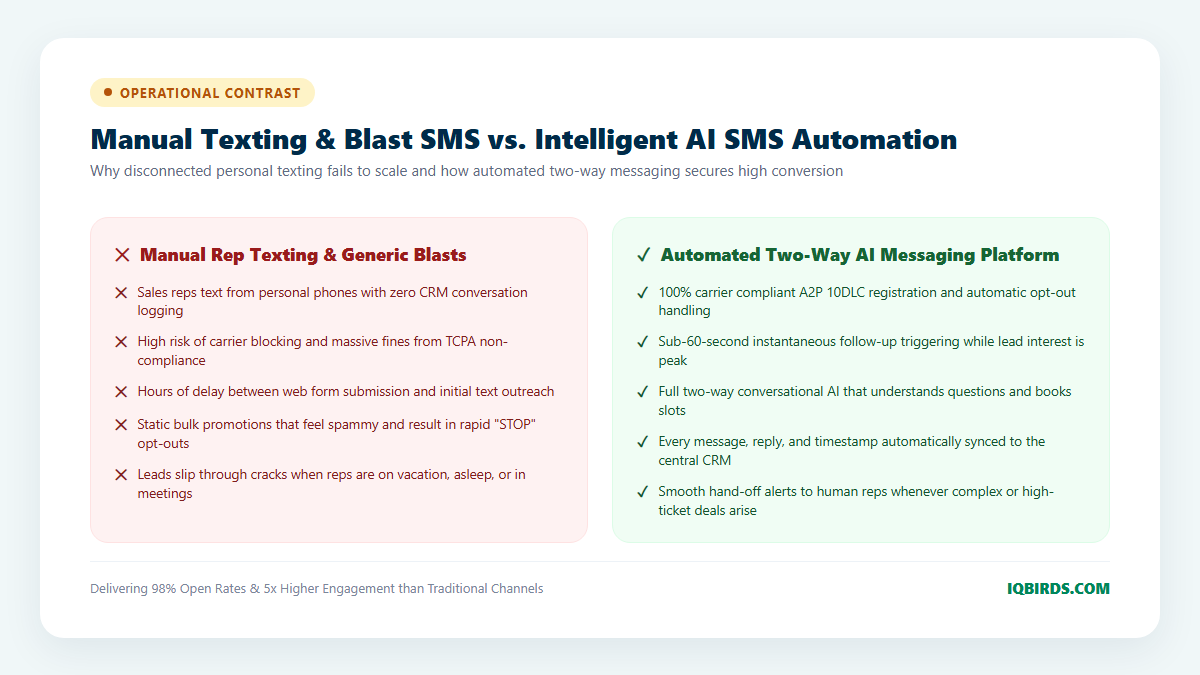
Manual Texting vs. Automated AI Messaging Platforms
Many businesses mistakenly believe that having sales reps send manual text messages from their personal smartphones is sufficient. In reality, disconnected texting creates severe compliance liabilities, data silos, and poor customer experiences:
7-Step Roadmap to Deploy Automated SMS Follow-Ups
Implementing a compliant, high-converting messaging system requires technical precision across carrier regulations, telephony APIs, and CRM integrations. Follow this 7-step engineering blueprint:
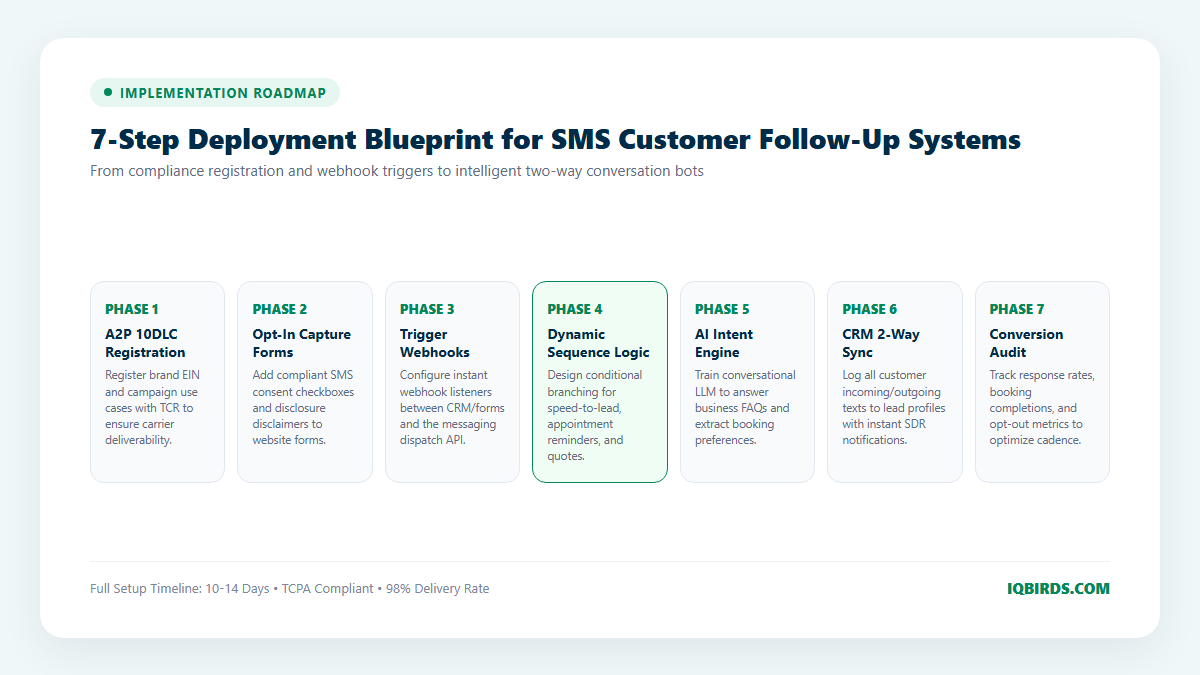
Step 1: Complete A2P 10DLC Brand & Campaign Registration
Before sending business text messages to North American carriers (AT&T, Verizon, T-Mobile), register your company with The Campaign Registry (TCR) via your messaging provider (such as Twilio, MessageBird, or Telnyx). Submit your legal business name, EIN, registered physical address, and detailed descriptions of your messaging use cases. Unregistered traffic faces 100% carrier filtering or punitive per-message surcharges.
Step 2: Implement Bulletproof Website Consent & Opt-In Forms
Under TCPA (Telephone Consumer Protection Act) regulations, you must capture explicit, verifiable consent before sending automated text messages. Update all web forms to include an unchecked consent checkbox with mandatory disclosure language: “By checking this box, you agree to receive automated marketing and informational text messages from [Company] at the mobile number provided. Consent is not a condition of purchase. Message and data rates may apply. Reply STOP to cancel.” Ensure opt-in timestamps and IP addresses are recorded in your database.
Step 3: Deploy Webhook Listeners for Instant Lead Triggers
Configure automated webhooks between your lead capture points (WordPress Elementor forms, HubSpot landing pages, Facebook Lead Ads, or Calendly) and your messaging backend. Ensure payload data passes customer first name, mobile number, specific service interest, and source UTM parameters within milliseconds of form submission.
Step 4: Design Conditional Branching & Timing Logic
Map your sequence logic using a visual workflow builder. Establish quiet hours (e.g., never send automated marketing texts before 8:00 AM or after 8:30 PM in the recipient’s local time zone). Build fallback rules: if a prospect responds via SMS, automatically halt any competing email drip sequences to prevent communication overlap.
Step 5: Train Conversational AI for Instant Reply Handling
Integrate a fine-tuned LLM or retrieval-augmented generation (RAG) agent that can interpret prospect text responses. Equip the AI agent with your company FAQ database, pricing tiers, and calendar scheduling API. When a prospect texts back asking “What’s your pricing?” or “Can we meet Thursday instead?”, the AI responds conversationally and executes the requested calendar change in real time.
Step 6: Configure 2-Way CRM Integration & Rep Alerts
Establish bidirectional synchronization via enterprise AI integration services. When high-value prospects engage in deep conversations, configure automated Slack or SMS alerts that notify the assigned account executive to jump in for a seamless live human takeover.
Step 7: Monitor Carrier Deliverability & Conversion Metrics
Continuously track key telemetry: carrier delivery rates (must remain >97%), opt-out rates (target <1.5%), response rates, and revenue pipeline generated. Periodically audit your sender reputation score with major carriers to ensure your 10DLC trust tier remains in good standing.
Critical TCPA Compliance Rules to Follow in 2026
Non-compliance with cellular messaging regulations carries severe legal penalties—up to $1,500 per unsolicited text message under the TCPA. Protect your business by strictly adhering to these operational rules:
- Never Buy or Rent Mobile Lists: Automated text messaging is strictly prohibited on third-party purchased contact lists. Only text prospects who have directly opted in through your first-party properties.
- Honor Opt-Out Keywords Instantly: Your messaging system must instantly recognize standard carrier opt-out keywords (STOP, CANCEL, UNSUBSCRIBE, QUIT, END) and immediately blacklist the number from future automated broadcasts.
- State Brand Identity in First Text: Every initial SMS must clearly identify your legal business name (e.g., “Hi [Name], this is Alex with IQBIRDS…”).
- Respect Time Zone Quiet Hours: Never trigger automated messages outside of 8:00 AM to 8:30 PM recipient local time. Use timezone lookup APIs based on the recipient’s area code to ensure timing accuracy.
- Include Standard Disclosures: Maintain the required “Msg & data rates may apply. Reply STOP to cancel” disclaimer on initial transactional touches.
Frequently Asked Questions
What is A2P 10DLC and why is it mandatory?
A2P 10DLC (Application-to-Person 10-Digit Long Code) is a regulatory standard created by major US mobile carriers to protect consumers from mobile spam. It allows businesses to send high-volume, compliant text messages using standard 10-digit local phone numbers with carrier-verified trust scores and deliverability guarantees.
Can an AI agent handle complex objections over SMS?
Yes. Modern conversational AI models are trained on specific business knowledge bases and understand nuanced colloquial responses. They can answer pricing questions, explain service scopes, address common scheduling conflicts, and gracefully transfer the conversation to a human sales representative whenever a complex negotiation or custom request occurs.
How does SMS automation integrate with our existing CRM?
Modern messaging systems connect seamlessly with CRM platforms like HubSpot, Salesforce, Zoho, and Pipedrive through webhooks and REST APIs. Every text sent and received is recorded as an activity on the contact’s timeline, ensuring your sales team has complete visibility across all touchpoints.
How can IQBIRDS help my business automate customer follow-ups?
At IQBIRDS, we engineer turnkey messaging automation and CRM workflows through our dedicated AI automation services and AI CRM development solutions. We handle end-to-end A2P 10DLC registration, compliant opt-in funnel design, webhook synchronization, and custom conversational AI agents. Whether you want to eliminate appointment no-shows or convert inbound web leads within 60 seconds, our team builds the high-converting messaging infrastructure your revenue engine needs. Schedule a consultation with IQBIRDS today to audit your customer follow-up pipeline.