
AI Automation
AI Automation Agency for Small Businesses: Profitability & ROI in 2026
Small and mid-sized business owners in 2026 face an unprecedented operational dilemma. Customer acquisition costs have risen across digital advertising channels, skilled talent command record salary premiums, and customer expectations for immediate, 24/7 service have reached all-time highs. In response, forward-thinking business owners are turning to a specialized growth partner: an ai automation agency for small businesses 2026 that builds, integrates, and maintains custom autonomous workflows designed to maximize bottom-line profitability.
Rather than trying to hire scarce and expensive machine learning engineers or struggling with fragile DIY “no-code” zap scripts that break whenever an API schema updates, partnering with a dedicated AI automation agency provides immediate access to production-grade artificial intelligence infrastructure. In this comprehensive guide, we unpack how small businesses leverage AI agencies to unlock 4x to 8x operational ROI, streamline administrative overhead, and systematically scale revenue without linearly expanding headcounts.

What Does an AI Automation Agency Actually Do for Small Businesses?
An AI automation agency (AAA) is a specialized consultancy and technical engineering partner that audits, architects, deploys, and manages intelligent autonomous systems across an organization’s core operations. Unlike legacy marketing agencies that focus purely on ad creative, or traditional IT consultancies that install monolithic software packages, an AI automation agency solves specific operational bottlenecks using modern language models, robotic process automation (RPA), and deep API integrations.
Typical workflows engineered by an AI automation agency include:
- Autonomous Lead Intake & Speed-to-Lead: Responding to inbound web inquiries via SMS and email in under 60 seconds, answering complex technical questions, and qualifying budget before booking meetings on sales calendars.
- Intelligent CRM & Pipeline Synchronization: Eliminating manual data entry by extracting client details from emails, Zoom call transcripts, and proposal documents directly into custom AI CRM systems.
- Multi-Agent Marketing Workflows: Orchestrating personalized cold outreach sequences, content syndication, and ad performance monitoring through dedicated AI marketing automation services.
- Financial & Invoice Processing: Extracting line-item data from PDF vendor invoices, matching purchase orders, and pushing reconciled entries into QuickBooks, Xero, or NetSuite without human data entry errors.
- 24/7 Tier-1 Customer Support Agents: Deploying Retrieval-Augmented Generation (RAG) conversational agents trained strictly on proprietary internal knowledge bases, resolving over 65% of customer inquiries autonomously while escalating nuanced queries to human managers.
By engaging comprehensive AI automation services, small businesses gain enterprise-grade technology capabilities at a predictable fraction of the cost of traditional enterprise consulting firms.
The 4 Profitability Levers: How AI Automations Expand Margins
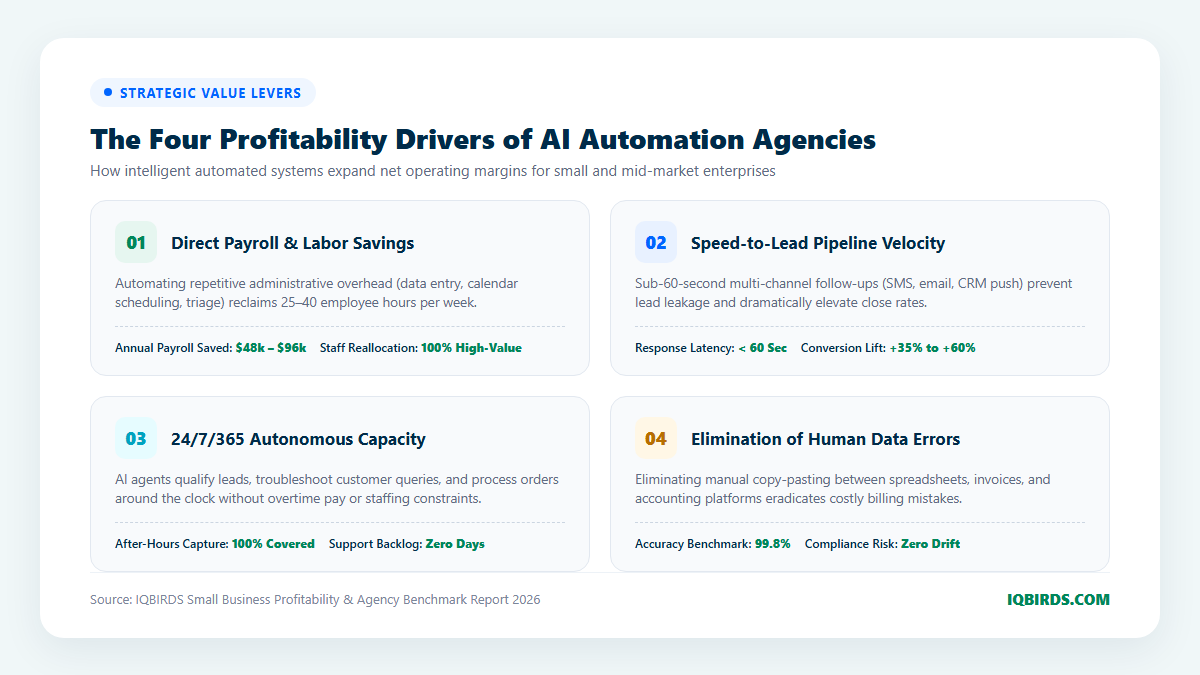
Small business profitability is governed by the relationship between gross revenue, direct labor expenses, customer acquisition costs, and overhead. AI automation systematically expands net profit margins across four measurable operational levers:
1. Direct Payroll Overhead & Labor Reallocation
Administrative overhead is frequently the largest expense on a small business profit-and-loss statement. Skilled professionals—such as account executives, paralegals, property managers, and medical office coordinators—spend between 30% and 45% of their working hours performing repetitive data entry, file renaming, scheduling coordination, and email drafting.
When an AI automation agency automates these mechanical tasks, the business reclaims hundreds of employee hours each month. Rather than hiring additional administrative staff to support company growth, existing team members are freed to focus on high-margin revenue activities: closing sales deals, client relationship management, and strategic service delivery.
2. Dramatic Acceleration in Speed-to-Lead
In competitive markets, the business that contacts an inbound prospect first wins the deal over 70% of the time. When leads submit forms after business hours or during busy lunch rushes, human sales teams frequently take 2 to 12 hours to respond. During this latency window, prospects continue searching and book calls with faster-responding competitors.
AI automation engines respond within 45 seconds around the clock. By initiating an immediate, context-aware conversation via SMS or email, answering preliminary questions, and locking in a calendar appointment instantly, conversion rates from existing ad traffic regularly increase by 35% to 60%—lowering blended customer acquisition cost (CAC) without spending an extra dollar on paid media.
3. 24/7/365 Operational Throughput
Traditional small businesses are constrained by standard 9-to-5 operating hours. In contrast, an AI-automated business operates continuously. International leads, weekend shoppers, and late-night inquiries are greeted, qualified, and serviced in real time. Order processing, inventory synchronization, and invoice reconciliation execute continuously overnight, ensuring morning operations begin with a clean, fully updated system.
4. Eradication of Costly Human Errors
Manual data entry is inherently error-prone. Misspelled customer email addresses cause lost quotes, incorrect billing amounts cause cash-flow delays, and forgotten customer follow-ups cause high-value deals to quietly vanish from sales pipelines. AI automations execute deterministic logic with 99.8%+ data accuracy, ensuring client records, invoices, and contracts are synchronized flawlessly across every system.
In-House AI Engineers vs. Partnering with an AI Automation Agency
As business leaders recognize the transformative potential of artificial intelligence, many debate whether to build an internal AI engineering team or hire a dedicated agency. A direct financial and operational comparison reveals why agency partnerships represent the superior strategic choice for small and mid-market companies:
7-Step Roadmap: How an AI Automation Agency Implements Solutions
A professional agency does not haphazardly connect random tools. Enterprise deployment follows a disciplined 7-phase methodology to ensure data security, system stability, and immediate commercial impact:
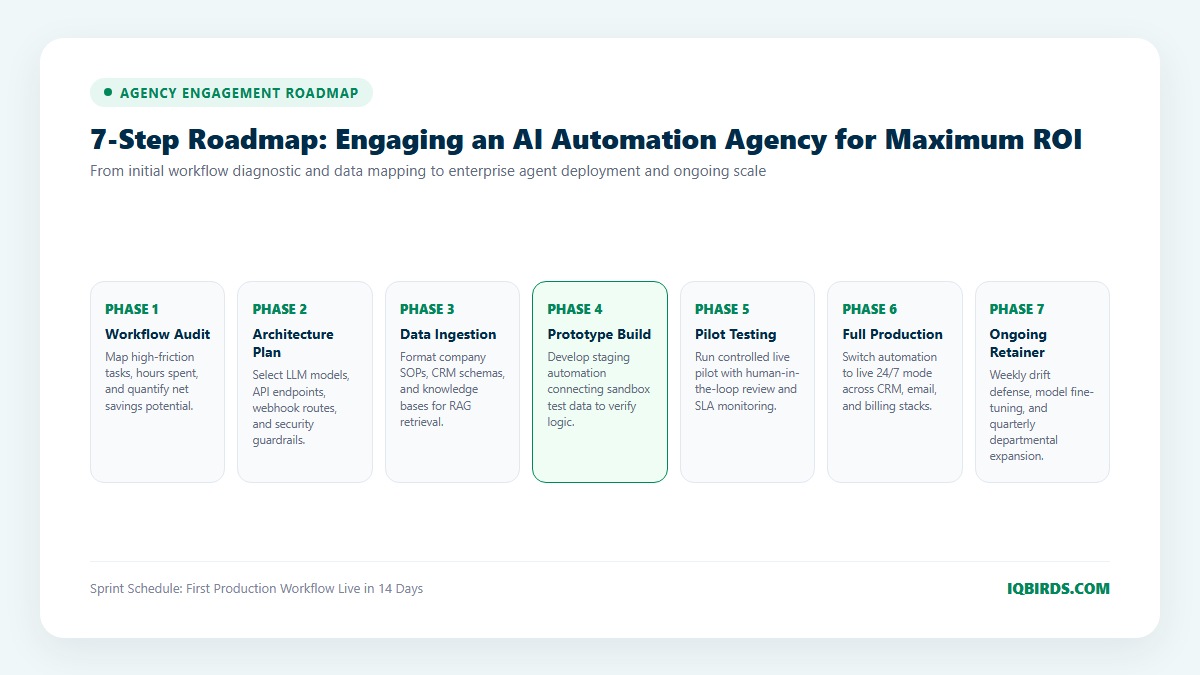
Step 1: Operational Diagnostic & Time-Study Audit
The agency begins by conducting an operational audit across your company’s departments. By interviewing staff, reviewing daily task logs, and analyzing system bottlenecks, the agency calculates the exact hourly cost of repetitive manual labor and assigns an ROI score to each potential automation candidate.
Step 2: Technical Architecture & Security Modeling
Next, engineers architect the system blueprint. They select appropriate LLM foundation models (e.g., Anthropic Claude for long-context document analysis, OpenAI GPT-4o for complex reasoning, or open-source Llama-3 for private local deployments), define API endpoints, design webhook routes, and establish strict enterprise data isolation to ensure proprietary client information is never used for public model training.
Step 3: Knowledge Ingestion & SOP Vectorization
To ensure AI agents act in strict accordance with company standards, the agency ingests internal documentation: employee handbooks, customer service transcripts, pricing matrices, and sales objection battle cards. This data is cleaned, chunked, and stored in vector databases (such as Pinecone, Qdrant, or Supabase pgvector) to power high-accuracy Retrieval-Augmented Generation (RAG).
Step 4: Sandbox Prototype Development & Guardrail Tuning
Engineers construct the automation workflow inside an isolated staging sandbox. They configure deterministic guardrails, validation schemas, and fallback triggers. If an AI agent ever encounters an ambiguous customer inquiry or low confidence score (<90%), it gracefully routes the transaction to a designated human manager for review rather than generating an incorrect response.
Step 5: Controlled Pilot Testing (Human-in-the-Loop)
The automation is deployed on a controlled slice of live traffic (e.g., 20% of inbound web leads or a single customer service channel). Agency engineers monitor latency, token usage, accuracy metrics, and user feedback in real time, fine-tuning prompts and error-handling routines based on actual customer behavior.
Step 6: Full Production Rollout & Staff Training
Once the pilot achieves verified performance thresholds, the system is promoted to 100% production traffic across all customer touchpoints. The agency conducts interactive team workshops, training internal staff on how to review automated activity logs, interact with AI assistant copilots, and interpret executive ROI dashboards.
Step 7: Ongoing SLA Monitoring, Drift Defense & Scaling
Post-deployment, the agency provides continuous managed services. AI models and third-party APIs update frequently; the agency actively monitors for model drift, updates prompt structures, ensures uptime compliance, and regularly introduces new automation modules to expand business throughput.
Key Metrics to Measure Your AI Automation Agency’s Success
When working with an AI automation partner, hold them accountable to quantifiable commercial benchmarks:
- Monthly Hours Saved: The verified reduction in manual hours spent on administrative tasks across administrative, sales, and support teams.
- Speed-to-Lead Response Time: Average time elapsed between inbound form submission and automated multi-channel contact (target: sub-60 seconds).
- Autonomous Resolution Rate: The percentage of Tier-1 customer inquiries or booking requests resolved without human staff intervention (target: >65%).
- Cost Per Acquired Customer (CAC): Reductions in blended acquisition costs achieved through enhanced conversion velocity.
- Net Return on Investment (ROI): The ratio of total financial value generated (hours saved + revenue gained) against agency fees (target: minimum 3x to 5x within 90 days).
Frequently Asked Questions
How much does it cost for a small business to hire an AI automation agency in 2026?
Pricing varies based on scope and architectural complexity. Most small businesses invest between $3,500 and $12,000 for initial workflow architecture and turnkey deployment, followed by ongoing monthly managed retainers ranging from $1,500 to $5,000 for 24/7 SLA monitoring, drift protection, and continuous system optimization.
Is my small business too small to benefit from AI automation?
Not at all. In fact, micro-businesses and small teams (3 to 25 employees) experience the highest relative impact from AI automation. Because small teams operate with limited headcount, automating 20 to 30 hours of weekly administrative friction often has the equivalent commercial impact of adding one or two full-time employees without the payroll overhead.
Will AI automations replace our existing employees?
No. High-performing businesses use AI automation to empower existing employees, not eliminate them. By removing soul-crushing data entry and mechanical scheduling tasks, employees can focus on strategic client relationships, creative problem-solving, and revenue-generating activities that require human empathy and critical thinking.
How can IQBIRDS help my small business deploy AI automation?
At IQBIRDS, we specialize as an end-to-end AI automation agency for small businesses. Our multidisciplinary engineering team designs, builds, and maintains custom AI agents, automated CRM engines through our AI CRM development services, and multi-system API bridges via system integration solutions. We don’t just recommend ideas—we build code-ready, SLA-backed automated infrastructure that drives measurable cash-flow expansion. Schedule a technical strategy consultation with IQBIRDS today to uncover the highest-ROI automation opportunities in your business.