
AI Automation
Workload Balancing with AI: Automating Repetitive Marketing Operations (2026)
Modern marketing departments are drowning in administrative complexity. As multi-channel distribution expands across Google Ads, Meta, TikTok, LinkedIn, YouTube, email marketing, and affiliate networks, marketing operations managers spend less than 35% of their working hours on high-impact strategic growth. The remaining 65% is consumed by mechanical busywork: reformatting creative banner sizes, manually creating UTM tracking links, chasing cross-departmental approvals, and resolving team burnout caused by uneven task distribution. In 2026, leading growth teams are solving this crisis through marketing operations workload balancing automation ai systems.
By delegating mechanical project routing, capacity allocation, asset syndication, and SLA monitoring to intelligent autonomous workflows, marketing organizations unlock unprecedented agility. In this guide, we explore how modern enterprises build an AI-driven marketing operations engine that balances sprint workloads dynamically, eliminates creative bottlenecks, and maximizes return on marketing investment.

The Hidden Costs of Unbalanced Marketing Operations
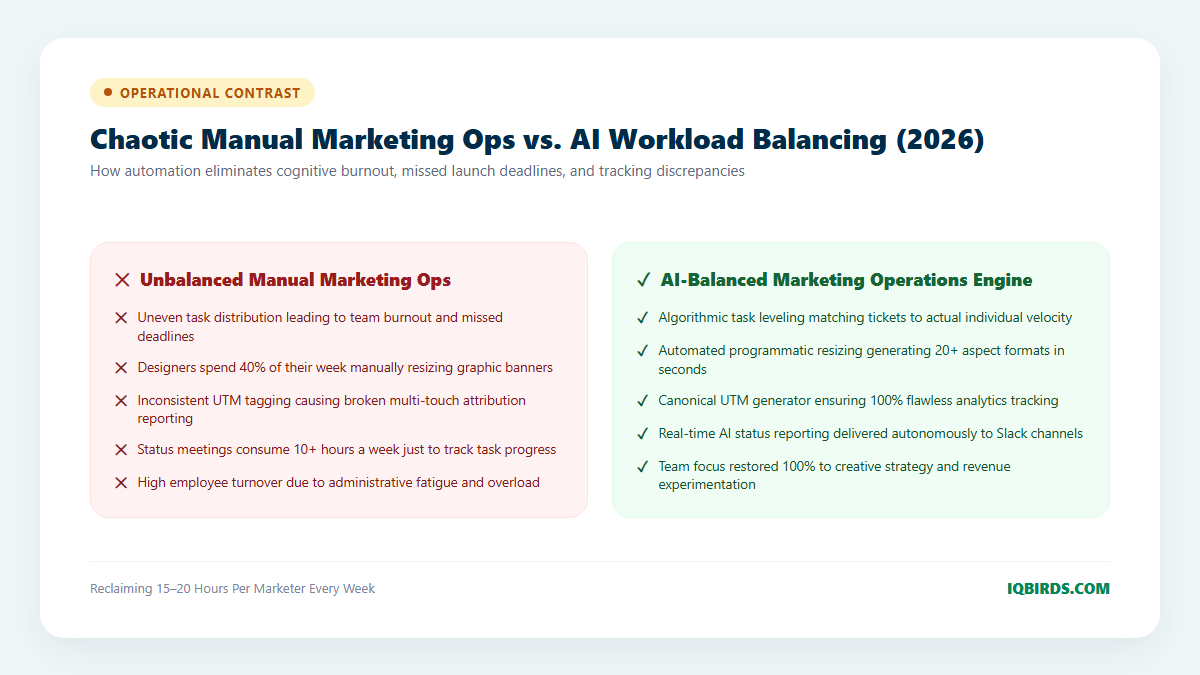
In traditional marketing teams, project distribution is managed subjectively. A project manager or department head assigns creative briefs based on gut feeling or whoever is currently in the office. This un-automated model inevitably produces two costly organizational dysfunctions:
- Chronic High-Performer Burnout: Your top 20% most dependable designers and copywriters receive a disproportionate share of complex tickets. Over time, cognitive fatigue leads to degraded creative quality and costly employee attrition.
- Invisible Capacity Dead Zones: Junior team members or specialized talent often sit with open bandwidth because managers lack real-time visibility into active workloads and task dependencies.
- Attribution and Data Drift: When marketers rush to push campaigns live under deadline pressure, manual UTM tagging errors proliferate, corrupting multi-touch attribution reports and blinding leadership to true channel ROAS.
By implementing specialized AI marketing automation services, companies replace subjective project distribution with deterministic mathematical load leveling, ensuring peak team utilization without employee exhaustion.
The 4 Pillars of AI-Driven Marketing Workload Balancing
High-efficiency marketing teams rely on four foundational pillars to automate repetitive operations while maintaining strict quality governance:
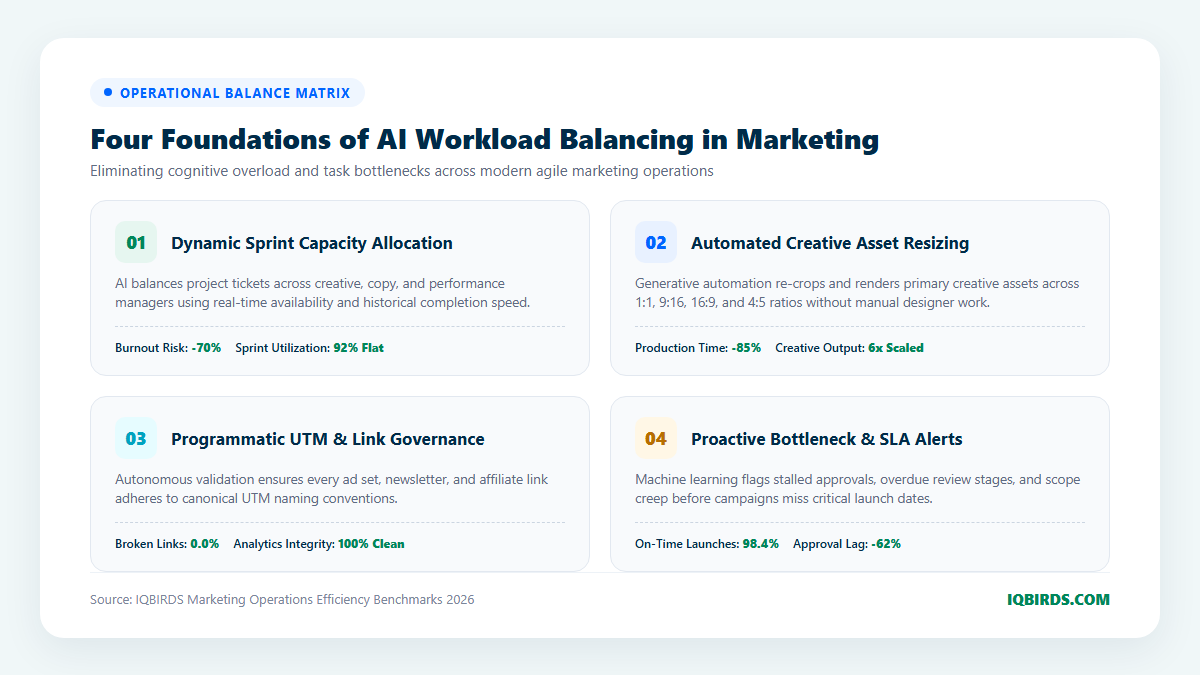
1. Dynamic Sprint Capacity Allocation
Modern workload balancing tools connect directly to project management platforms (such as Jira, Asana, Monday.com, or ClickUp). When a new campaign brief is submitted, an AI triage agent evaluates the ticket’s scope, required skill sets, and historical task duration. It then references the live capacity dashboard of each team member, factoring in scheduled PTO, current active tickets, and recent velocity scores.
The system assigns the task to the marketer with optimal availability and expertise, leveling the team’s sprint utilization curve. If a critical priority ticket arrives while the team is at maximum capacity, the AI automatically suggests low-urgency tasks to defer, preventing deadline collisions.
2. Automated Creative Asset Resizing & Variant Generation
One of the most soul-crushing time drains in marketing operations is adapting a single approved hero graphic into 15 different aspect ratios for various ad channels: 1:1 for Instagram feeds, 9:16 for Reels and TikTok, 16:9 for YouTube preroll, and 4:5 for Facebook feeds.
With generative AI asset pipelines integrated into custom AI automation workflows, designers produce only the primary master asset in Figma. The automation engine programmatically generates all localized aspect variations, intelligently repositioning focal subjects, extending backgrounds using generative fill, and applying brand typography overlays automatically in seconds.
3. Canonical UTM & Link Governance
Human data entry errors in tracking URLs cause massive reporting inaccuracies. A campaign tagged as utm_source=facebook by one marketer and utm_source=Meta_Ads by another creates split reporting silos in Google Analytics 4 and custom BI dashboards.
An automated UTM governance system eliminates manual link building. When an ad set or newsletter draft is finalized, the system parses the campaign metadata, generates canonical UTM strings according to strict corporate taxonomy, checks destination landing page HTTP status codes to prevent 404 errors, and shortens the URL using your branded domain.
4. Proactive Bottleneck Detection & SLA Alerting
Campaign delays rarely occur during active creative production; they occur during approval waiting periods. Creative briefs frequently sit in executive email inboxes for days, waiting for legal sign-off or brand review.
AI operations bots actively track Service Level Agreements (SLAs). If an approval stage remains pending for more than 24 hours, the system automatically dispatches gentle reminders via Slack or Microsoft Teams. If the bottleneck threatens a hard launch date, the bot escalates the ticket directly to the marketing director with an impact analysis, keeping projects on schedule.
Manual Marketing Ops vs. AI Workload Balancing Platforms
Compare the operational reality of managing marketing operations manually against deploying an intelligent AI workload balancing engine:
7-Step Roadmap to Automate Marketing Operations Workload
Deploying a robust workload balancing infrastructure requires structured engineering across task trackers, asset repositories, and communication channels. Follow this 7-step deployment blueprint:
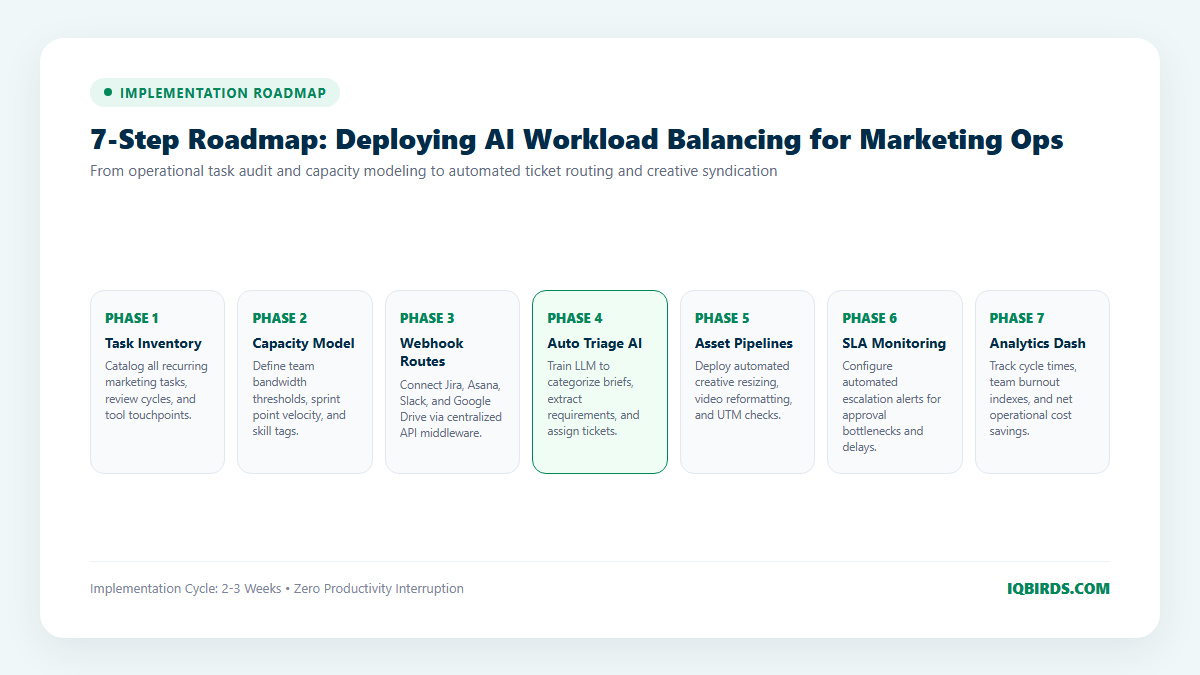
Step 1: Task Inventory & Operational Bottleneck Audit
Document every recurring task performed by your marketing team: brief creation, copy editing, design resizing, link building, compliance reviews, and performance reporting. Categorize each task by cognitive complexity and time investment to identify high-leverage automation candidates.
Step 2: Capacity Scoring & Velocity Modeling
Establish baseline capacity metrics within your project management system. Define maximum weekly sprint points per team member, document specific skill proficiencies (e.g., motion graphics vs. long-form copywriting), and configure working hours across remote time zones.
Step 3: Centralized Webhook & API Infrastructure
Establish bidirectional API bridges connecting your core toolchain: Asana/Jira, Slack/Teams, Figma, Google Drive/Dropbox, and ad platforms via enterprise system integration services. This creates a unified data fabric where tasks move automatically between systems.
Step 4: AI Brief Parser & Automated Triage
Deploy a natural language triage agent. When a team member or stakeholder submits a marketing request in Slack or via form, the LLM reads the description, extracts deliverables, checks for missing specifications (such as target audience or dimensions), creates the ticket, and routes it to the optimal team member based on live capacity scores.
Step 5: Automated Creative Production & Formatting Pipelines
Connect image and video automation APIs to your creative workflow. When a designer marks a hero asset as approved, background workers automatically generate all required ad dimensions, run brand compliance checks, and save the export files in organized cloud folders with canonical naming conventions.
Step 6: SLA Tracking & Proactive Escalation Rules
Configure automated timers on review stages. If a stakeholder does not approve copy or creative within 24 hours, the system pings them via their preferred communication channel. If unresolved after 48 hours, the ticket automatically alerts the marketing director with recommended adjustments to keep the launch date secure.
Step 7: Real-Time Operational Telemetry & Optimization
Launch live operational dashboards displaying sprint completion velocity, bottleneck frequency, and reclaimed hours. Review telemetry monthly to identify new areas where AI agents can relieve friction and further expand team throughput.
How Marketing Ops Automation Connects with CRM Pipelines
A high-velocity marketing operations engine feeds directly into your sales organization. When campaigns launch on time with verified UTM parameters, lead attribution is crystal clear inside your custom AI CRM. Lead routing agents can instantly prioritize high-intent prospects based on specific campaign touchpoints, closing the loop between creative marketing execution and closed revenue.
Frequently Asked Questions
Does workload balancing automation require changing our project management software?
No. Modern AI automation layers integrate on top of your existing tools, including Asana, Jira, ClickUp, Monday.com, and Notion. We build API bridges and webhook connectors that enhance your current software without forcing your team to learn a completely new platform.
How does the AI determine who is best suited for an incoming ticket?
The AI capacity model evaluates multiple data points: the specific skill requirements of the brief, the marketer’s historical task completion speed, current active sprint load, and scheduled availability. It selects the team member who can deliver high quality without exceeding their healthy bandwidth limits.
Will automating creative resizing reduce visual quality?
No. The AI system uses deterministic layout rules and generative fill to respect safe zones, logo placement, and text legibility standards. High-end pipelines always include an instant 1-click designer review step in Figma before assets are released for ad deployment.
How can IQBIRDS help automate our marketing operations?
At IQBIRDS, we engineer custom marketing automation systems and AI operations workflows for high-growth brands and enterprise marketing teams. We eliminate administrative friction, design automated creative pipelines, and build real-time workload balancing engines that free your team to focus on revenue-generating strategy. Schedule an operational consultation with IQBIRDS today to audit your marketing team’s workflow capacity.