
AI Automation
Cold Email Marketing System with AI Automation: Complete 2026 Platform Guide
Cold outbound marketing underwent a massive disruption in 2024 and 2025 when Google and Yahoo enforced strict deliverability protocols, penalizing high-volume generic spam with ruthless domain burn. In 2026, building a scalable pipeline requires a modern cold email marketing system with AI automation—a synchronized architecture combining secondary domain fleets, automated warm-up protocols, multi-agent prospect intelligence, and autonomous conversation routing.
Instead of manually copying templates or blasting 10,000 unverified records, enterprise sales and marketing teams now deploy intelligent AI platforms that research individual prospects in real time, generate mathematically unique copy variations, and route positive replies directly into CRM booking funnels. In this comprehensive guide, we unpack the exact architecture, software stack, implementation roadmap, and governance strategies required to scale your outbound revenue predictably in 2026.

What Is an AI-Powered Cold Email Marketing System?
An AI cold email marketing system is an autonomous end-to-end outbound infrastructure that orchestrates prospect identification, data verification, context enrichment, generative personalization, deliverability governance, and conversational response management. Unlike legacy email tools that rely on static mail-merge tags (such as {{First_Name}} or {{Company_Name}}), an AI-driven platform treats every email as an individualized conversation engineered from verifiable commercial intent signals.
Modern outbound relies on a distributed multi-agent framework where specialized AI models perform dedicated functions:
- The Signal Mining Agent: Continuously monitors hiring boards, executive promotions, technology stack installations, and funding announcements to identify companies experiencing active buying triggers.
- The Deep Context Agent: Crawls prospect websites, recent press releases, and podcast transcripts to extract genuine conversation hooks and strategic priorities.
- The Generative Synthesis Agent: Drafts concise, benefit-driven messaging that aligns your service offering directly with the prospect’s identified operational bottleneck.
- The Deliverability Sentinel: Balances sending volume across dozens of auxiliary Google Workspace or Microsoft 365 mailboxes, strictly capping throughput below 35 emails per mailbox per day while maintaining DKIM, SPF, and DMARC alignment.
- The Conversation & Triage Agent: Reads incoming replies, interprets buyer sentiment, handles preliminary objections, and pushes calendar booking links or notifies account executives within 180 seconds.
By delegating these complex workflows to autonomous systems through dedicated AI marketing automation services, organizations reduce manual prospecting hours by over 80% while multiplying qualified meeting volume.
The 4 Core Pillars of Scalable Cold Email Platforms in 2026
High-performing outbound engines do not rely on random hacks or clever subject line tricks. They succeed because they balance four foundational operational pillars that ensure technical compliance and psychological relevance.
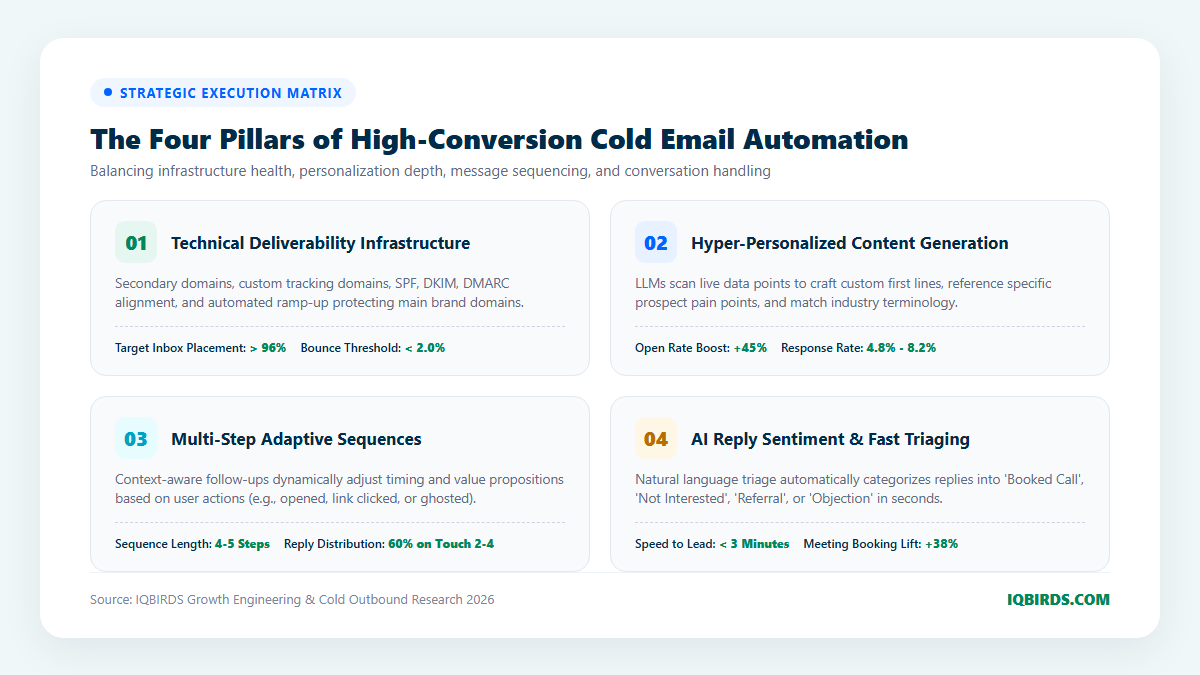
1. Bulletproof Deliverability Infrastructure
In 2026, sending cold emails from your primary corporate domain is equivalent to operational suicide. A single wave of spam complaints can blacklist your core Google Workspace or Microsoft 365 tenant, causing client invoices, team communications, and investor updates to land in spam folders. Scalable cold email systems isolate outbound risk by deploying secondary lookalike domains (e.g., if your primary domain is company.com, secondary domains might include trycompany.com, getcompany.com, or companyhq.com).
Each secondary domain requires pristine DNS configuration: SPF (Sender Policy Framework), DKIM (DomainKeys Identified Mail) 2048-bit keys, DMARC (Domain-based Message Authentication, Reporting, and Conformance) with strict alignment policies, and Custom Tracking Domains (CTD) to eliminate shared link tracking penalties. Furthermore, mailboxes must undergo a 14- to 21-day automated peer-to-peer warm-up cycle before sending a single live prospect email.
2. Multi-Source Lead Intelligence & Zero-Bounce Verification
Data decay is the silent killer of outbound campaigns. B2B databases decay at approximately 2.5% per month due to job transitions, company acquisitions, and corporate restructuring. Sending to invalid addresses causes your bounce rate to exceed the critical 2.0% threshold, triggering immediate algorithmic penalties across major Internet Service Providers (ISPs).
An enterprise AI cold email system utilizes waterfall data enrichment. When a prospect record is identified, the system validates the email address across multiple verification APIs (such as ZeroBounce, MillionVerifier, or NeverBounce) with real-time SMTP handshake verification. If an address returns a “catch-all” or “risky” status, the system routes it to an AI scraper to uncover verified alternative contact points before allowing it into an active outbound campaign.
3. Contextual LLM Personalization at Scale
Prospects in 2026 have developed complete immunity to superficial personalization. Seeing “Hey [Name], noticed you’re the VP of Operations at [Company]” generates immediate deletion. Buyers respond to operational relevance—demonstrating that you understand their immediate challenges, their market category, and their competitive landscape.
AI automation platforms achieve this by feeding structured enrichment data into fine-tuned language models. The prompt instructs the model to identify a specific pain point (e.g., “noted your recent open role for 3 QA engineers following your Series B announcement”) and tie it directly to your quantifiable solution without sounding mechanical. Every email sent has unique syntactic variety, eliminating hash-matching spam filters that flag identical bulk templates.
4. Real-Time Conversation Triage & Instant CRM Sync
According to research published by Harvard Business Review and Gartner, responding to an interested buyer within five minutes increases meeting conversion rates by nearly 400% compared to responding after 30 minutes. In an un-automated outbound setup, positive replies often sit in secondary inboxes for hours before a human sales development representative (SDR) checks them.
With conversational AI routing integrated into custom AI CRM systems, incoming replies are processed via natural language classification in real time. If a prospect replies, “Sounds interesting, can you send over a case study or pricing?”, the AI agent identifies the intent, retrieves the exact case study from your knowledge base, drafts a personalized reply with the sales rep’s calendar link, and logs the deal stage in HubSpot or Salesforce instantaneously.
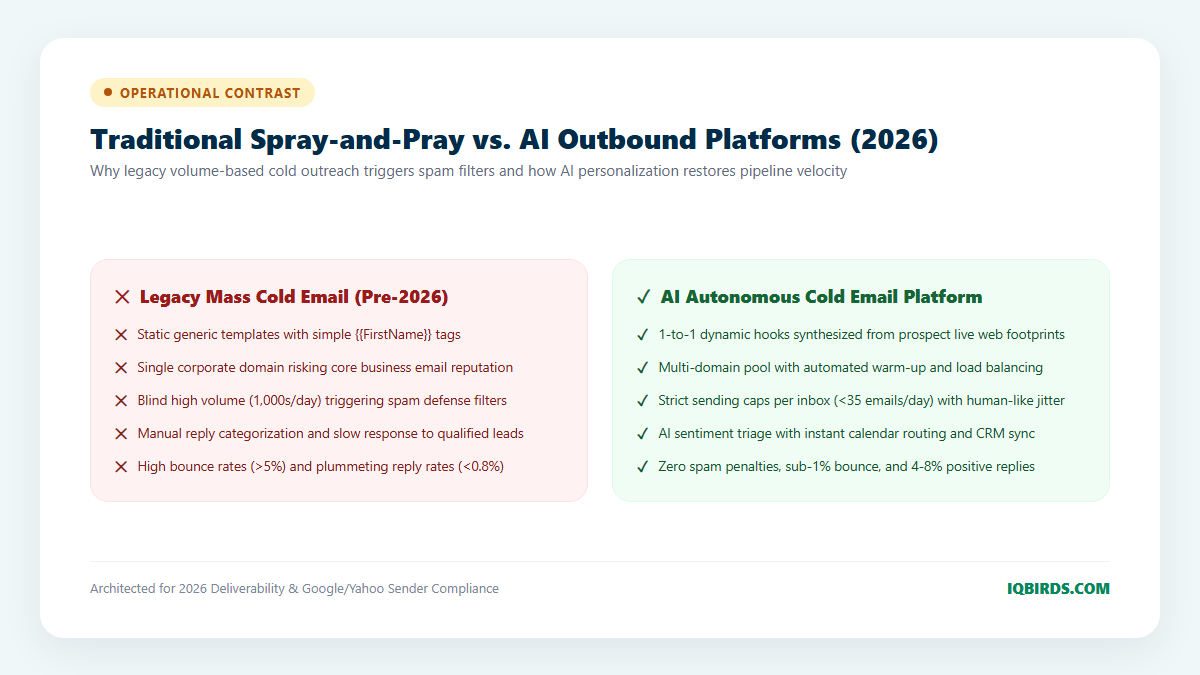
Legacy Cold Outreach vs. Autonomous AI Platforms
To understand why legacy outbound methodologies fail in modern B2B markets, compare the core mechanisms of manual cold email against an autonomous AI-driven platform:
7-Step Implementation Roadmap to Deploy an AI Cold Email Engine
Building an autonomous outbound pipeline requires methodical execution to safeguard deliverability and ensure steady deal flow. Follow this battle-tested 7-step engineering blueprint:
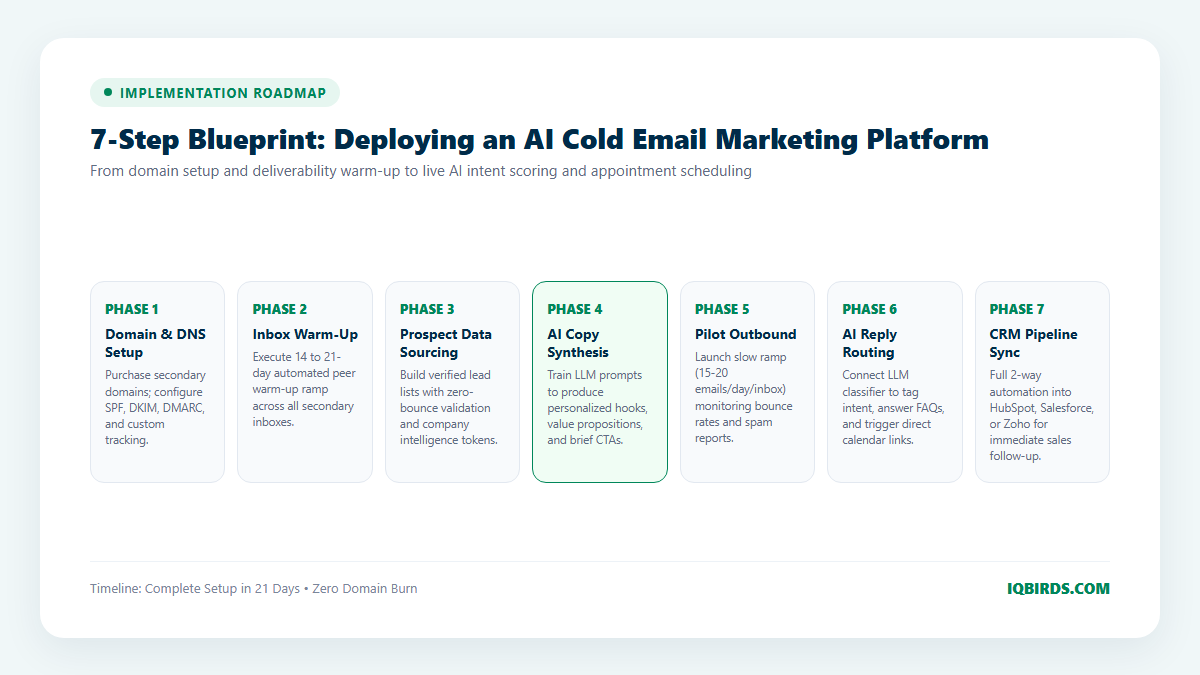
Step 1: Secondary Domain Acquisition & Forwarding
Acquire 5 to 10 secondary domains that closely resemble your primary brand name. Set up permanent 301 HTTP redirects from each secondary domain to your primary website so prospects who paste the root domain into their browser land seamlessly on your main landing page. Distribute domain registrations across multiple registrars (such as Cloudflare, Namecheap, or Porkbun) to diversify infrastructure footprint.
Step 2: DNS Authentication & Custom Tracking Domains
Configure complete DNS records for every domain before initiating any email traffic. Point your MX records to separate Google Workspace or Microsoft 365 tenants. Create SPF records (v=spf1 include:_spf.google.com ~all), generate 2048-bit DKIM private keys, and configure strict DMARC policies (p=quarantine; pct=100; rua=mailto:dmarc@yourdomain.com). In addition, create a CNAME record for a Custom Tracking Domain (e.g., track.secondarydomain.com) to isolate open and click tracking away from shared vendor IP pools.
Step 3: Automated Warm-Up & Reputation Ramp (14–21 Days)
Connect your mailboxes to an automated deliverability network such as Instantly, Smartlead, or Warmup Inbox. The warm-up engine automatically sends, receives, and rescues peer emails from spam folders, gradually ramping from 5 emails per day up to 30 emails per day over a three-week window. Do not rush this phase: rushing will trigger new-domain filters in Google and Microsoft spam engines.
Step 4: AI Lead Scoring, Waterfall Enrichment, & Scrubbing
Source prospect records matching your Ideal Customer Profile (ICP) using tools like Apollo, Clay, or Sales Navigator. Run every prospect record through an automated waterfall enrichment sequence to obtain verified direct email addresses, LinkedIn profiles, and verified company data. Validate every record against strict bounce prevention tools—automatically purging unverified catch-alls and spam traps.
Step 5: Dynamic Prompt Engineering & Multi-Touch Copywriting
Develop structured LLM prompts that synthesize prospect signals into high-converting email copy. Ensure your copy follows proven outbound principles: keep emails between 50 and 90 words, focus on one specific problem, include social proof or verifiable metrics, and use a low-friction “soft” Call to Action (e.g., “Worth exploring a 5-minute teardown?” rather than demanding a 30-minute demo call). Set up dynamic Spintax to ensure structural diversity across every outbound message.
Step 6: Controlled Sequence Launch & Deliverability Monitoring
Launch your pilot campaign with conservative sending volume (10 to 15 emails per mailbox per day). Closely monitor key health metrics: bounce rates must remain under 1.5%, unsubscribe rates under 1.0%, and spam complaints near 0.0%. If an individual mailbox experiences a sudden drop in open rates, immediately pause its outbound queue and return it to isolated warm-up mode.
Step 7: Automated Reply Triage, Scheduling & CRM Synchronization
Connect your cold email platform to your core CRM via webhook automations or comprehensive AI integration services. When a prospect replies, an AI classifier parses the response. Positive leads receive automated calendar booking links and trigger instant Slack notifications for your sales team, while out-of-office replies automatically pause sequences until the prospect returns.
Key Performance Indicators (KPIs) to Track in 2026
To evaluate the efficiency of your AI cold email marketing system, monitor these core benchmarks on a rolling 14-day basis:
- Inbox Placement Rate (>95%): The percentage of delivered emails landing in primary inboxes rather than promotional or spam folders (audited via seed testing tools).
- Bounce Rate (<1.5%): Hard and soft bounces must be rigorously contained to prevent domain blacklisting.
- Open Rate (>55%): High open rates indicate healthy deliverability and compelling, non-spammy subject lines.
- Positive Reply Rate (3.5%–7.0%): The proportion of replies expressing genuine commercial interest or scheduling calls.
- Meeting Booking Rate (>15% of positive replies): Measures how effectively your triage automation converts interest into completed calendar appointments.
- Customer Acquisition Cost (CAC) Reduction: The net savings realized by replacing expensive paid search bidding with high-margin programmatic outbound.
Common Outbound Mistakes & Deliverability Pitfalls
Even seasoned marketing teams encounter costly roadblocks when deploying cold email platforms. Avoid these frequent errors:
- Sending from Primary Domains: Never use your main business domain for outbound prospecting. A single blacklisting incident can disrupt critical corporate correspondence.
- Relying on Generic, High-Volume Templates: ISPs now use advanced semantic fingerprinting. Blasting identical copy to thousands of contacts triggers domain suppression within hours.
- Ignoring DMARC and Custom Tracking Domains: Unauthenticated senders are aggressively filtered or rejected by Google and Yahoo mail servers.
- Neglecting Speed-to-Lead: Allowing interested replies to sit for hours destroys conversion momentum. AI reply triaging is non-negotiable in competitive markets.
- Demanding 30-Minute Demos in First Touches: Prospects resist high-friction commitments. Offer actionable insights, teardowns, or short video benchmarks before asking for calendar time.
Frequently Asked Questions
Is cold email marketing still legal and compliant in 2026?
Yes, B2B cold email remains completely legal in the United States under the CAN-SPAM Act, provided you maintain accurate sender identity, provide a clear physical business address, and include an effortless one-click opt-out mechanism. In the European Union and United Kingdom, B2B outbound is governed by GDPR and PECR, requiring a legitimate interest assessment (LIA), strict B2B targeting relevance, and immediate removal upon request.
What is the ideal daily sending limit per mailbox?
In 2026, the gold-standard recommendation is 30 to 35 cold emails per day per mailbox, with an additional 15 to 20 warm-up emails running in the background. If you need to send 1,000 emails per day, deploy a fleet of 30 to 35 mailboxes distributed across 10 to 12 secondary domains.
How does AI personalization differ from simple merge tags?
Merge tags merely insert predefined spreadsheet values (such as names or company titles) into identical copy blocks. AI personalization uses large language models to inspect external web data, evaluate recent business milestones, and generate custom, context-aware introductory hooks and value arguments tailored specifically to that individual recipient.
How can IQBIRDS help my business build an AI cold email marketing system?
At IQBIRDS, we design, deploy, and manage enterprise-grade outbound engines through our specialized AI automation services and marketing automation platforms. We handle domain fleet acquisition, DNS deliverability architecture, custom LLM scraping agents, and two-way CRM integrations. Whether you need a turnkey outbound infrastructure or dedicated pipeline acceleration, our engineering team ensures your message lands in primary inboxes and reliably books qualified revenue meetings. Schedule a technical consultation with IQBIRDS today to audit your outbound growth engine.