
AI Automation
Best AI Tools for Small Business Automation in 2026: The Definitive Stack
Navigating the generative AI software market in 2026 can be overwhelming for small business owners. With thousands of new AI startups launching every month, each promising revolutionary productivity gains, many companies fall into the trap of “SaaS bloat”—subscribing to a dozen disconnected AI tools that drain monthly cash flow while creating confusing data silos. To build a truly profitable business in 2026, founders must focus on the best ai tools for small business automation 2026: a curated, interoperable technology stack that actually integrates with your core operations.
Rather than adopting gimmicky AI novelty wrappers, high-growth small and mid-market enterprises deploy a disciplined four-layer architecture: automated lead intelligence, autonomous conversational response agents, resilient integration middleware, and intelligent CRM pipelines. In this definitive guide, we review the top-performing AI tools across each category, evaluate their real-world ROI, and provide an actionable blueprint to connect them into a self-healing operational engine.

The 4 Essential Layers of the 2026 Small Business AI Stack
A high-performing automation stack does not rely on a single monolithic software vendor. It connects specialized best-in-class platforms through reliable API middleware. The four foundational layers of the modern small business AI stack include:
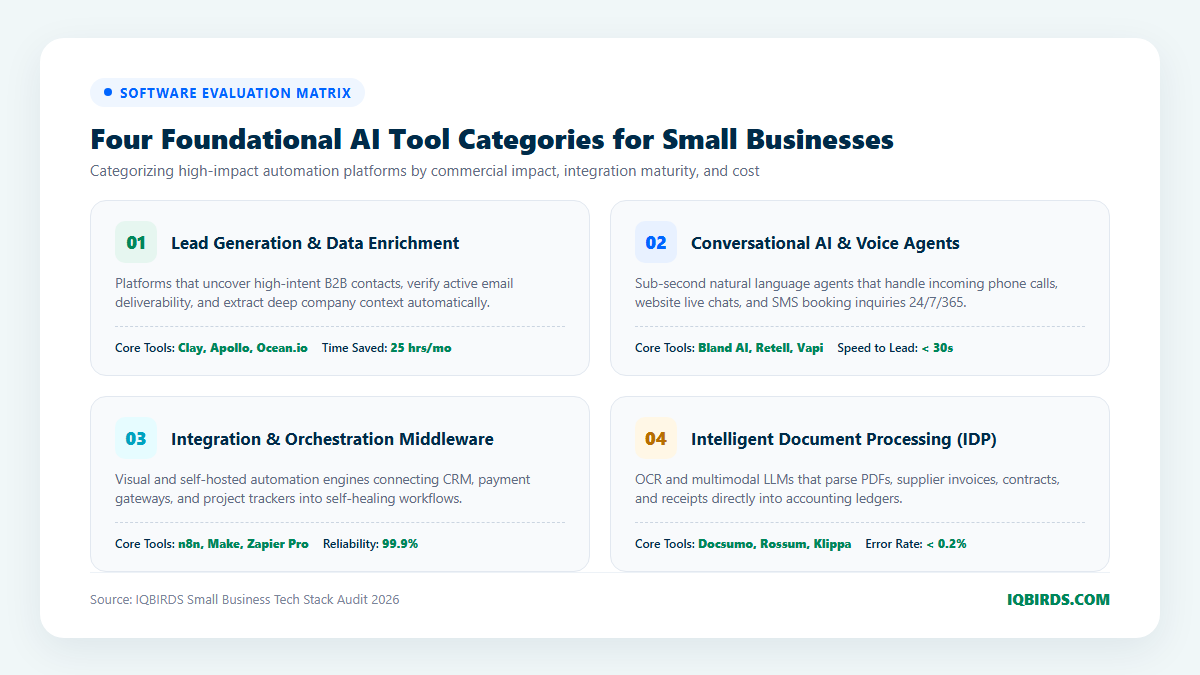
Layer 1: Lead Intelligence & Data Enrichment (Clay, Apollo, Ocean.io)
B2B outbound and inbound qualification require verified contact data and real-time buying signals. Modern data platforms combine dozens of enrichment providers into a single unified workspace:
- Clay.com: The gold standard in programmatic prospecting. Clay acts as a spreadsheet connected to 50+ data providers (including LinkedIn, GitHub, Crunchbase, and BuiltWith), allowing businesses to scrape company websites, run automated LLM research prompts, and find verified work emails in seconds.
- Apollo.io: An all-in-one database of over 275 million business contacts. Apollo provides robust search filters for funding rounds, job postings, and technographics, integrated with built-in email sequencing.
- ZeroBounce / MillionVerifier: Essential deliverability shields that run real-time SMTP handshakes to ensure email bounce rates remain strictly below 1.5%.
Layer 2: Autonomous Outbound & Deliverability (Smartlead, Instantly)
Once verified prospect lists are built, automated messaging platforms handle multi-mailbox rotation and inbox placement:
- Smartlead.ai: Built specifically for high-volume cold outreach across secondary domain fleets. Smartlead features unlimited mailbox warm-up, dynamic Spintax, custom tracking domains, and an AI Master Inbox that centralizes replies from dozens of accounts.
- Instantly.ai: An intuitive, scalable cold email platform offering automated warm-up networks, lead verification credits, and CRM sync integrations designed for small business agility.
When combined with dedicated AI marketing automation platforms, these tools maintain sub-1% spam complaint rates while generating steady streams of qualified sales discovery calls.
Layer 3: Conversational AI & Voice Agents (Bland AI, Retell AI, Vapi)
One of the most dramatic technological breakthroughs in 2026 is human-parity conversational voice AI. Businesses no longer rely on clunky interactive voice response (IVR) phone trees:
- Bland.ai: A programmable conversational voice API capable of handling outbound calls and inbound customer support with sub-800ms latency. The AI speaks fluently, understands interruptions, answers pricing FAQs, and books appointments directly on Google Calendar.
- Retell AI & Vapi: Developer-friendly voice platforms that combine advanced language models (such as Claude 3.5 and GPT-4o) with ultra-realistic text-to-speech engines (ElevenLabs and Deepgram), providing 24/7 front-desk phone coverage for clinics, law firms, and service contractors.
Layer 4: Integration Middleware & CRM Synchronization (n8n, Make, HubSpot)
Disparate AI tools cannot create enterprise value without robust orchestration middleware connecting them into unified workflows:
- n8n.io: A powerful open-source workflow automation platform that can be self-hosted on private cloud servers. Unlike legacy zap tools, n8n supports complex branching logic, AI agent nodes, custom JavaScript/Python code execution, and enterprise data privacy with zero per-task billing penalties.
- Make.com: An intuitive visual integration platform ideal for marketing and operations teams building multi-app webhooks and data transformation routines.
- HubSpot & Zoho CRM: The central single source of truth. When augmented with custom AI CRM development, every customer interaction, call recording transcript, and purchase milestone is organized automatically without manual sales rep data entry.
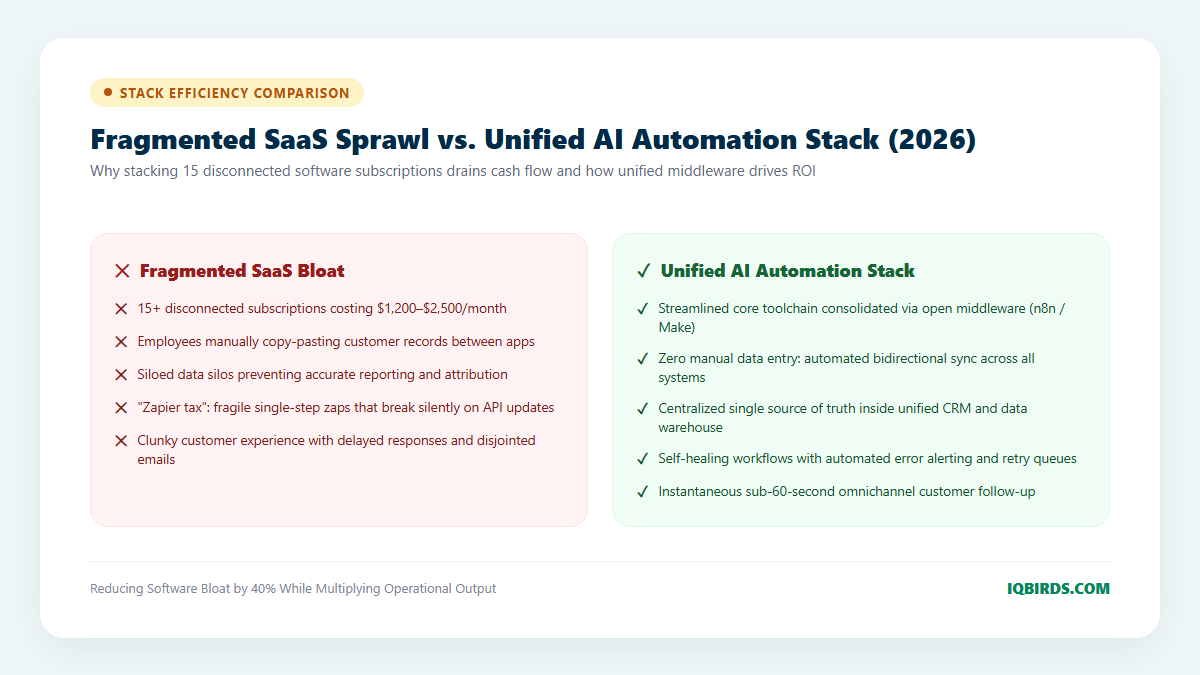
Fragmented SaaS Sprawl vs. Unified AI Automation Stack
Many business owners accumulate software subscriptions haphazardly, creating operational chaos. Contrast the fragmented subscription model against an engineered AI architecture:
7-Step Roadmap: Deploying the Small Business AI Stack
Adopting an integrated AI automation stack requires a phased deployment strategy to avoid disrupting daily operations. Follow this 7-step engineering blueprint:
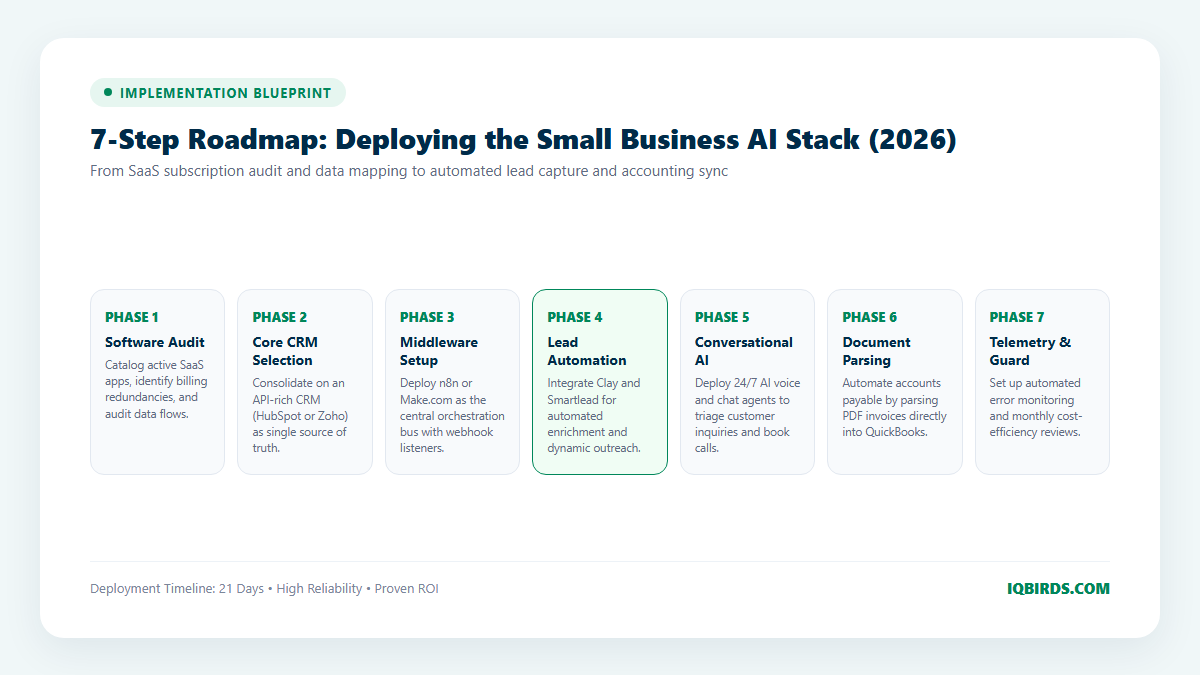
Step 1: SaaS Subscription Audit & Redundancy Removal
Perform a comprehensive audit of all credit card statements and software licenses. Identify duplicate tools (e.g., paying for both Zapier and Make, or multiple uncoordinated email marketing apps). Cancel unused licenses and consolidate your core software footprint.
Step 2: Core CRM Selection & Architecture Consolidation
Anchor your entire operational architecture around a robust, API-accessible CRM (such as HubSpot, Salesforce, or Zoho). Configure custom property fields, pipelines, and lifecycle stages so that every downstream AI automation has structured data destinations.
Step 3: Deploy Orchestration Middleware (n8n / Make)
Set up your central workflow orchestration bus using n8n or Make.com through professional system integration services. Establish secure webhook endpoints, configure environment variables for API keys, and set up error-logging notifications inside a private Slack or Microsoft Teams channel.
Step 4: Connect AI Lead Enrichment & Outbound Funnels
Deploy Clay and Smartlead to automate prospect data sourcing. Create automated enrichment waterfalls that scrub email addresses against ZeroBounce and generate context-driven outbound hooks, routing interested prospects directly into your CRM deal stages.
Step 5: Implement 24/7 Conversational AI Voice & Chat
Connect a conversational voice agent (such as Retell or Bland AI) to handle after-hours phone calls and inbound website live chat. Equip the agent with your company SOPs and Google Calendar scheduling links, capturing qualified leads while your human team sleeps.
Step 6: Automate Document Processing & Accounting Sync
Deploy intelligent document processing tools (such as Docsumo or Klippa) to parse supplier bills, receipts, and client invoices. Integrate parsed line items directly into QuickBooks or Xero, eliminating manual accounting entry errors.
Step 7: Real-Time Telemetry & Cost Governance
Build an executive dashboard tracking monthly token usage, API costs, hours reclaimed, and closed revenue attributed to automated workflows. Conduct quarterly reviews to optimize prompts and upgrade LLM models as more capable, cost-effective versions are released.
Frequently Asked Questions
Can a non-technical small business manage this AI stack independently?
While tools like Make and HubSpot are user-friendly, architecting reliable multi-agent pipelines with error handling, webhook retry queues, and deliverability warm-up requires technical expertise. Most small businesses partner with an experienced AI automation agency for initial architecture and deployment, followed by routine monthly maintenance.
What is the minimum budget required to deploy a modern AI stack?
Software subscription costs for a high-efficiency small business AI stack typically total $300 to $800 per month (covering CRM, middleware, enrichment credits, and mailbox warm-up). This software investment replaces the equivalent of $4,000 to $8,000 in monthly administrative payroll.
Is our business data secure when using third-party AI APIs?
Yes, provided you utilize enterprise API endpoints rather than public consumer chat interfaces. Major commercial model providers (such as Anthropic and OpenAI) maintain strict enterprise privacy agreements guaranteeing that data sent through API endpoints is never used to train public models.
How can IQBIRDS help my company build a custom AI technology stack?
At IQBIRDS, we design, integrate, and support custom AI automation stacks tailored specifically for small and mid-market companies. Through our dedicated AI automation services, AI CRM development solutions, and system integration pipelines, we eliminate software bloat and build robust, self-healing automated workflows that drive measurable profit growth. Schedule a technical architecture session with IQBIRDS today to build your 2026 AI technology stack.