
AI Automation
What to Look for in a UI UX Design Services Company (2026 Guide)
Hiring the right digital product design partner is one of the most critical decisions a founder, product executive, or enterprise technology leader can make. The digital product experience directly dictates user acquisition efficiency, onboarding retention curves, and customer lifetime value. However, the agency marketplace is crowded with thousands of design shops—ranging from cheap freelance collectives and superficial visual styling boutiques to enterprise consultancies that charge six-figure retainers for bloated slide decks. In 2026, selecting the right ui ux design services company requires looking beyond flashy Dribbble screenshots and evaluating true technical craftsmanship, engineering feasibility, and commercial impact.
World-class software cannot be designed in a visual vacuum. Modern product leaders need a design partner that understands code: design token architectures, headless component libraries, responsive viewports, and WCAG accessibility standards. In this comprehensive evaluation guide, we unpack the exact criteria, technical benchmarks, red flags, and interview questions you must use to select an elite UI/UX design studio that accelerates your product roadmap.

The Red Flags of Traditional “Visual-Only” Design Agencies
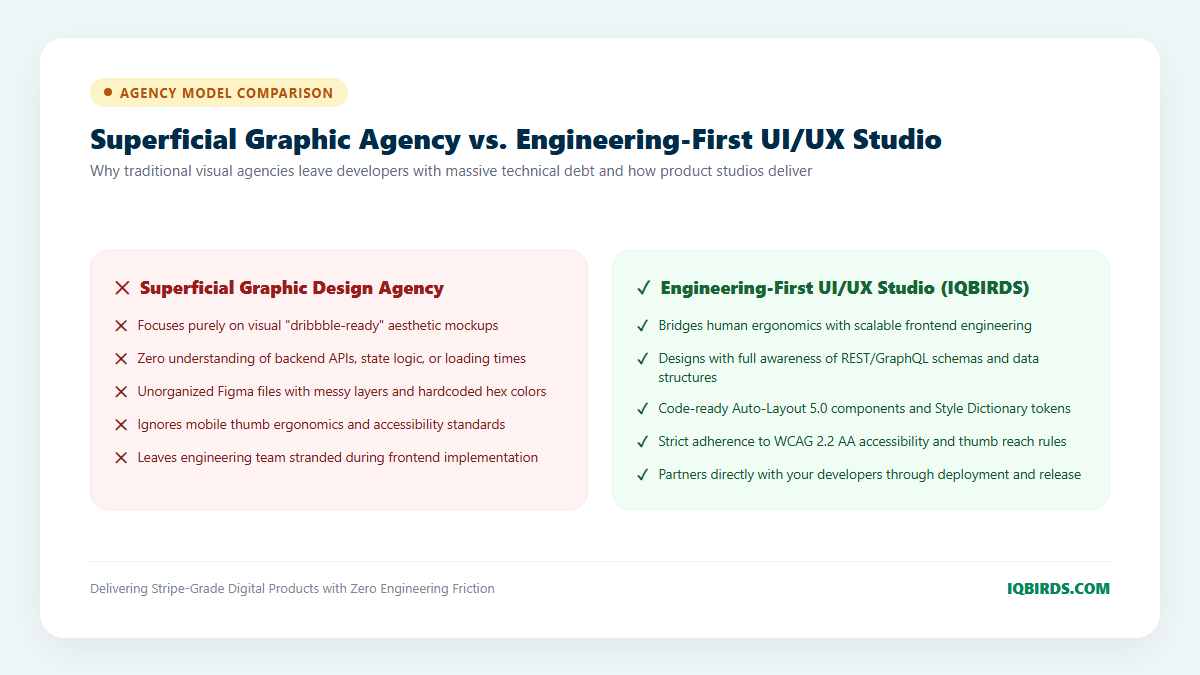
Before examining what to look for in an exceptional design agency, it is essential to understand the warning signs of mediocre design vendors. The most common traps include:
- Dribbble-Only Portfolios: Studios that display stunning concept screenshots but cannot point to a single live web or mobile application running their designs in production. Conceptual mockups frequently ignore real-world constraints like dynamic text lengths, network latency, and responsive viewports.
- Disorganized Figma Canvas Architecture: If you open an agency’s Figma file and find hardcoded hex colors, un-grouped frame layers, missing Auto-Layout constraints, and no semantic text styles, your developers will face months of painful guesswork during implementation.
- Total Ignorance of Frontend Code: When a design agency claims “we don’t worry about coding; that’s your developer’s job,” run in the opposite direction. Designers who do not understand CSS Flexbox, Grid, component states, and API data payloads author interfaces that are prohibitively expensive or physically impossible to build.
- Vanity Metrics Over Conversion Focus: Agencies that talk endlessly about “brand vibes” without ever discussing customer onboarding friction, shopping cart abandonment rates, or user retention curves.
Partnering with a full-stack studio providing comprehensive UI UX design services eliminates these risks by aligning design aesthetics with production engineering.
The 4 Core Pillars of Elite UI/UX Design Companies
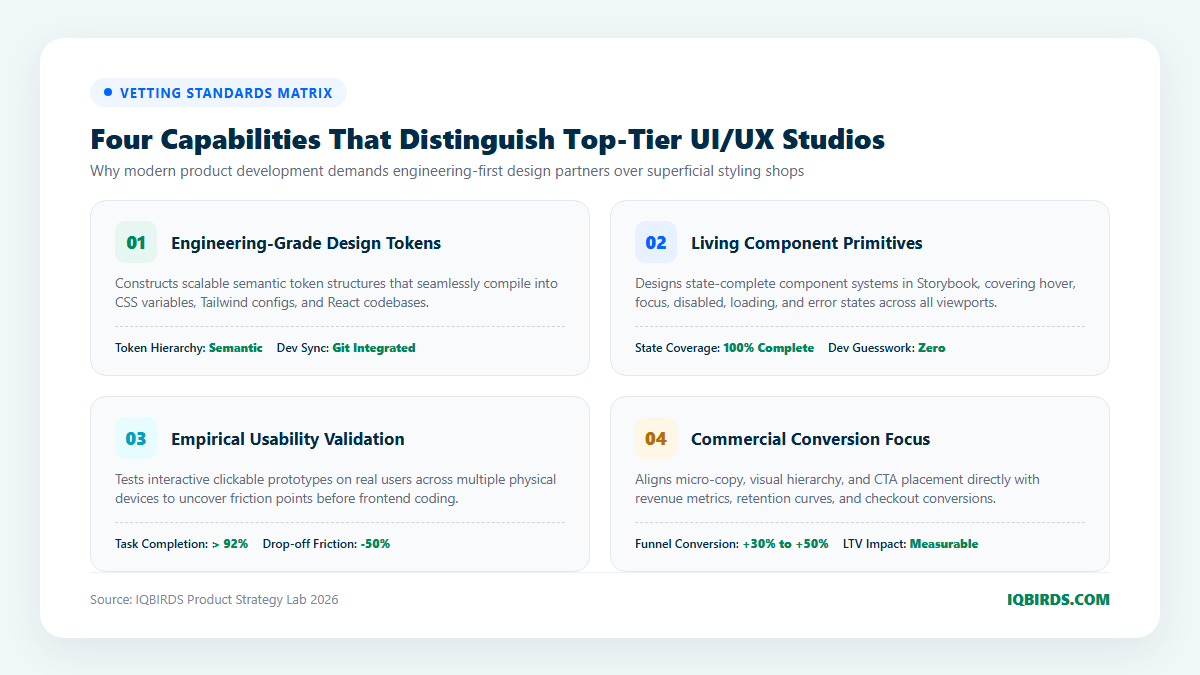
When vetting design partners in 2026, look for studios that demonstrate mastery across four foundational product dimensions:
1. Engineering-Grade Design Token Maturity
Top-tier design agencies treat design as code. They construct centralized design token systems using tools like Style Dictionary and Figma Variables. Colors, typography scales, spacing margins, and corner radii are categorized semantically (e.g., color-background-surface-subtle rather than hardcoded #F8FAFC).
This allows design systems to compile automatically into CSS variables, Tailwind configurations, and TypeScript objects—enabling seamless dark mode pairing, effortless brand theming, and zero visual drift between mockups and production releases.
2. Living Component Primitives (Storybook Handoff)
Instead of delivering static page mockups, elite agencies deliver living component systems. They construct comprehensive component libraries inside isolated environments like Storybook, documenting every interactive state: default, hover, focus-visible, active, disabled, loading shimmer skeleton, and error validation.
Your software developers can inspect the exact React or Flutter component primitives, test interactive behavior in the browser, and import production-ready components directly into codebases without guessing dimensions.
3. Empirical Usability Validation & Accessibility (WCAG 2.2 AA)
Great design studios test their assumptions empirically. Before handing over mockups to engineers, they build clickable high-fidelity prototypes and conduct moderated usability sessions with actual target users. They track task completion times, confusion points, and tap accuracy on real physical devices.
Furthermore, they guarantee compliance with WCAG 2.2 Level AA accessibility standards: ensuring color contrast ratios meet or exceed 4.5:1, interactive touch targets span at least 48×48 pixels, and screens support full screen-reader and keyboard navigation.
4. Direct Focus on Commercial Conversion & Retention
Elite design partners view their work through the lens of executive business metrics. They design onboarding funnels that minimize time-to-value, structure checkout flows that eliminate friction, and design dashboard data visualizations that keep daily active users engaged. Every design decision is justified by its impact on user retention and commercial revenue.
Superficial Styling Shops vs. Engineering-First Product Studios
Contrast the operational and financial outcomes of hiring a traditional visual agency versus partnering with an engineering-first product studio:
7-Step Roadmap: How to Vet and Select the Right Design Partner
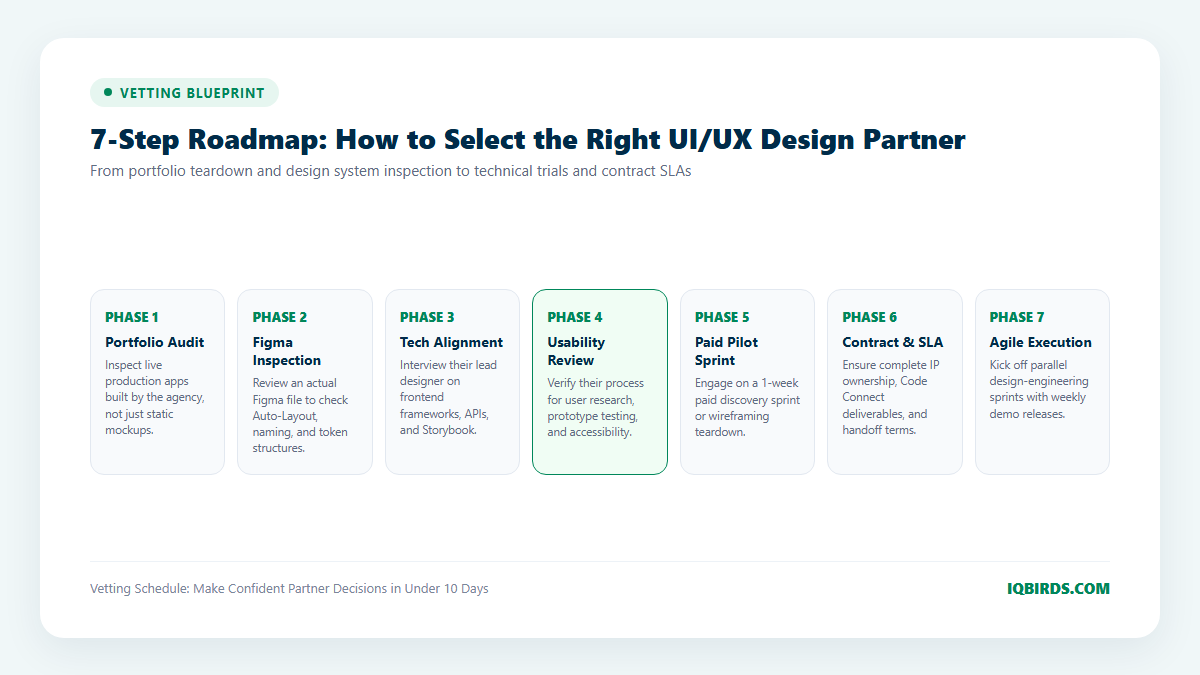
To avoid costly agency mismatches, follow this rigorous 7-phase vetting methodology:
Step 1: Inspect Live Production Applications
Ask prospective agencies to share links to live, working web and mobile apps they designed that are currently in production. Download the apps, interact with forms, test edge cases, and inspect the responsive behavior on both desktop and mobile screens.
Step 2: Request a Live Figma File Walkthrough
During your technical interview, ask the agency’s lead product designer to share their screen and walk you through an actual Figma design file from a recent project. Look for Auto-Layout usage, structured component variants, semantic token naming, and clean layer organization.
Step 3: Conduct a Technical Feasibility Interview
Have your lead software engineer interview the agency’s design directors. Ask how their design system integrates with frontend frameworks like React, Next.js, Tailwind CSS, or React Native. Evaluate whether they understand API loading states, optimistic rendering, and responsive grid breakpoints.
Step 4: Verify Usability Research & Testing Processes
Inquire about their user research methodology. Do they conduct customer discovery interviews? How do they validate clickable prototypes before authoring production UI? Ask to see an example of a usability test report or user flow diagram.
Step 5: Engage in a Short Paid Discovery Sprint
Before committing to a massive six-figure contract, hire the agency for a 1- to 2-week paid discovery or wireframing sprint. This low-risk engagement allows you to test their communication speed, strategic thinking, design quality, and team chemistry firsthand.
Step 6: Review Intellectual Property & Handoff Terms
Ensure the agency agreement grants your business 100% intellectual property ownership of all Figma files, design tokens, Storybook code, and graphic assets upon invoice payment. Verify that deliverables include complete developer handoff documentation.
Step 7: Launch Agile Collaborative Sprints
Once engaged, integrate the agency directly into your product sprints. Participate in weekly design reviews, inspect interactive prototype demos, and maintain tight feedback loops between designers, product managers, and developers.
Connecting Product UI/UX to Automated Growth Backends
A Stripe-grade user interface is only the front door to a successful digital business. World-class software combines intuitive interfaces with automated backends through custom AI automation services, AI CRM development, and system integration pipelines.
When customer actions inside your app trigger automated onboarding emails, instant SMS notifications via marketing automation engines, and real-time CRM updates, your product achieves maximum commercial retention and lifetime value.
Frequently Asked Questions
What is the typical pricing structure for an elite UI/UX design company?
High-end product design studios typically bill through two models: fixed-scope project sprints (ranging from $15,000 to $60,000 depending on complexity and screen count) or dedicated monthly dedicated retainers ($6,000 to $18,000/month) that embed senior product designers into your ongoing agile development cycles.
How does a product design agency differ from a branding agency?
Branding agencies focus on visual identity: logos, color palettes, typography guidelines, and brand story. A UI/UX product design company engineers the actual functional software interfaces: navigational logic, user workflows, design token systems, interactive components, and usability validation.
Can an agency redesign our app while our team keeps building features?
Yes. By adopting a component-driven design system in parallel with your existing codebase, the design agency can construct new UI foundations in Figma and Storybook without blocking active backend engineering sprints.
How can IQBIRDS help design and engineer our next digital product?
At IQBIRDS, we operate as a premier UI UX design services company bridging human-centered design craft with cutting-edge software engineering. We don’t just deliver static mockups—we engineer comprehensive design token architectures, living Storybook component systems, and production-ready code that matches the standards of Apple and Linear. Schedule a design consultation with IQBIRDS today to discuss your product roadmap and elevate your digital experience.