
AI Automation
AI Automation Statistics Every CEO Should Know
AI automation statistics matter because they help CEOs separate real business momentum from loud market noise. The numbers now show a clear pattern: companies are adopting AI quickly, but only the disciplined ones are turning automation into measurable workflow improvement, customer value, and durable profit.
For CEOs, that difference matters. A tool demo can look impressive in one department, yet the business only benefits when AI improves how work moves across sales, operations, finance, service, and leadership reporting. Therefore, the most useful AI automation statistics are not just adoption percentages. They reveal where organizations are scaling, where ROI is delayed, where governance is weak, and where human teams need better systems around them.

Why CEOs Should Watch AI Automation Statistics
AI has moved past the curiosity stage. In its latest global survey, McKinsey reported that 88% of organizations use AI in at least one business function, up from 78% the prior year. However, the same research shows that many companies still remain in pilot or experimentation mode, with only about one-third scaling AI programs across the organization.
This is the central CEO lesson. Adoption is no longer the hard part. Instead, the hard part is connecting AI automation to repeatable workflows, clean data, clear ownership, and financial outcomes. As a result, leaders should treat AI metrics like operating metrics, not marketing proof.
The numbers also show that AI automation is becoming a board-level issue. Microsoft’s Work Trend Index found that 82% of leaders called 2025 a pivotal year to rethink strategy and operations, while 81% expected AI agents to be moderately or extensively integrated into their AI strategy within 12 to 18 months. In short, CEOs are not just buying tools. They are being pushed to redesign how work gets done.
The AI Automation Statistics CEOs Should Know
1. AI Adoption Is High, but Scaling Is Still Uneven
The most important adoption statistic is not that AI is popular. It is that AI use is broadening faster than many operating models can absorb. McKinsey’s 88% adoption figure tells CEOs that competitors are already using AI somewhere in the business. Still, because only about one-third are scaling AI across the enterprise, the advantage is not evenly distributed.
Therefore, growing businesses should not panic because larger competitors have started. A smaller company can still move faster if it chooses practical workflows, measures outcomes, and avoids random tool sprawl. For example, automating lead follow-up, CRM updates, invoice reminders, service ticket routing, quote preparation, and reporting can create visible wins without rebuilding the whole company at once.
2. Generative AI Is Becoming Normal Business Infrastructure
Stanford HAI’s 2025 AI Index reported that business AI usage climbed sharply, with 78% of organizations reporting AI use in 2024, compared with 55% in 2023. It also reported that generative AI attracted $33.9 billion in global private investment in 2024. Meanwhile, Stanford’s 2026 AI Index economy chapter shows organizational AI adoption continuing upward into 2025.
That investment matters because it changes what software vendors, customers, employees, and competitors expect. Over time, AI-assisted workflows will feel less like a special project and more like standard business infrastructure. Because of that, CEOs should ask whether their company is learning how to use AI responsibly now or waiting until the market makes that learning urgent.

3. ROI Exists, but It Usually Requires Workflow Redesign
Many leaders expect AI to create quick savings. Sometimes it does. However, the strongest results usually come when automation changes the workflow, not just the interface. The Deloitte 2026 State of AI in the Enterprise report found that worker access to AI rose by 50% in 2025 and that companies with at least 40% of AI projects in production are expected to double within six months. Still, only 34% of organizations are truly reimagining the business around AI.
This gap is useful. It shows that access alone is not strategy. If employees use AI to write faster emails while broken handoffs remain unchanged, the company may feel busier without becoming stronger. Instead, CEOs should look for redesigned processes where AI removes delays, routes work, summarizes context, triggers next steps, and gives managers better visibility.
4. Agentic AI Is Growing Faster Than Governance
AI agents are becoming a serious automation topic because they can plan and complete multi-step tasks. For example, an agent can review a form submission, qualify the lead, update the CRM, draft a follow-up message, notify the right sales person, and create a task. However, that power also introduces risk when permissions, data access, approvals, and audit trails are weak.
Deloitte’s 2026 report warns that agentic AI use is expected to rise sharply, yet only one in five companies has a mature governance model for autonomous AI agents. Therefore, CEOs should not judge automation maturity by how many agents the company has. They should judge it by whether those agents are supervised, measurable, secure, and aligned with business rules.
5. CEOs Are Rewiring Decision-Making Around AI
IBM’s 2026 CEO Study adds another important angle. IBM reported that 69% of CEOs say AI is already changing core parts of their business, and that CEOs expect the share of operational decisions made by AI without human intervention to rise significantly by 2030. In practice, this does not mean CEOs should remove human judgment. It means they need clearer decision rights and stronger operating models.
As AI takes on more routine execution, human teams must become better at setting goals, reviewing exceptions, designing guardrails, and interpreting results. Because of this, AI automation statistics should lead to leadership questions: Which decisions can be automated? Which decisions need human review? Which decisions should never be delegated to AI?
AI Automation Statistics Comparison Table
| Metric category | Vanity metric | CEO-ready metric | Why it matters |
|---|---|---|---|
| Adoption | Number of AI tools purchased | Workflows improved by AI automation | Shows whether AI is changing real operations |
| Productivity | Hours claimed as saved | Cycle time reduction and output quality | Connects time savings to business throughput |
| Revenue | AI mentioned in sales materials | Qualified leads, conversion rate, and speed to follow-up | Shows whether automation improves growth |
| Cost | Tool subscription cost | Cost per completed workflow or customer interaction | Reveals whether automation lowers operating friction |
| Risk | Policy document created | Auditable approvals, permissions, and error reviews | Protects the business as automation expands |
| Scaling | Number of pilots launched | Production workflows used by teams every week | Separates experiments from operational value |
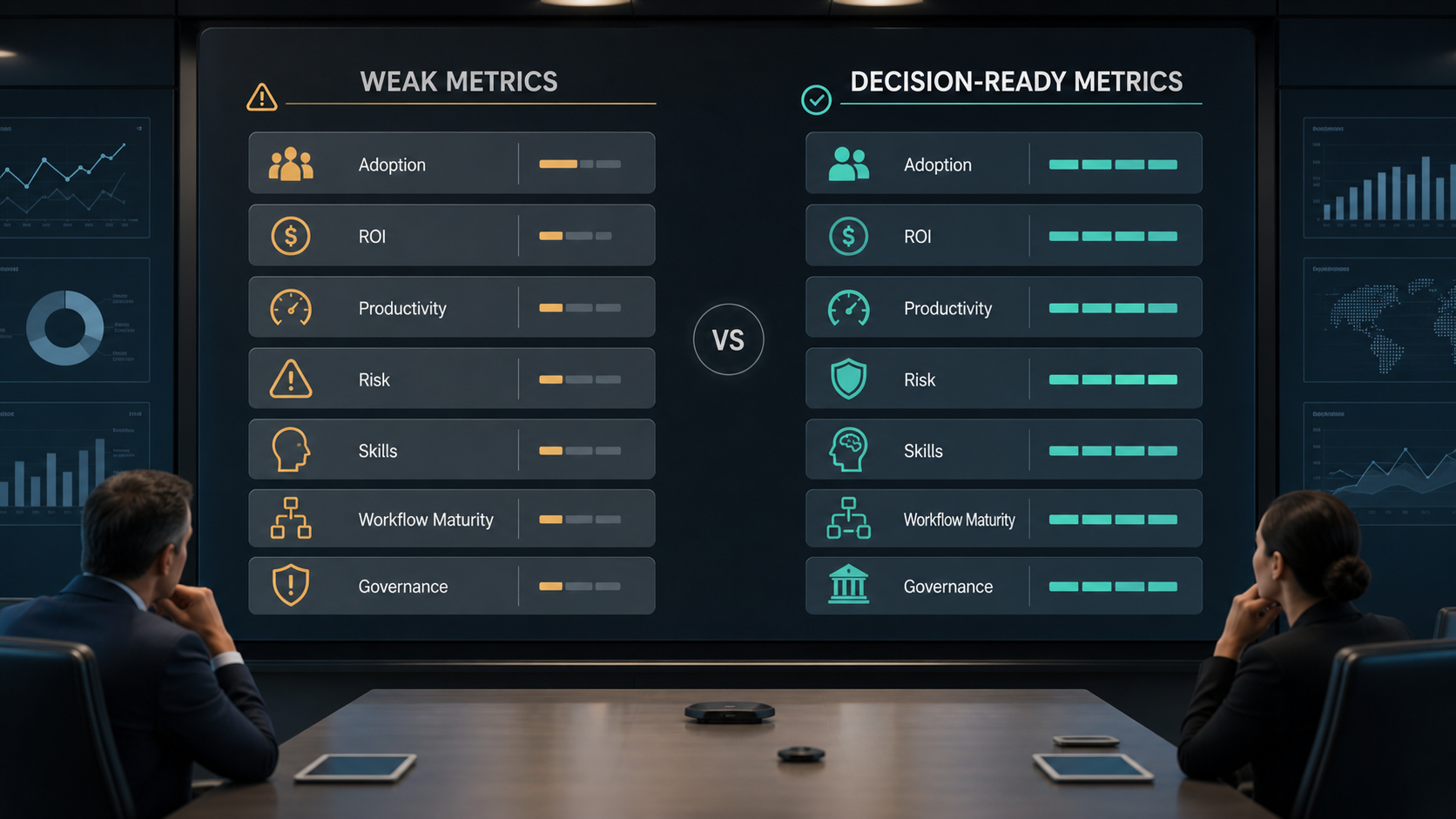
This table shows why CEOs should avoid surface-level AI reporting. A company can buy tools, launch pilots, and announce automation without changing the economics of the business. By comparison, CEO-ready metrics focus on production workflows, measurable outcomes, risk controls, and adoption by real teams. In practice, that is where AI automation statistics become useful for strategy.
What These Numbers Mean for Business Strategy
The message is practical: AI automation should be managed like a business transformation program, not a software shopping trip. First, CEOs should identify the workflows where delays, missed follow-ups, manual data entry, and inconsistent decisions create measurable cost. Next, they should connect those workflows to automation opportunities. Finally, they should review the results in simple language that finance, operations, sales, and service leaders can all understand.
For many growing companies, the best starting point is revenue operations. A lead that sits unanswered for hours can quietly reduce conversion. Outdated CRM records can damage forecasting. Slow proposal preparation can push a buyer to a competitor. Therefore, services like AI automation services, AI integration services, and AI CRM development become valuable when they connect scattered systems into a workflow that teams can actually use.
At the same time, CEOs should avoid chasing every new AI capability. The smartest approach is focused. For example, a multi-location company may use automation to standardize lead routing and reporting across branches, while a professional service firm may use AI to summarize intake forms and prepare client follow-ups. In both cases, the goal is the same: turn repeated work into a reliable system.
Step-by-Step Guide for CEOs
Step 1: Choose the Workflow, Not the Tool
Start with a business workflow that already matters. Good examples include lead qualification, appointment booking, customer onboarding, invoice follow-up, support triage, proposal creation, hiring intake, and management reporting. Then map how the work happens today from first trigger to final outcome.
Step 2: Measure the Current Baseline
Before automation begins, record the current numbers. Measure response time, completion time, error rate, handoff delays, customer wait time, team workload, and conversion impact. Without a baseline, it becomes difficult to prove whether AI helped or simply added another layer of software.
Step 3: Automate the Repetitive Parts First
Next, automate the steps that are predictable and low risk. These may include extracting information from forms, updating CRM fields, sending internal alerts, assigning tasks, summarizing calls, generating draft responses, and creating reports. Because these steps are repetitive, they usually create quick operational relief.

Step 4: Add Human Review Where It Matters
After that, define approval points. Human review should remain in place for sensitive customer decisions, pricing exceptions, legal language, hiring decisions, compliance issues, and financial approvals. This protects the company while still letting automation handle preparation and routing.
Step 5: Review ROI Every Month
Finally, review the automation like any other operating investment. Look at speed, quality, revenue impact, customer satisfaction, employee workload, and risk events. If the workflow improves, expand it. If the data is unclear, tighten the process before adding more tools.
Key Benefits for Growing Businesses
AI automation can improve business performance in several practical ways. First, it can reduce response delays by moving work immediately after a trigger happens. Second, it can improve consistency because the same rules apply across teams and locations. Third, it can help managers see work that was previously hidden inside inboxes, spreadsheets, and disconnected apps.
In addition, automation can make employees more effective. Instead of spending energy on copy-paste work, status chasing, and manual reminders, teams can focus on judgment, relationships, and problem-solving. This is especially useful for service businesses, agencies, local companies, and professional firms where growth often creates more coordination work before it creates more profit.
Most importantly, AI automation can help CEOs make faster decisions. When workflows produce reliable data, leadership can see where leads drop, where projects slow down, where customers wait, and where teams need support. Because of that, automation becomes more than efficiency. It becomes operational visibility.
Common Mistakes to Avoid
The first mistake is measuring activity instead of outcomes. Tool usage, prompt counts, and demo excitement do not prove business value. Instead, CEOs should measure workflow completion, cost per outcome, quality improvement, and customer impact.
The second mistake is automating a broken process too early. If the current workflow has unclear ownership, duplicate data, and confusing approvals, AI may only make the mess move faster. Therefore, clean the process before scaling it.
The third mistake is ignoring governance until something goes wrong. Permissions, audit logs, data access, approval points, and exception handling should be part of the design from the start. Otherwise, every successful pilot can create a new risk.
The fourth mistake is leaving employees out of the change. People need to understand what AI will do, what they will still own, and how success will be measured. Without that clarity, adoption slows and teams return to old habits.
How IQBIRDS Helps Your Business
IQBIRDS helps businesses turn AI automation statistics into practical systems. Instead of starting with a tool list, we start with the workflow that needs improvement. Then we map the process, identify automation opportunities, connect the right platforms, and build AI-assisted systems that support daily work.
For example, IQBIRDS can help automate contact form responses, lead scoring, CRM updates, customer support routing, proposal preparation, internal reporting, and follow-up sequences. We can also connect AI automation with your existing CRM, website, email tools, forms, calendars, and business apps so your team does not need to manage everything manually.
Because every business has different operations, we focus on measurable improvement. That means clearer workflows, better data handoffs, faster response times, and automation that fits how your team already works. In short, IQBIRDS helps you move from AI interest to AI execution.
Frequently Asked Questions
What are AI automation statistics?
AI automation statistics are data points that show how businesses use AI to automate workflows, improve productivity, reduce costs, support decisions, and scale operations. They help leaders understand adoption trends, ROI potential, risk, and operational readiness.
Which AI automation statistics should CEOs track first?
CEOs should start with workflow cycle time, response speed, cost per completed task, conversion impact, error rate, employee workload, customer satisfaction, and percentage of automated workflows used in production. These metrics connect AI to real business performance.
Do AI automation statistics prove ROI?
They can help prove ROI when they are tied to a baseline. For example, if lead response time falls, conversion improves, and manual admin hours decrease after automation, the business can connect AI activity to measurable value.
How often should companies review AI automation metrics?
Most growing companies should review core automation metrics monthly. However, high-volume workflows such as sales follow-up, support routing, and order processing may need weekly review while the system is being improved.
What is the biggest mistake CEOs make with AI automation data?
The biggest mistake is treating adoption as success. A company may use AI in several departments and still see little business impact if workflows, governance, data quality, and team habits do not change.
Should small businesses track AI automation statistics?
Yes. Small businesses may benefit even more because a few automated workflows can save time quickly. Simple metrics such as response time, booking rate, missed leads, follow-up completion, and customer wait time can reveal where automation is working.
How can IQBIRDS help my business?
IQBIRDS can help your business identify the best automation opportunities, connect your existing tools, build AI workflows, improve CRM processes, and measure results. The goal is to create practical automation that supports growth without adding unnecessary complexity.
Final Thoughts
AI automation statistics show that the market is moving quickly, but they also show that many businesses are still learning how to scale. For CEOs, the opportunity is not simply to adopt AI before competitors do. The real opportunity is to build better workflows, stronger decision systems, and a company that learns faster from its own operations.
If your business wants to use AI automation in a practical way, start with one important workflow, measure the baseline, improve the process, and scale only after the results are clear. IQBIRDS can help you plan, build, and optimize that journey with AI automation designed for real business outcomes.
Need AI Automation?
Discover how IQBirds helps businesses automate workflows and build custom digital products.