
AI Automation
RAG vs Fine-Tuning: Choosing the Right AI Approach
RAG vs fine-tuning is one of the most important decisions businesses face when they want a smarter AI system. Both approaches can improve AI performance, but they solve different problems. RAG, or retrieval-augmented generation, helps an AI model answer using external knowledge sources. Fine-tuning helps a model learn a specific style, format, behavior, or task pattern from examples.
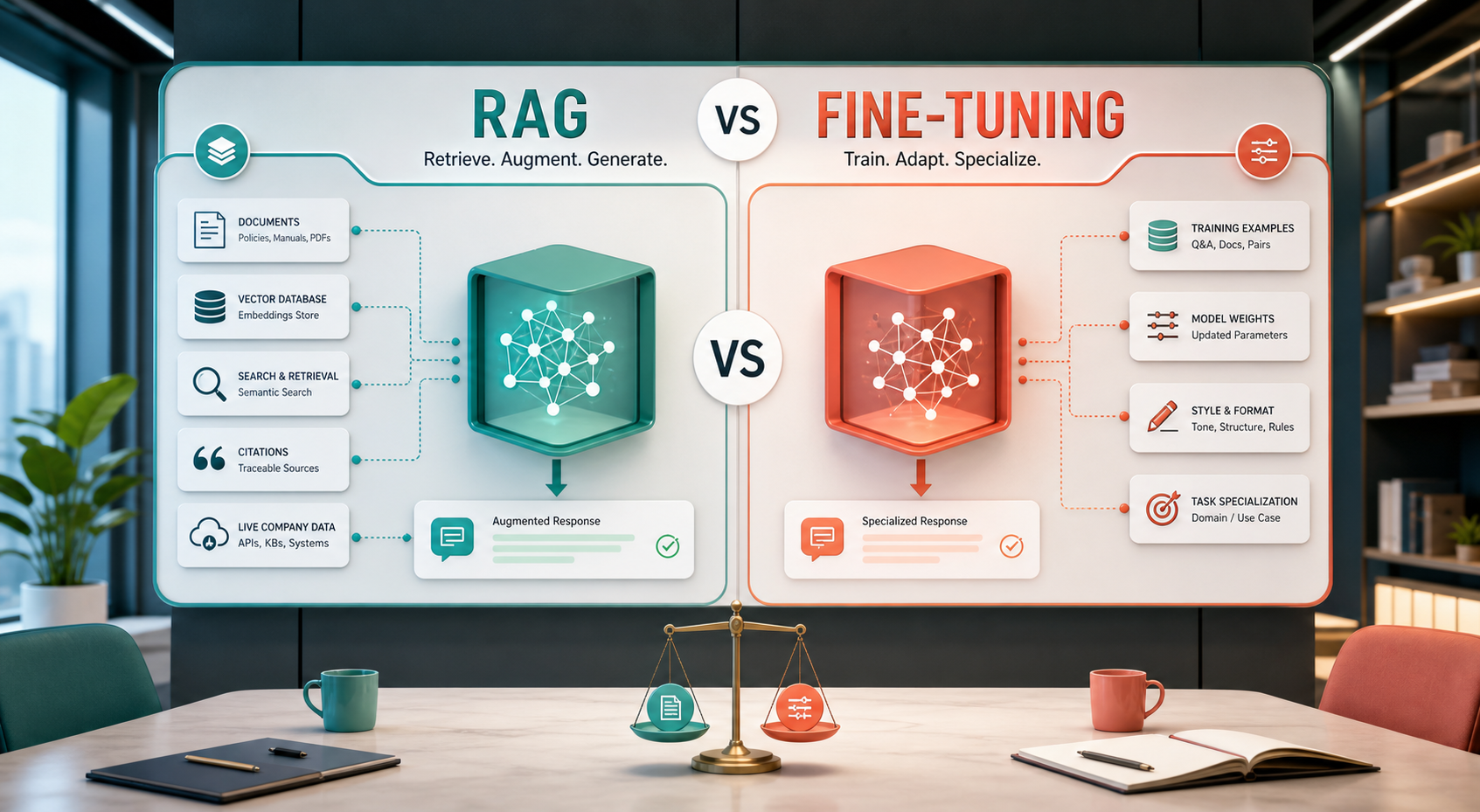
The simplest way to think about it is this: use RAG when the model needs better information, and use fine-tuning when the model needs better behavior. However, real business use cases are rarely that clean. A customer support AI may need fresh policy documents through RAG and a consistent response style through fine-tuning. Therefore, the right answer can be RAG, fine-tuning, or both.
What RAG vs Fine-Tuning Means in Simple Terms
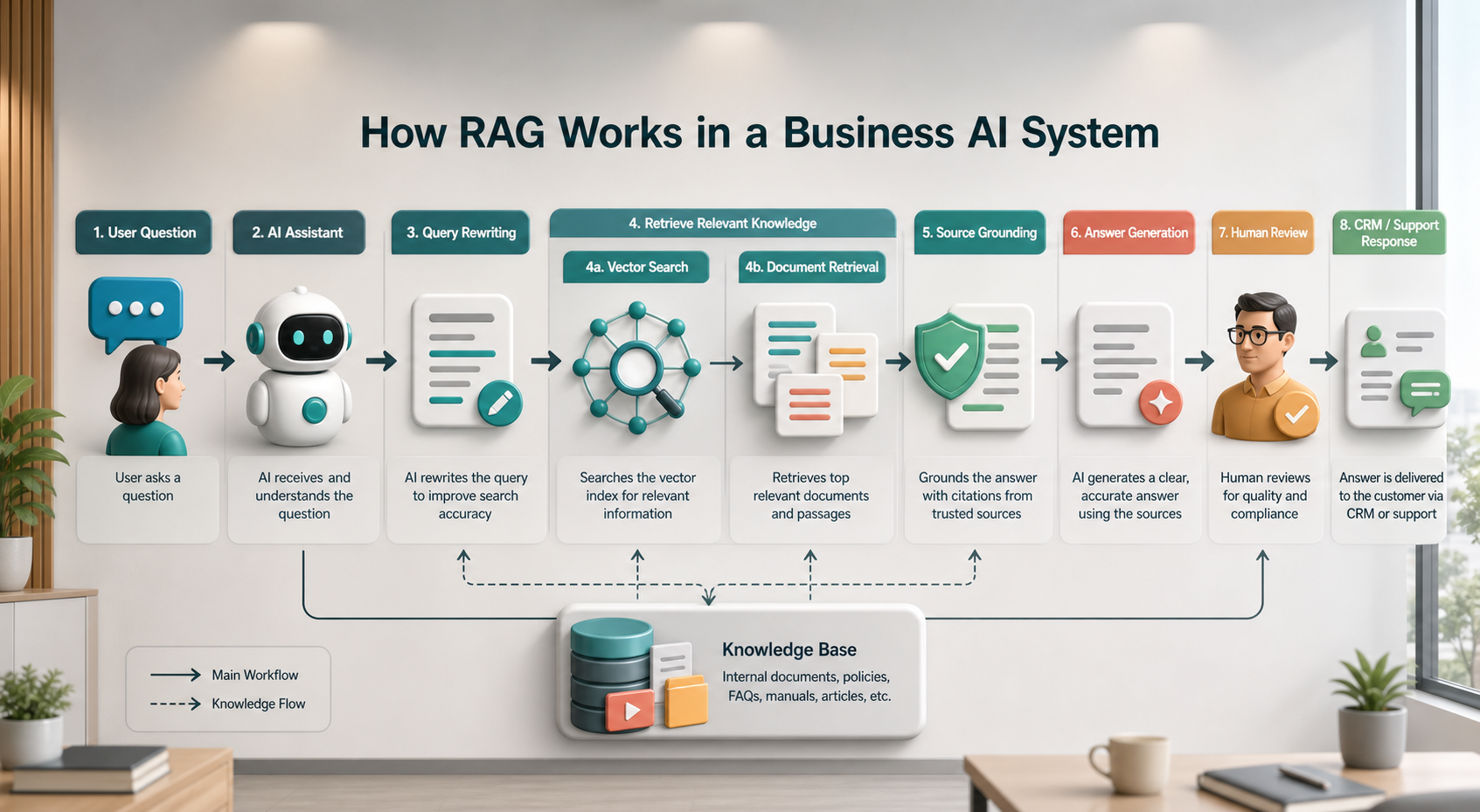
RAG is an approach where the AI system searches a knowledge source before answering. For example, a user asks a question, the system retrieves relevant documents, and the model uses those documents to generate a response. This can include company policies, product manuals, help articles, CRM notes, PDFs, database records, or internal knowledge base content.
Fine-tuning is different. Instead of giving the model documents at answer time, you train the model with examples so it becomes better at a specific task. For example, you may fine-tune a model to classify support tickets, produce a consistent JSON format, follow a brand tone, or respond in a specific structure. In addition, fine-tuning can reduce repeated prompting because the behavior becomes part of the model’s learned pattern.
In short, RAG improves what the model knows during a response. Fine-tuning improves how the model behaves. Both can be valuable, but they should be used for the right business reason.
Why This Choice Matters for Businesses
Choosing the wrong approach can waste time and money. If your AI gives weak answers because it lacks access to current company information, fine-tuning may not fix the problem. The model still will not know the newest policy, pricing, client notes, or product details unless that information is provided somehow. In that case, RAG is usually the better starting point.
However, if the model already has the right information but keeps returning inconsistent formats, wrong tone, or unstable classification results, RAG alone may not solve the issue. In that case, fine-tuning may help the model follow the pattern more reliably. For this reason, businesses should diagnose the actual problem before choosing the technical solution.
Where RAG Usually Fits Better
RAG usually fits better when the AI system needs current, private, changing, or source-grounded information. For example, a business may want an AI assistant that answers questions from internal documents, support articles, onboarding guides, product catalogs, service policies, or customer records. Because these sources can change often, retrieving the latest approved content is safer than trying to train the model every time something changes.
RAG is also helpful when answers need citations or traceability. If a manager wants to know why the AI gave a certain answer, the system can show the documents or passages used. This improves trust, review, and compliance. Also, RAG can reduce hallucinations because the model is grounded in retrieved material instead of relying only on general training data.
Still, RAG needs careful implementation. A weak retrieval system can pull the wrong documents, miss important context, or overload the prompt with irrelevant information. Therefore, RAG projects need clean content, good chunking, useful metadata, retrieval testing, access controls, and monitoring.
Where Fine-Tuning Usually Fits Better
Fine-tuning usually fits better when the model needs to perform a narrow task more consistently. For example, a business may fine-tune for ticket classification, lead qualification labels, structured extraction, policy decision categories, or a very specific response format. In these cases, the model learns from repeated examples and becomes more consistent for that task.
Fine-tuning can also help when brand voice and output structure matter. For example, a company may want a model to always write concise support replies, follow a defined tone, return clean JSON, or classify requests using exact internal categories. Instead of writing a long prompt every time, fine-tuning can teach the model the desired behavior.
However, fine-tuning is not the best way to add frequently changing knowledge. If your pricing, policies, inventory, legal guidance, or customer data changes often, training that information into a model can become expensive and outdated. In that case, RAG is usually more practical.
RAG vs Fine-Tuning Comparison Table
| Business Need | RAG | Fine-Tuning |
|---|---|---|
| Main purpose | Add current and relevant knowledge at response time. | Improve model behavior, style, task performance, or output format. |
| Best for | Company documents, knowledge bases, policy answers, customer records, and source-grounded responses. | Classification, structured output, tone, repeatable patterns, and specialized task behavior. |
| Data freshness | Strong, because documents and databases can be updated without retraining the model. | Weaker for changing facts because new facts require new examples or retraining. |
| Traceability | Often stronger because the system can show retrieved sources or citations. | Usually weaker because behavior is learned inside the model rather than tied to retrieved sources. |
| Setup needs | Requires clean content, embeddings, retrieval logic, access rules, and evaluation. | Requires high-quality examples, training files, evaluation data, and model testing. |
| Cost pattern | Costs come from retrieval infrastructure, storage, embedding, and context usage. | Costs come from data preparation, training, evaluation, and model usage. |
| Best business fit | AI assistants that must answer from fresh or private business knowledge. | AI systems that must behave consistently on a specific task. |
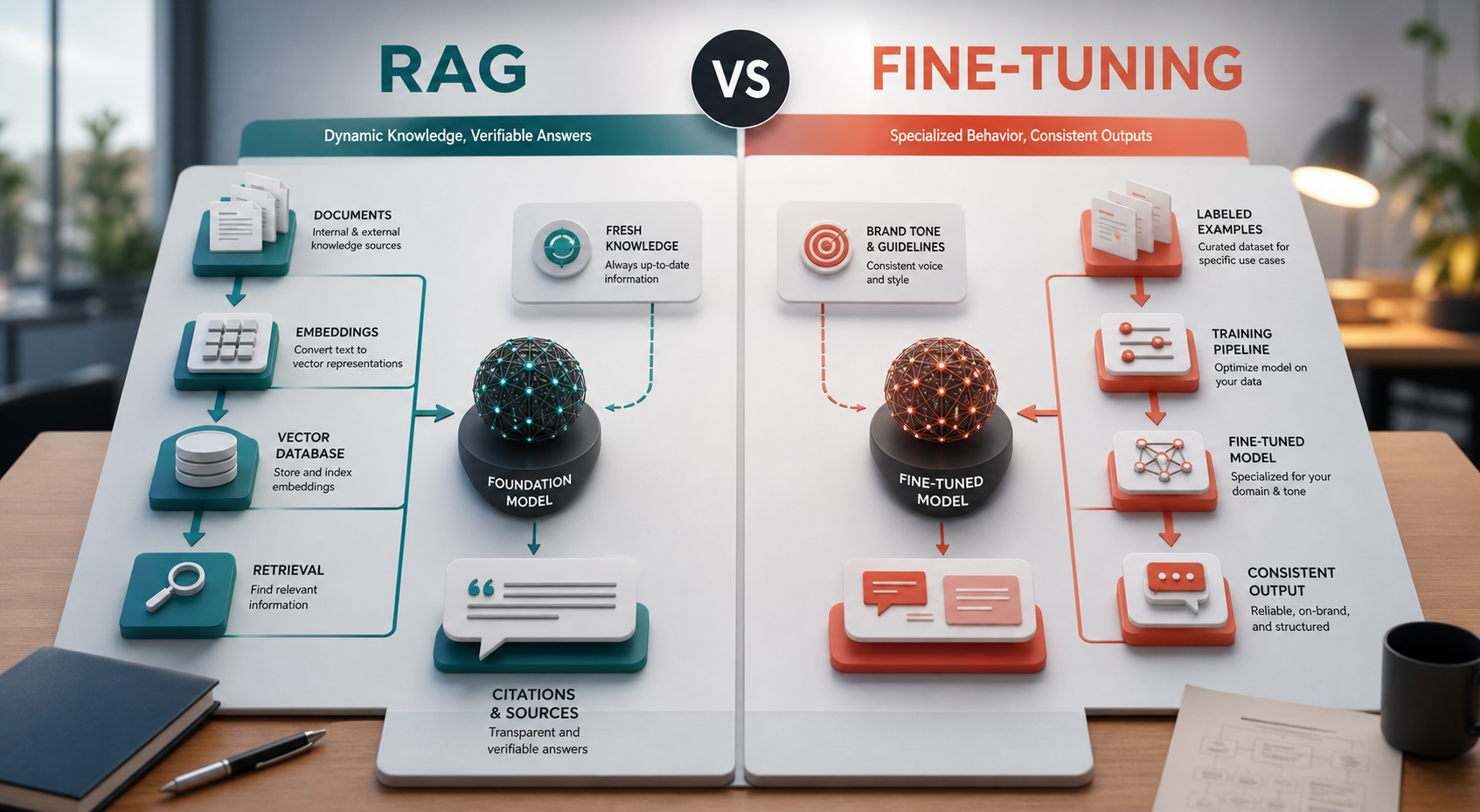
This table shows why the decision should start with the problem. If the model is missing facts, use RAG. If the model knows enough but behaves inconsistently, consider fine-tuning. However, if your AI system needs both fresh knowledge and consistent behavior, a hybrid approach may be the strongest option.
When a Hybrid Approach Makes Sense
A hybrid approach uses RAG and fine-tuning together. For example, a customer support AI may retrieve the latest help center articles through RAG while using fine-tuning to answer in the company’s approved tone and format. As a result, the answer can be current, source-grounded, and consistent.
This approach can also work for sales, healthcare administration, financial services, legal operations, HR, and internal knowledge systems. RAG supplies the approved information. Fine-tuning improves the way the AI classifies, formats, or communicates that information. Still, a hybrid approach is more complex, so teams should prove the business value before adding both layers.
This is where practical implementation support matters. IQBIRDS helps businesses design AI systems through AI integration services, AI automation services, and AI CRM development. If your business is also comparing AI architecture choices, our guide on MCP vs APIs for AI integrations can help connect the strategy to real systems.
For current technical context, review official resources such as OpenAI fine-tuning documentation, OpenAI retrieval documentation, Google Cloud’s RAG overview, and AWS’s RAG explanation. Because model features and platform capabilities change over time, official documentation should guide implementation details.
Step-by-Step Guide to Choosing the Right AI Approach
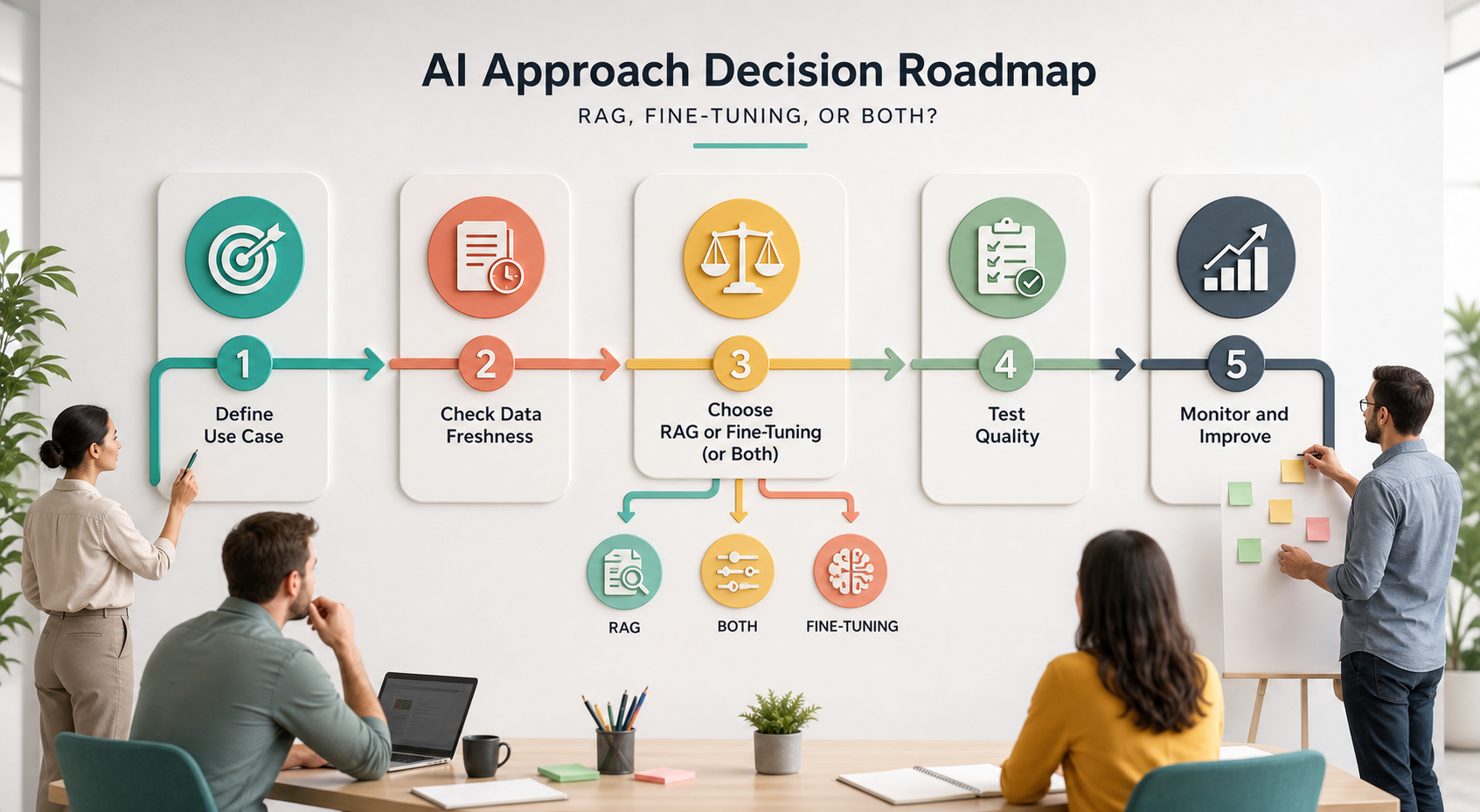
First, define the use case clearly. Write down what users will ask, what the AI should produce, what systems it needs to access, and what a good answer looks like. This prevents the team from choosing technology before understanding the business problem.
Next, check whether the problem is knowledge or behavior. If answers are wrong because the AI lacks current company information, start with RAG. However, if answers are wrong because the AI ignores a format, tone, or classification pattern, fine-tuning may be more relevant.
After that, review your data quality. RAG needs clean, organized, and searchable content. Fine-tuning needs high-quality examples that show the exact behavior you want. In both cases, weak data creates weak results.
Then, build a small test. For RAG, test whether retrieval finds the right documents and whether answers cite the right sources. For fine-tuning, test whether outputs improve on real examples compared with the base model and a strong prompt.
Finally, measure business outcomes. Track answer accuracy, editing time, support resolution speed, user trust, cost per task, and error reduction. Most importantly, keep monitoring after launch because knowledge, prompts, models, and user expectations will change.
Key Benefits of Choosing Correctly
- More accurate answers because the system solves the right problem.
- Better use of company knowledge through approved documents and databases.
- More consistent outputs for classification, formatting, tone, and task behavior.
- Lower wasted budget because teams avoid training when retrieval would work better.
- Improved trust when answers can be traced back to sources.
- Faster staff workflows because AI responses need less correction.
- More scalable AI systems that can improve over time with evaluation and monitoring.
In addition, the right approach helps teams communicate clearly. Leaders, developers, and department managers can understand why RAG, fine-tuning, or a hybrid approach was chosen. As a result, the AI project becomes easier to explain, improve, and defend.
Common Mistakes to Avoid
Fine-Tuning to Add Changing Facts
Fine-tuning is not the best way to store information that changes often. Instead, use RAG for updated policies, pricing, inventory, customer records, or knowledge base content.
Using RAG With Messy Documents
RAG depends on retrieval quality. If documents are outdated, duplicated, unclear, or poorly organized, the AI may retrieve weak context and produce weak answers.
Skipping Evaluation
Teams should compare outputs before and after the change. Also, they should test real examples, edge cases, and difficult questions before rolling the system out to staff or customers.
Assuming Fine-Tuning Fixes Everything
Fine-tuning can improve behavior, but it does not automatically create accurate business knowledge. If the model needs private or current information, retrieval is still important.
Forgetting Human Review
Important answers should still include human review when risk is high. For example, legal, medical, financial, pricing, and customer-sensitive workflows need guardrails and approval rules.
How IQBIRDS Helps Your Business
IQBIRDS helps businesses choose the right AI approach based on the workflow, not the hype. We start by mapping the use case, reviewing the data, and identifying whether the main issue is knowledge, behavior, integration, or process design. Then we recommend RAG, fine-tuning, prompt engineering, automation, or a hybrid architecture.
We can help organize knowledge bases, connect documents and databases, design retrieval workflows, prepare evaluation sets, and build AI automations around CRM, support, sales, and operations. In addition, IQBIRDS can help define human review steps, reporting dashboards, and monitoring processes so the AI system stays useful after launch.
This practical approach helps your business avoid expensive experiments. Instead of choosing RAG vs fine-tuning based on buzzwords, you choose the approach that improves accuracy, consistency, and business outcomes.
Frequently Asked Questions
What is the difference between RAG and fine-tuning?
RAG retrieves relevant information from external sources before the model answers. Fine-tuning trains the model on examples so it behaves better for a specific task, tone, format, or pattern.
Is RAG better than fine-tuning?
RAG is better when the AI needs fresh, private, or source-grounded knowledge. Fine-tuning is better when the AI needs more consistent behavior, formatting, tone, or task performance.
Can RAG and fine-tuning work together?
Yes. Many business AI systems can use both. RAG provides current knowledge, while fine-tuning improves how the model responds, classifies, formats, or follows the company’s style.
When should a business use RAG?
Use RAG when the AI must answer from company documents, policies, knowledge bases, customer records, product data, or other information that changes over time.
When should a business use fine-tuning?
Use fine-tuning when the model needs to produce more consistent outputs for a narrow task, such as classification, structured extraction, brand voice, formatting, or domain-specific response patterns.
Is fine-tuning cheaper than RAG?
It depends on the use case. Fine-tuning may reduce prompt length for repeated tasks, but it requires training data and evaluation. RAG may require retrieval infrastructure, embeddings, storage, and context usage.
How can IQBIRDS help my business?
IQBIRDS can help your business compare RAG vs fine-tuning, organize knowledge sources, design AI workflows, connect CRM and business tools, evaluate quality, and build the right AI automation approach.
Final Thoughts
RAG vs fine-tuning is not about which approach sounds more advanced. It is about matching the solution to the problem. RAG is usually the better choice when the model needs access to fresh and trusted knowledge. Fine-tuning is usually better when the model needs to behave more consistently for a defined task.
If your business wants to build a practical AI system, IQBIRDS can help you choose the right approach, connect the right data, and create AI workflows that improve accuracy, reduce manual work, and support long-term growth.
Need AI Automation?
Discover how IQBirds helps businesses automate workflows and build custom digital products.