
Blog
How to Choose the Right Mobile App Development Company in 2026: A Founder’s Evaluation Guide
Selecting the right mobile app development company is one of the highest-stakes decisions a founder, product executive, or enterprise digital leader can make in 2026. A world-class mobile application acts as your primary engine of customer retention, brand authority, and recurring digital revenue. Conversely, partnering with the wrong vendor results in delayed launches, spiraling technical debt, fragile spaghetti code, and tens of thousands of dollars wasted on post-launch rewrites.
The mobile software ecosystem in 2026 is radically different from what it was even three years ago. Modern mobile users have zero tolerance for clunky UI transitions, slow Cold-Start loading times, or battery-draining background syncs. At the same time, platforms like the Apple App Store and Google Play have instituted stringent privacy policies, biometric authentication requirements, and strict review guidelines that catch inexperienced development teams off guard.
In this definitive executive guide, we break down the exact vetting frameworks, architectural questions, delivery model trade-offs, and contract safeguards required to choose a high-performing mobile app development company that builds for long-term scalability and commercial success.
The True Cost of Choosing the Wrong Mobile App Partner
When software projects derail, business leaders often blame technology. In reality, over 80% of failed app initiatives fail due to organizational misalignment between the client and the agency. Inexperienced development shops frequently commit four catastrophic errors:
- Over-Promising on Low Fixed-Bids: Inexperienced agencies quote unrealistically low budgets to win contracts, only to reveal halfway through that crucial modules—such as push notification backends, offline synchronization, or admin analytics dashboards—were “out of scope.”
- Junior Developer Bait-and-Switch: The sales pitch features polished senior architects, but actual coding is quietly outsourced to junior developers with limited comprehension of memory management, reactive state handling, or native OS constraints.
- Ignoring Cross-Platform Memory Leaks: Building with cross-platform frameworks like Flutter or React Native without deep understanding of native bridge communication creates apps that stutter, drop frames below 60fps, and overheat devices.
- Zero Post-Launch Ownership: Once the code is handed over and the final invoice is settled, the agency disappears, leaving the client stranded when subsequent iOS or Android OS updates break critical app functionality.
To avoid these costly pitfalls, product leaders must transition from treating vendor selection as a procurement bidding war to treating it as a rigorous technical partnership audit.
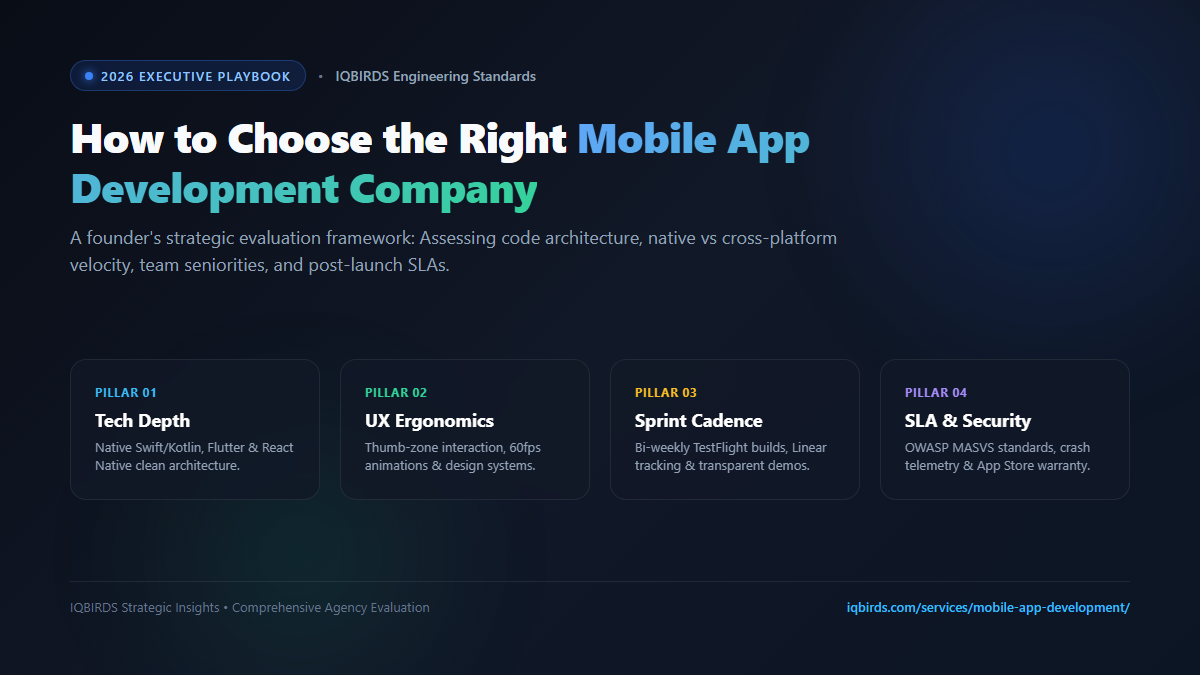
4 Pillars of the Mobile App Partner Evaluation Framework
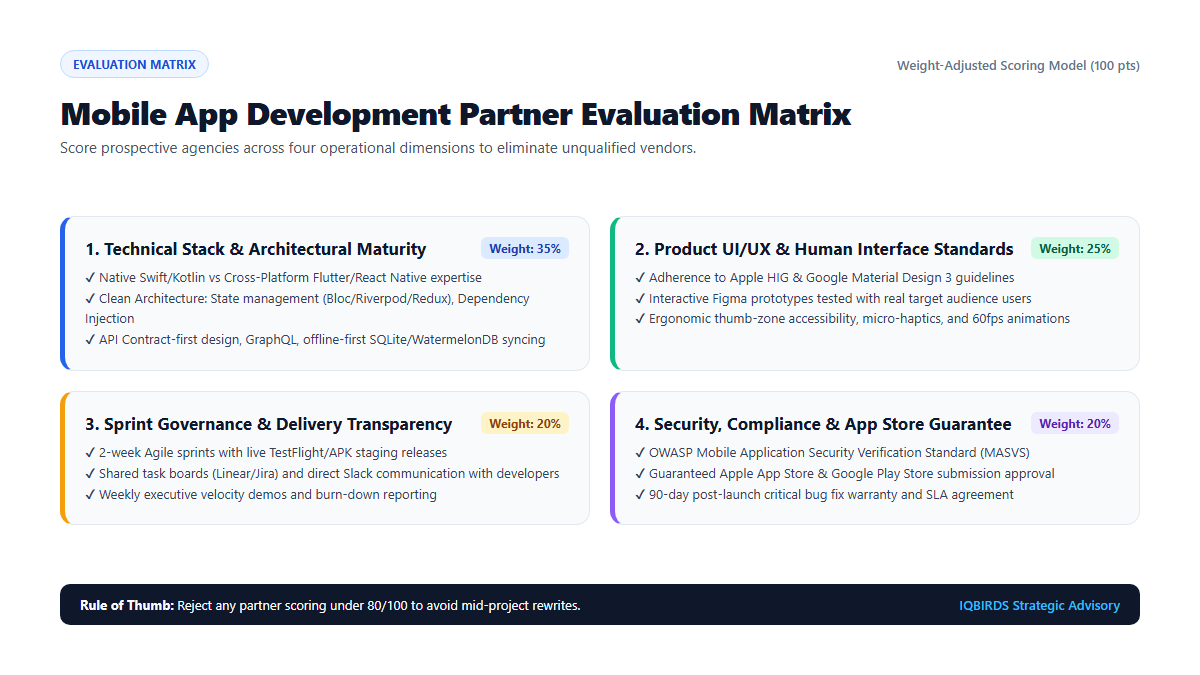
Before reviewing agency portfolios or scheduling sales calls, establish a standardized scoring rubric. At IQBIRDS Mobile Engineering, we evaluate prospective mobile initiatives across four core operational pillars:
1. Technical Architecture & Code Modularity (35% Weight)
Clean code architecture separates successful apps from disposable prototypes. During technical interviews, ask prospective partners to demonstrate how they organize code repositories. Top-tier agencies utilize Clean Architecture or Domain-Driven Design (DDD) patterns, separating the presentation UI layer, business domain logic, and data repository layers.
Furthermore, evaluate their proficiency across the modern mobile stack:
- Native Development (Swift & Kotlin): Essential for hardware-intensive utilities, real-time audio/video processing, augmented reality, or mission-critical enterprise apps.
- Cross-Platform Frameworks (Flutter & React Native): Highly effective for fast time-to-market and shared codebases across iOS and Android, provided the team writes custom native modules when bridge performance demands it.
- Offline-First Data Syncing: How does the app handle intermittent connectivity? Top agencies design with local SQLite, Room, or WatermelonDB caching to ensure instantaneous user response regardless of cell signal.
2. Product UI/UX & Human Interface Mastery (25% Weight)
Writing code that compiles is easy; engineering an interface that millions of people effortlessly navigate is rare. A capable mobile app development company does not treat design as mere graphic decoration. They integrate user research, ergonomic thumb-zone positioning, tactile haptic feedback, and accessibility compliance (WCAG 2.2 AA) into every wireframe.
Look for agencies that provide clickable, interactive Figma prototypes tested with real target audience demographics before a single line of production code is written. Seamless alignment with modern UI/UX design standards reduces downstream development changes by up to 60%.
3. Agile Governance, Sprint Cadence & Transparency (20% Weight)
Software development should never feel like a black box. Inquire about the agency’s sprint rituals and delivery cadence. High-performing teams operate on strict 2-week Agile sprints with weekly demos, shared Linear or Jira boards, and continuous integration (CI/CD) pipelines that automatically push test builds to Apple TestFlight and Google Play Internal Testing.
If an agency expects you to wait 12 weeks for a “grand reveal,” walk away. Modern delivery requires continuous, transparent feedback loops where you can interact with live working software every fourteen days.
4. Security, Compliance & App Store Guarantee (20% Weight)
Mobile security cannot be an afterthought bolted on at the end. Verify that the agency adheres to the OWASP Mobile Application Security Verification Standard (MASVS). Inquire about their data encryption protocols (AES-256 for data at rest, TLS 1.3 with SSL certificate pinning for data in transit) and token management via iOS Keychain and Android Keystore.
Most importantly, insist on an explicit contractual guarantee covering successful Apple App Store and Google Play Store submission approval, alongside a 60- to 90-day post-launch warranty covering critical bug remediation.
Delivery Models Compared: In-House vs Freelancers vs Specialized Agency
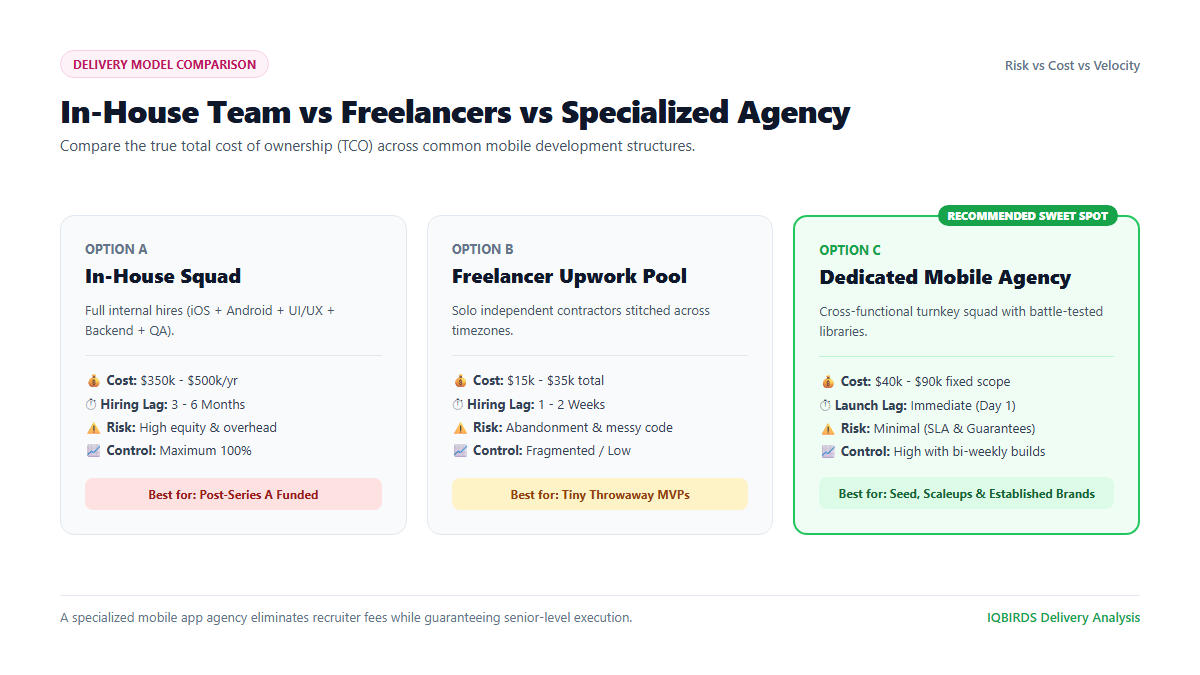
Founders frequently debate whether they should recruit an internal team, hire freelance contractors on Upwork, or engage an established mobile app development company. Each approach involves distinct trade-offs in capital expenditure, management overhead, and delivery velocity:
| Evaluation Metric | In-House Engineering Team | Freelancer Contractor Pool | Specialized Mobile App Agency |
|---|---|---|---|
| Total Annual Cost | $350,000 – $550,000+ (Salaries, Benefits, Taxes) | $15,000 – $40,000 (Hourly / Milestone) | $40,000 – $100,000 (Fixed Scope / Retainer) |
| Time to First Sprint | 3 to 6 Months (Recruiting & Vetting) | 1 to 2 Weeks | Immediate (Day 1 Onboarding) |
| Skill Breadth | Limited to 2–3 specific hires | Isolated solo specialists | Full cross-functional squad (PM, UI/UX, iOS, Android, QA, DevOps) |
| Code Accountability | Internal employee responsibility | Very low (High risk of project abandonment) | Contractual SLA & App Store approval guarantee |
| Infrastructure & Tooling | Must purchase all CI/CD, testing, & design licenses | Ad-hoc individual tools | Enterprise-grade device testing labs & automated CI/CD pipelines |
For early-stage startups testing disposable landing pages, freelancers can be sufficient. For massive tech conglomerates with $50M+ in funding, building a 50-person in-house engineering wing makes sense. However, for seed-funded startups, scaleups, and established brands building core commercial apps, engaging a specialized mobile app development company provides the optimal balance of senior talent, institutional knowledge, and capital efficiency.
The 6-Phase Mobile App Delivery Lifecycle (2026)
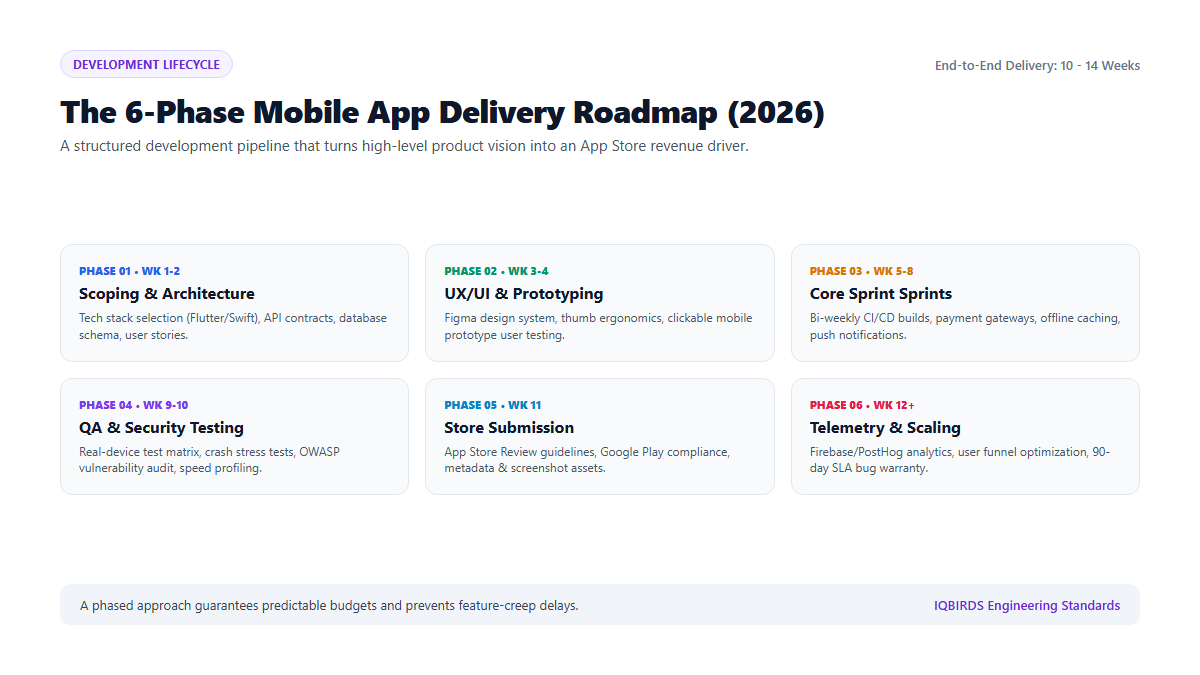
A mature software agency follows a proven, repeatable delivery roadmap that systematically de-risks product development at every phase:
Phase 1: Discovery, Technical Architecture & Scoping (Weeks 1–2)
The discovery phase defines technical feasibility before writing code. The team documents user personas, maps user stories, selects the optimal tech stack (Native vs Flutter/React Native), architectures the database schema, and establishes API contract specifications with your backend engineers.
Phase 2: Ergonomic UX/UI Prototyping & User Testing (Weeks 3–4)
Designers construct a cohesive design system containing typography tokens, atomic components, and dark/light color palettes. A clickable Figma prototype is deployed to test navigation flows and eliminate UX friction points prior to frontend development.
Phase 3: Core Sprint Execution & Continuous Integration (Weeks 5–8)
Frontend mobile engineers and backend API developers build core product features across bi-weekly sprints. Automated CI/CD pipelines compile test builds after every Git push, conducting automated unit tests and distributing fresh builds to stakeholders via Apple TestFlight.
Phase 4: Multi-Device QA, Security & Performance Profiling (Weeks 9–10)
Quality assurance engineers test the application across an exhaustive matrix of physical iOS and Android smartphones and tablets. Testing covers extreme network latency simulation, OS dark mode behavior, biometric auth flows, memory leak profiling, and OWASP security vulnerability scans.
Phase 5: App Store Review & Commercial Deployment (Week 11)
The agency prepares high-converting App Store screenshots, promotional video previews, privacy nutrition labels, and compliance documentation. The app is submitted to the Apple App Store Review team and Google Play Console, with the agency resolving any unexpected metadata queries.
Phase 6: Post-Launch Telemetry, Bug Warranty & Scaling (Week 12+)
Following commercial launch, the team monitors crash telemetry via Crashlytics and PostHog. A 60- to 90-day bug warranty ensures that any edge-case defects discovered by real users are immediately resolved under the agency’s SLA agreement.
10 Critical Questions to Ask During Your Agency Interview
When conducting introductory interviews with prospective mobile partners, bypass generic sales pitches and ask these targeted, technical questions:
- “Who specifically will be writing my code, and can I review their senior engineer profiles?” Ensure you are getting dedicated senior developers rather than junior interns.
- “Which architectural design pattern do you enforce across your mobile codebases?” Listen for Clean Architecture, MVVM, or Bloc/Riverpod modularity.
- “How do you handle offline caching and intermittent data synchronization?” Look for local database syncing rather than basic error dialogs.
- “Do I own 100% of the intellectual property (IP) and Git repositories from Day 1?” The contract must clearly state that all source code, assets, and design files belong exclusively to you.
- “What is your automated testing coverage percentage?” A professional team writes automated unit, integration, and widget tests for all mission-critical workflows.
- “How frequently will I be able to interact with working builds on my own device?” Insist on bi-weekly TestFlight/Internal APK distributions.
- “What happens if our app is rejected during Apple App Store review?” The agency should guarantee resolution of all technical rejection points at no extra cost.
- “How do you manage API contract changes between mobile and backend teams?” Listen for Swagger/OpenAPI documentation and versioned endpoints.
- “What post-launch SLA support is included after the final deployment?” Verify bug-fix warranties and response time commitments for critical production issues.
- “Can you share references from founders whose apps are currently active in the App Store?” Speak directly with past clients about the agency’s communication, deadline adherence, and technical honesty.
Conclusion: Partnering for Long-Term Mobile Growth
Building a successful mobile application is not a one-time transaction; it is an ongoing engineering commitment. The best mobile app development company does not simply take orders and write code—they act as strategic product partners who challenge assumptions, optimize user journeys, and protect your capital through disciplined architecture.
By evaluating candidates against an objective scoring matrix, verifying architectural standards, and demanding radical sprint transparency, you position your mobile venture for rapid market validation, stellar app store ratings, and compounding commercial growth.
Ready to validate your mobile app architecture and scope your development sprint? Explore our end-to-end Mobile App Development Services or contact our engineering team for a technical consultation.
Frequently Asked Questions (FAQ)
What is the typical cost of hiring a mobile app development company?
In 2026, a professional mobile app developed by a specialized agency typically ranges from $35,000 to $85,000 for a focused Minimum Viable Product (MVP), and $90,000 to $200,000+ for a complex enterprise-grade application with real-time syncing, AI workflows, and multi-tier third-party integrations.
Should I choose Flutter, React Native, or Native iOS/Android?
If your budget requires building for both iOS and Android simultaneously with rapid velocity, Flutter and React Native provide exceptional 60fps performance and share up to 90% of business logic. If your product relies on deep hardware integration (e.g., custom Bluetooth LE, advanced ARKit, real-time audio DSP), native Swift (iOS) and Kotlin (Android) remain the gold standard.
How long does it take to develop a custom mobile app from scratch?
A well-architected mobile app MVP typically requires 10 to 14 weeks from initial discovery scoping to public App Store launch. Highly complex platforms with custom backend architectures and enterprise security certifications generally take 16 to 24 weeks.
Who owns the code and intellectual property once the project finishes?
Under standard, reputable agency contracts, you retain 100% ownership of all source code, Git repositories, Figma design assets, databases, and intellectual property. Never sign an agreement where the agency claims partial ownership or charges licensing fees for your core product software.