
AI Automation
Why Marketing Operations Managers Are Automating Time-Consuming Tasks (2026)
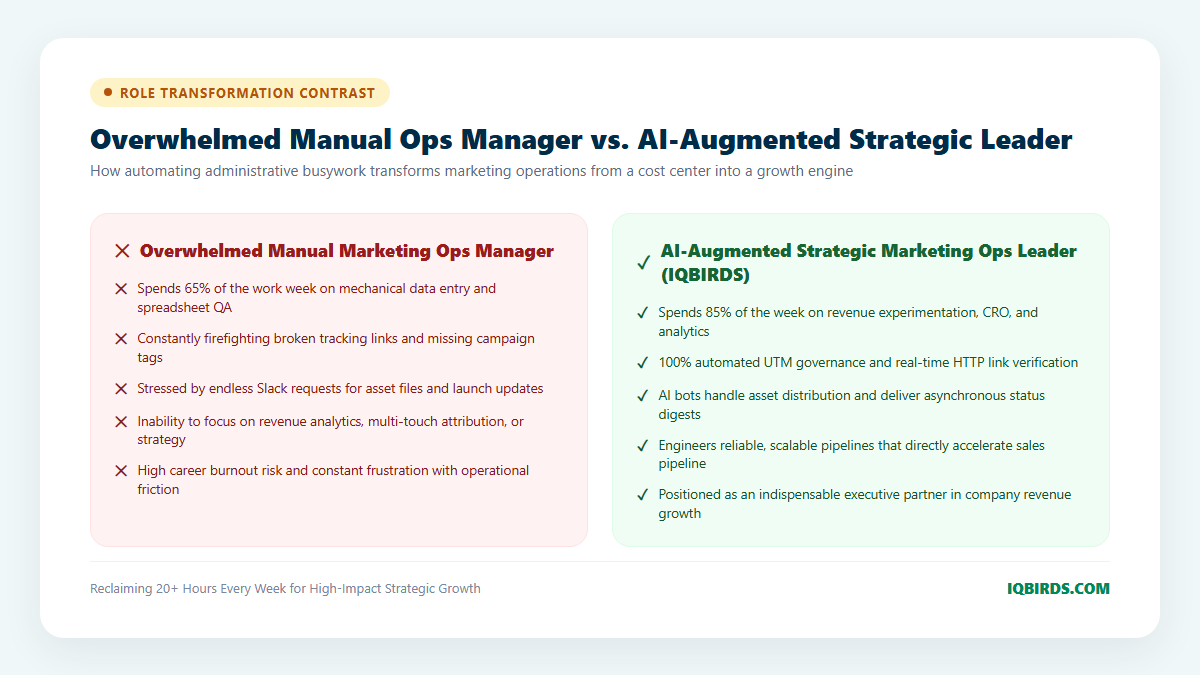
The role of the Marketing Operations (MOPs) Manager has quietly become one of the most critical—and most overwhelmed—positions in the modern enterprise. As companies deploy increasingly complex tech stacks across ad networks, CRM platforms, email marketing engines, and customer data platforms, the MOPs manager is expected to maintain pristine data integrity while supporting dozens of simultaneous campaign launches. Yet industry research reveals that the average marketing operations professional spends less than 35% of their working week on strategic optimization. The remaining 65% is swallowed by tedious, soul-crushing administrative busywork: building UTM links, deduplicating webinar CSVs, chasing creative approvals, and reformatting banners. In 2026, leading professionals are transforming their careers by mastering marketing operations manager time consuming tasks ai automation.
By delegating mechanical data plumbing, asset rendering, and SLA alerting to intelligent autonomous workflows, marketing operations leaders reclaim 15 to 25 hours every week. This fundamental shift allows MOPs teams to transition from overworked tactical firefighters into high-leverage growth architects who drive revenue experimentation and multi-touch attribution. In this comprehensive guide, we unpack the top time-consuming tasks being automated, the underlying technology architecture, and a 7-step blueprint to automate your weekly marketing operations workload.

The 4 Biggest Time-Sinks in Marketing Operations (And How AI Solves Them)
High-growth marketing operations teams do not attempt to automate everything at once. They systematically target the four highest-friction administrative workflows that consume the most manual hours:
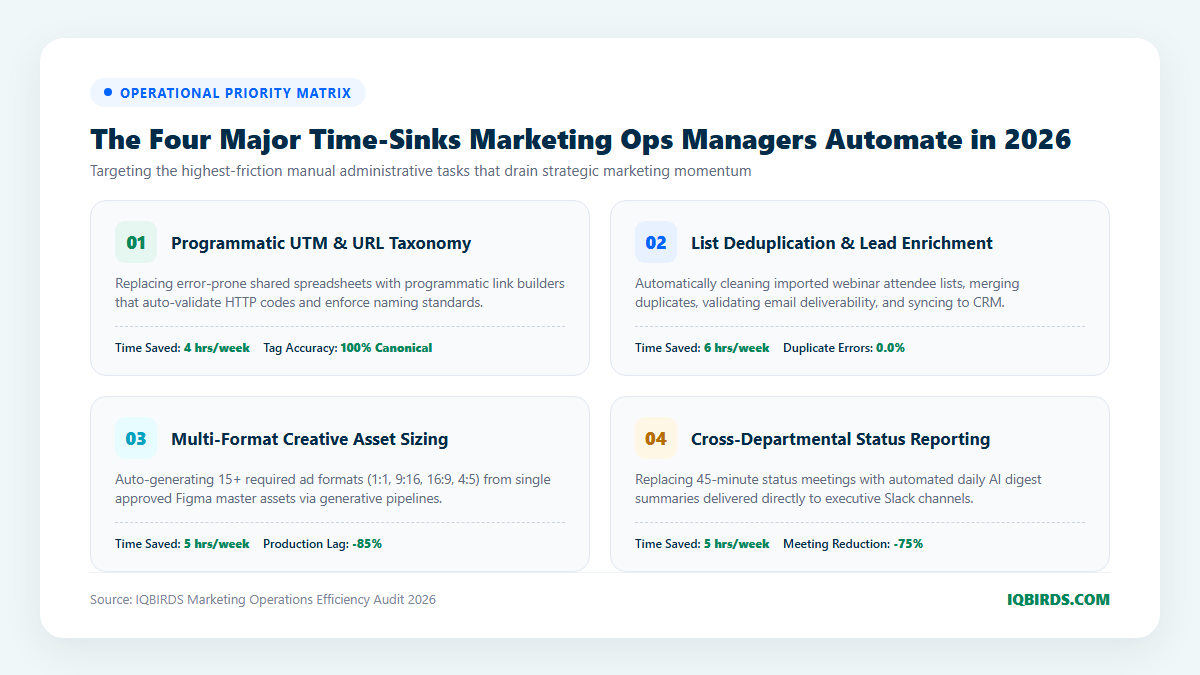
1. Programmatic UTM & Link Taxonomy Governance
Tracking attribution accurately across dozens of paid and organic channels requires consistent URL tagging. In traditional setups, MOPs managers maintain a massive Google Sheet where marketing team members paste links and manually select UTM parameters. This manual system inevitably breaks down: typos proliferate, campaign names deviate from naming conventions, and attribution models in Google Analytics 4 become corrupted.
With programmatic UTM automation integrated via AI marketing automation services, the spreadsheet is eliminated. Marketers create campaign tracking links through an automated Slack bot or browser extension. The automation validates canonical parameters, verifies that the destination URL returns an HTTP 200 status code (preventing broken 404 links), creates the shortened tracking link, and registers the campaign record in your analytics database automatically.
2. List Deduplication, Data Cleansing, & CRM Enrichment
Following a successful webinar, conference, or co-marketing campaign, MOPs managers are handed CSV spreadsheets containing thousands of attendee records. Manually formatting column headers, identifying duplicates, verifying active email deliverability, and mapping records to existing CRM accounts takes hours of tedious spreadsheet work.
Modern automated ingestion pipelines connect cloud upload folders directly to enrichment APIs. When a new attendee CSV is dropped into Google Drive, background workers automatically deduplicate contacts against your CRM, scrub emails against ZeroBounce, enrich missing job titles and company revenues via Apollo or Clay, and push clean records into custom AI CRM systems in seconds.
3. Multi-Format Creative Asset Sizing
Marketing operations managers frequently spend hours coordinating with graphic designers to generate 15 different aspect ratios for a single ad campaign: 1:1 square feeds, 9:16 vertical stories, 16:9 widescreen video banners, and 4:5 mobile carousels.
By connecting creative webhooks to generative image processing pipelines, designers approve a single master Figma asset, and background AI workers automatically generate all required ad aspect ratios, reposition focal points, and deposit production-ready assets into organized campaign folders with canonical file naming conventions.
4. Cross-Departmental Status Reporting & Standups
MOPs managers spend an average of 4 to 6 hours every week compiling status reports for executive leadership and answering repetitive Slack messages asking “What’s the status of the Q2 webinar campaign?”.
Automated digest bots connect Jira, Asana, and ad platforms, generating a concise, natural language daily digest summary posted directly to executive Slack or Microsoft Teams channels every morning. Leadership receives instant visibility into launched campaigns, pending approvals, and active blockers without interrupting the MOPs manager’s focused work.
Manual Marketing Ops Manager vs. AI-Augmented Strategic Leader
Compare the day-to-day operational reality of managing marketing operations manually versus deploying an intelligent AI task automation engine:
7-Step Roadmap: Automating Marketing Ops Tasks in 2026
Transitioning from manual marketing ops management to an automated engine requires a phased deployment approach. Follow this 7-step blueprint:
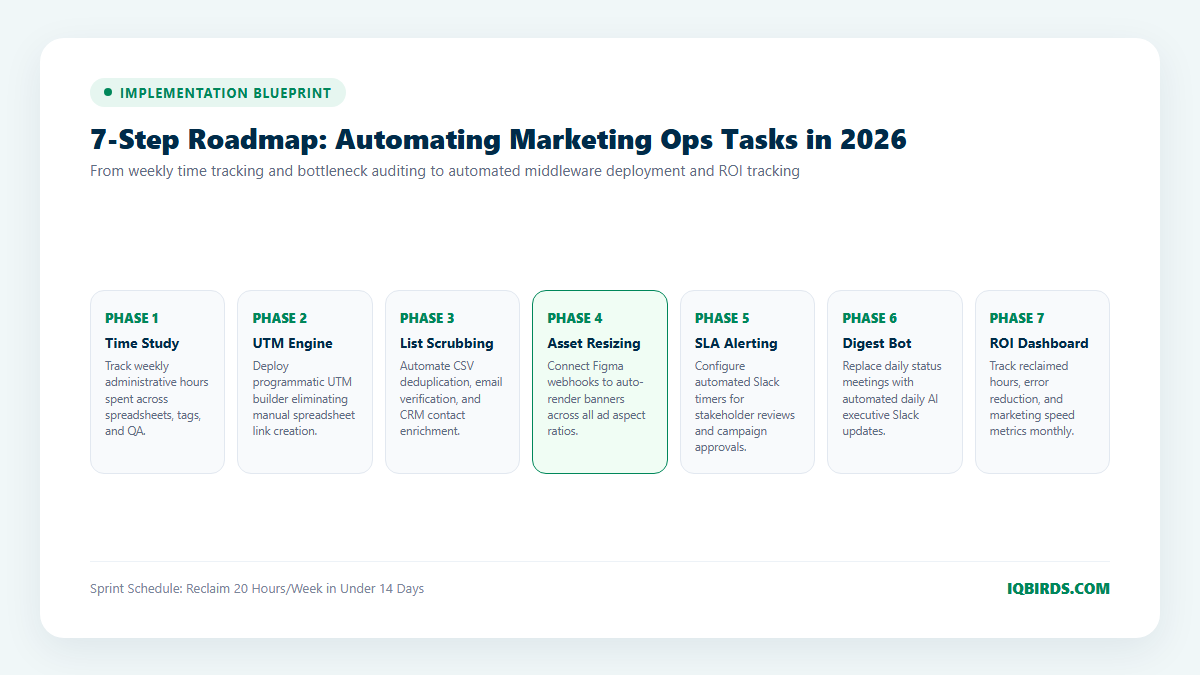
Step 1: Conduct a Weekly Administrative Time Study
Log all tasks performed over a two-week period. Categorize every activity into “Strategic Revenue Driver” (attribution modeling, funnel testing, budget optimization) vs “Mechanical Administrative Task” (UTM creation, list formatting, approval chasing).
Step 2: Deploy Programmatic UTM & Link Governance
Retire manual spreadsheets. Build an automated link creation workflow in Slack or Make.com that enforces strict naming conventions and verifies destination URLs before links are approved for media spend.
Step 3: Automate Lead List Cleansing & Enrichment
Configure automated CSV ingestion pipelines. Connect Google Drive or Dropbox to enrichment APIs (Clay, Apollo, ZeroBounce) that scrub and map attendee data into your CRM automatically.
Step 4: Establish Creative Asset Resizing Pipelines
Set up automated creative export pipelines that convert approved master Figma designs into required ad dimensions, saving hours of designer and MOPs coordination time.
Step 5: Configure SLA Approval Alerts
Set up automated reminders in Slack or Teams for legal, compliance, and executive reviews. If a stakeholder does not approve a brief within 24 hours, the system gently escalates the ticket to keep launch dates secure.
Step 6: Deploy Asynchronous Executive Digest Bots
Replace daily status meetings with automated daily AI digest summaries delivered to executive channels every morning, providing full transparency without meeting fatigue.
Step 7: Track Reclaimed Hours & Attribution Accuracy
Review operational metrics monthly: quantify hours reclaimed, track reduction in attribution discrepancies, and document improvements in campaign launch speed.
Connecting Marketing Operations to Scalable Revenue Infrastructure
Automating marketing operations unlocks massive leverage across the entire commercial organization. When marketing data flows flawlessly into your sales CRM through system integration services and AI automation workflows, lead conversion velocity accelerates, customer acquisition costs plummet, and your company scales predictably.
Frequently Asked Questions
Will automating these tasks make the MOPs role obsolete?
Not at all. In fact, automation elevates the MOPs manager from an administrative coordinator into an indispensable strategic growth leader. By eliminating repetitive mechanical tasks, MOPs professionals focus on high-value analytics, customer journey optimization, and revenue attribution modeling.
How long does it take to deploy these marketing ops automations?
Most core automations—such as programmatic UTM governance, automated CSV list scrubbing, and executive Slack digests—can be architected and deployed in 10 to 14 business days without interrupting active marketing campaigns.
What software is typically used to build these workflows?
Modern marketing ops automation utilizes open middleware like n8n or Make.com, connected via REST APIs and webhooks to tools like Slack, Figma, HubSpot, Google Analytics 4, and ZeroBounce.
How can IQBIRDS help automate our marketing operations?
At IQBIRDS, we design, integrate, and maintain enterprise marketing operations automation systems. We eliminate administrative busywork, build programmatic UTM engines, automate creative asset pipelines, and engineer seamless CRM sync workflows that allow marketing teams to ship campaigns faster and with 100% data accuracy. Schedule a technical consultation with IQBIRDS today to audit your marketing operations workflow and reclaim your team’s time.