
AI Automation
Measuring Business Growth After AI Implementation
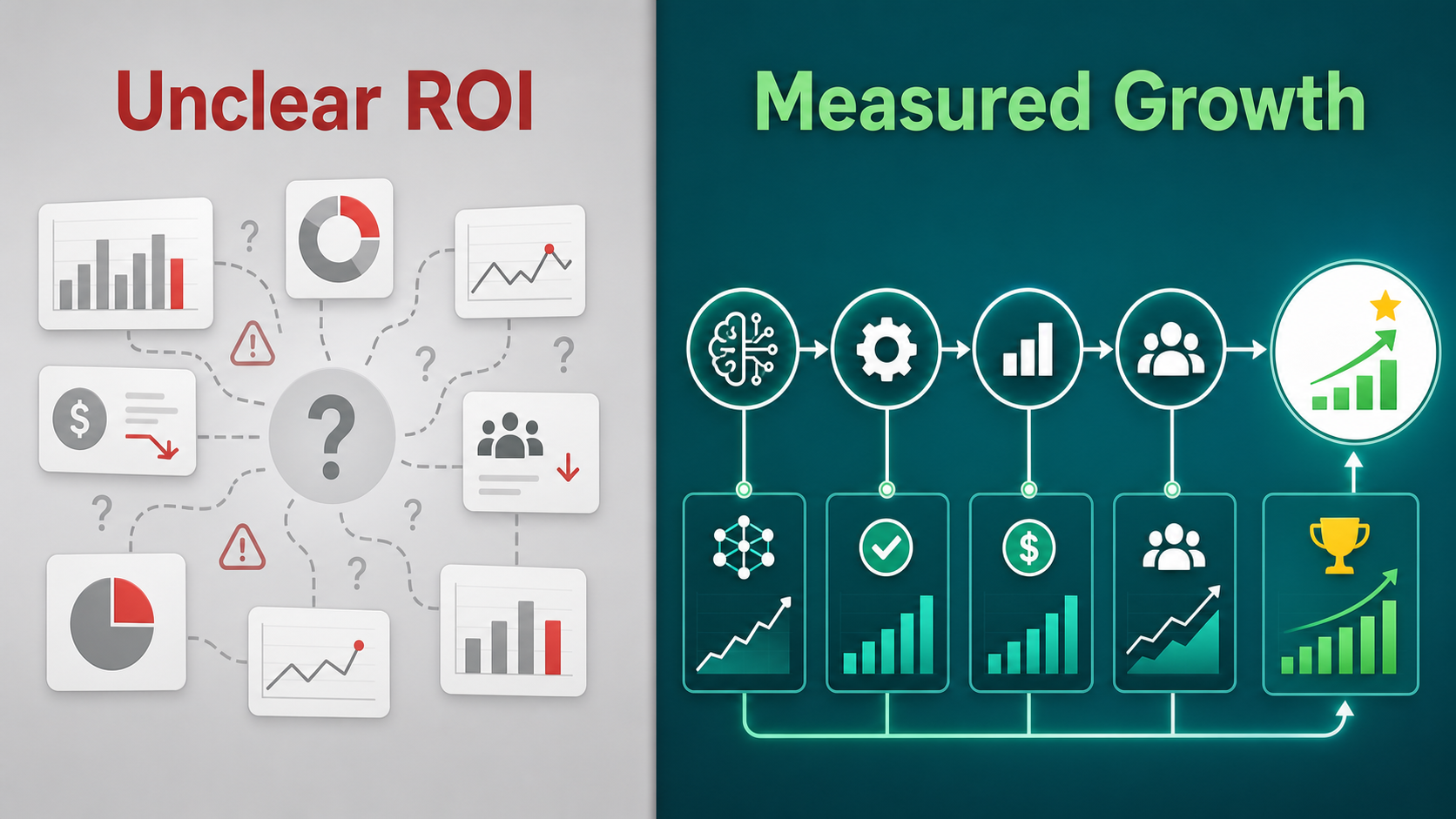
AI can make a business faster, cleaner, and easier to manage. However, the real question comes after launch: did the company actually grow because of it? That is where AI implementation ROI becomes important. It turns a broad technology project into a measurable business decision.
Many teams install AI tools and feel progress quickly. Leads are answered faster. Staff spend less time copying data. Reports look sharper. Still, business growth should be measured with more than a good feeling. After AI implementation, leaders need to compare what changed in revenue, cost, productivity, customer experience, and team capacity.

What Business Growth Means After AI Implementation
Business growth after AI implementation is not only about higher sales. It can also mean faster deal movement, better lead quality, stronger retention, fewer manual errors, lower support pressure, and more work completed without adding headcount. In practice, the strongest AI projects usually improve several of these areas at the same time.
For example, an AI lead response workflow may increase conversion because prospects receive faster replies. At the same time, it may reduce admin work because the CRM is updated automatically. Therefore, the ROI is not limited to one number. It includes both direct gains and operational savings.
Before measuring growth, define what success looks like for the workflow. A sales workflow may focus on booked calls and closed revenue. A support workflow may focus on response time and ticket volume per agent. Meanwhile, an operations workflow may focus on hours saved, process accuracy, or faster reporting.
Why AI Implementation ROI Needs a Baseline
You cannot prove improvement if you do not know the starting point. Because of that, the baseline is the most important part of measuring AI implementation ROI. It shows how the business performed before automation, assistants, AI workflows, or AI-powered CRM changes were introduced.
A useful baseline should include a short list of numbers that already matter to the business. These numbers may include monthly leads, call bookings, close rate, average response time, customer churn, manual hours, campaign cost, support backlog, or revenue per employee. Also, the baseline should include the period being compared, such as the previous 30, 60, or 90 days.
Without a baseline, AI results become difficult to explain. One month may look strong because demand was already rising. Another month may look weak because of seasonality. However, when the baseline is clear, leaders can separate normal business movement from the effect of the AI implementation.
The Metrics That Matter Most
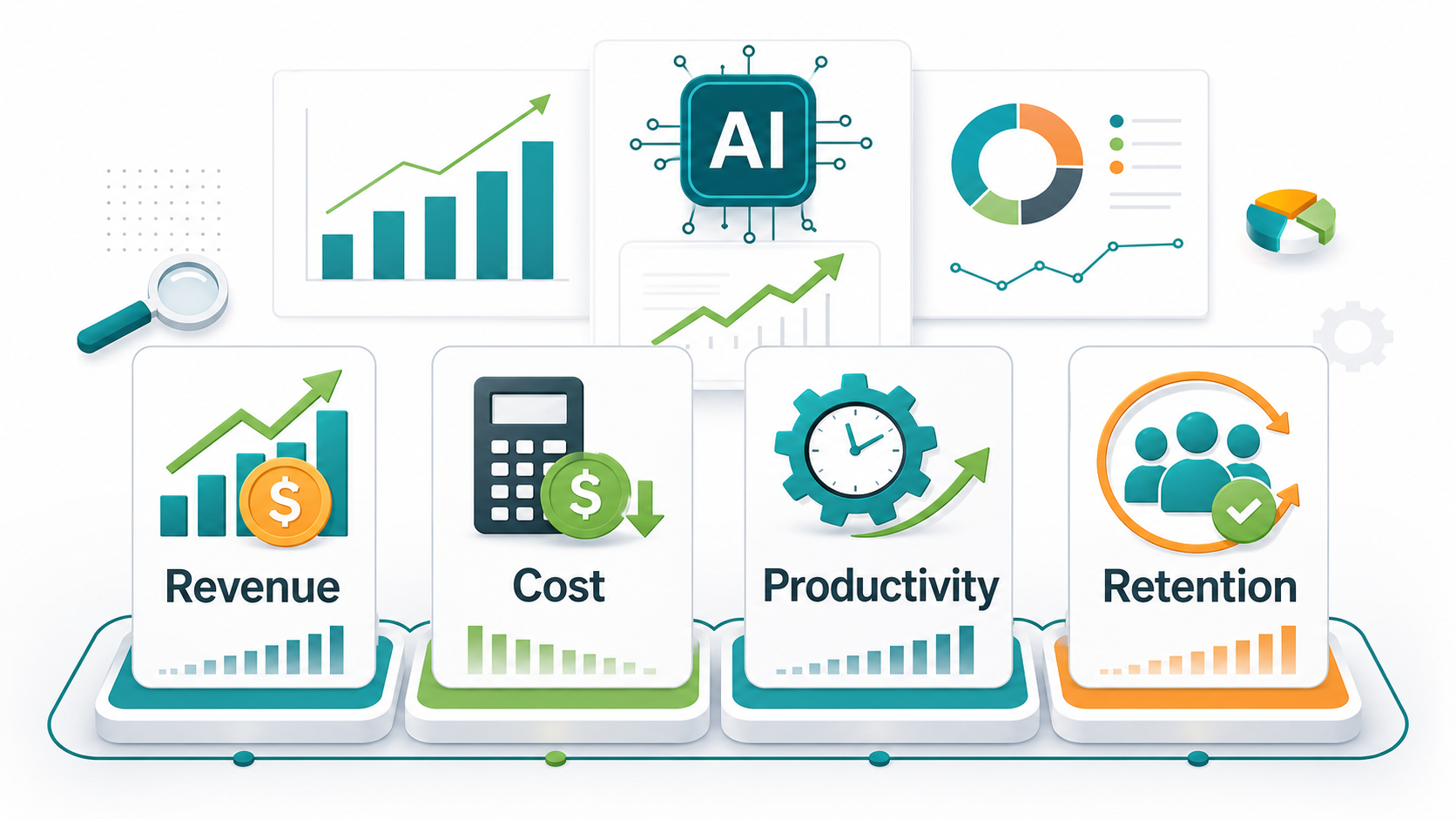
The best growth metrics depend on the business model. Still, most companies can start with four categories: revenue, cost, productivity, and customer retention. Together, these categories give a balanced view of AI performance. They also stop teams from measuring only activity, such as how many prompts were used or how many automations ran.
Revenue Metrics
Revenue metrics show whether AI helped the business win more work or sell more efficiently. Track qualified leads, booked calls, pipeline value, sales cycle length, close rate, average order value, and upsell revenue. If AI is used in marketing or sales, these numbers usually tell the clearest story.
Cost and Efficiency Metrics
Cost metrics show whether the business is doing the same work with less waste. Track manual hours saved, admin work reduced, duplicate data removed, fewer missed follow-ups, fewer rework cycles, and lower support handling cost. Also, calculate the cost of software, setup, maintenance, and training so the ROI stays honest.
Productivity Metrics
Productivity metrics show whether teams can complete more valuable work in the same amount of time. For example, a service team might handle more requests without hiring. A sales team might spend more time speaking with serious prospects instead of organizing spreadsheets. As a result, productivity becomes a growth lever, not just an internal efficiency win.
Customer Experience Metrics
Customer experience metrics show whether AI improves the journey for real people. Track first response time, resolution time, satisfaction scores, repeat purchase rate, retention, review quality, and complaint volume. These signals matter because AI that saves time but frustrates customers can damage growth over time.
AI Implementation ROI: What to Measure
| Growth Area | Before AI Implementation | After AI Implementation | Best ROI Signal |
|---|---|---|---|
| Lead response | Manual replies depend on staff availability | AI routes, drafts, and triggers faster follow-up | More booked calls from the same lead volume |
| CRM quality | Records are incomplete or updated late | Fields, notes, and tasks are cleaned automatically | Higher sales visibility and fewer missed deals |
| Customer support | Teams repeat answers and sort tickets manually | AI classifies, summarizes, and suggests replies | Lower response time and better resolution rate |
| Reporting | Reports are created by copying data between tools | Dashboards refresh from connected systems | Faster decisions with less reporting labor |
| Operations | Workflows rely on reminders and manual checks | AI monitors steps and flags exceptions | More completed work without extra headcount |
This table shows a simple idea: AI implementation ROI becomes easier to measure when each workflow has a before state, an after state, and a business signal. Instead of asking whether AI is useful in general, leaders can ask whether a specific workflow created more revenue, saved more time, improved accuracy, or protected customer relationships.
Use Trusted Benchmarks, But Measure Your Own Results
Industry research can help leaders set expectations. For example, McKinsey research on the state of AI shows that companies are continuing to expand AI use across business functions. Meanwhile, Deloitte has highlighted the gap between rising AI investment and elusive returns, which is exactly why measurement discipline matters.
Still, external benchmarks cannot replace your own data. A small local service business, a growing agency, and a multi-location company may all use AI differently. Therefore, the better approach is to combine practical benchmarks with your internal CRM, sales, support, and operations numbers.
If you need help connecting these systems, IQBIRDS offers AI automation services, AI integration services, and AI CRM development for businesses that want measurable workflows instead of disconnected tools. Also, related guides like AI workflows that deliver ROI in under 90 days and from contact form to customer using AI show how measurement works inside real customer journeys.
For broader context, Microsoft’s 2025 Work Trend Index discusses how AI is changing work structure, while IBM explains intelligent automation as a way to connect AI with process improvement. These references are useful, but the final proof should come from your own growth dashboard.
Step-by-Step Guide to Measuring Growth After AI
1. Choose One Workflow First
Start with one workflow instead of measuring the whole business at once. For example, choose lead intake, customer support, proposal follow-up, invoice reminders, or CRM cleanup. This keeps the measurement simple and gives the team a clear area to improve.
2. Record the Baseline
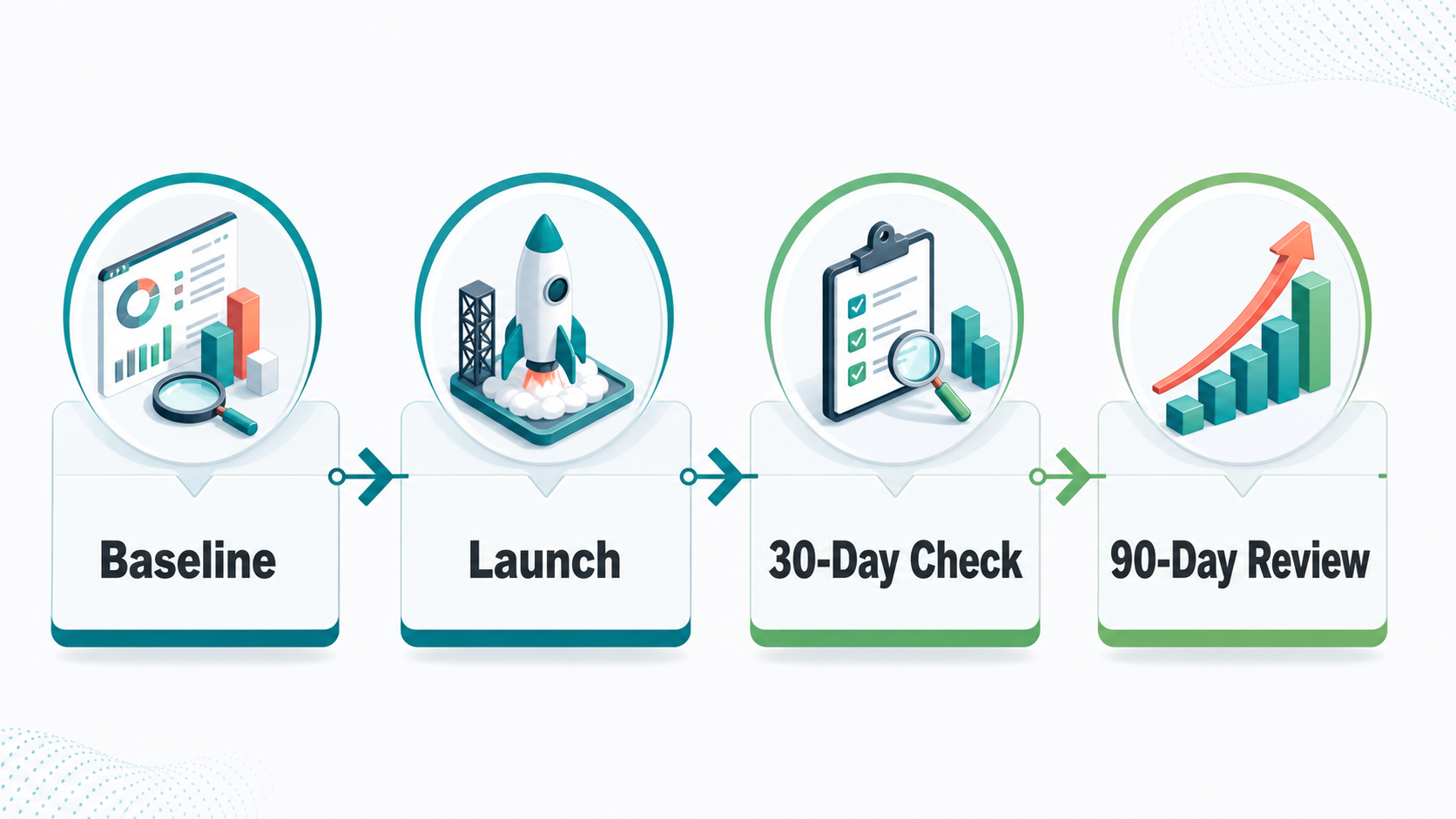
Next, capture the current numbers before AI changes the workflow. Use recent data from the last 30 to 90 days. Also, include qualitative notes, such as where staff lose time or where customers wait too long. These notes help explain the numbers later.
3. Define the ROI Formula
Then, decide how ROI will be calculated. A simple formula is gains minus cost, divided by cost. Gains may include new revenue, saved labor hours, reduced errors, or improved retention. Costs should include setup, tools, maintenance, training, and any human review time.
4. Connect the Data Sources
After that, connect the systems that hold the truth. This may include your CRM, website forms, calendar, help desk, payment tool, email platform, and reporting dashboard. When these systems stay disconnected, AI implementation ROI becomes harder to prove.
5. Review Results at 30, 60, and 90 Days
Once the workflow is live, review the numbers at regular points. A 30-day review catches broken steps early. A 60-day review shows whether the team is adopting the process. Finally, a 90-day review gives enough data to see whether growth is becoming consistent.
6. Compare Outcomes, Not Just Activity
Do not stop at activity metrics. More automated messages, more summaries, or more AI-generated drafts do not automatically mean growth. Instead, compare outcomes such as qualified meetings, conversion rate, faster response time, lower backlog, reduced admin hours, and better retention.
7. Improve the Workflow Based on Evidence
Finally, use the data to improve the workflow. If response time improved but close rate stayed flat, the issue may be lead quality or messaging. If labor hours dropped but errors increased, add a human approval step. Measurement should guide better decisions, not just produce a report.
Key Benefits of Measuring AI Implementation ROI
- Clear proof that AI is improving business growth, not only creating activity
- Better decisions about which workflows deserve more investment
- Stronger team confidence because results are visible
- Lower risk of wasting money on tools that do not improve outcomes
- Cleaner CRM, sales, support, and operations reporting
- Faster identification of broken processes after launch
- More accurate conversations with leadership about budget and scaling
- A practical way to compare AI projects against other business priorities
Most importantly, ROI measurement helps the business move from experimentation to execution. Once leaders know what is working, they can scale the right systems with more confidence.
Common Mistakes to Avoid
Measuring Too Late
Some businesses start measuring after the AI system has already been live for months. By then, the baseline is unclear. Avoid this by recording key metrics before launch, even if the first version is simple.
Tracking Vanity Metrics
Another common mistake is tracking usage instead of impact. AI usage matters, but it should connect to outcomes. Therefore, pair activity metrics with revenue, customer, efficiency, or quality metrics.
Ignoring Data Quality
If CRM records are messy, ROI reporting will be messy too. Before judging AI performance, clean key fields, standardize stages, remove duplicates, and make sure teams understand how data should be entered.
Removing Human Review Too Early
AI can speed up work, but early workflows often need review. In sensitive sales, support, finance, or customer communication tasks, human approval protects quality while the system improves.
Comparing the Wrong Time Periods
Seasonality can make results look better or worse than they are. For this reason, compare similar periods when possible. Also, note campaign changes, pricing changes, staffing changes, and market shifts that may affect the numbers.
How IQBIRDS Helps Your Business
IQBIRDS helps businesses measure and improve AI implementation ROI by connecting strategy, automation, CRM, and reporting. The goal is not to add AI for appearance. The goal is to build workflows that create visible business growth.
First, IQBIRDS maps the workflow and identifies the metrics that matter. Then, the team designs AI automations, CRM updates, integrations, approval steps, and dashboards around those metrics. As a result, the business can see how AI affects leads, sales, customer response, retention, and team productivity.
IQBIRDS can support lead management, AI CRM development, workflow automation, customer journey automation, internal reporting, and tool integration. Also, the implementation can include human approval rules so automation improves speed without losing control.
Frequently Asked Questions
What is AI implementation ROI?
AI implementation ROI measures the business value created after launching AI compared with the cost of building, running, and maintaining it. It can include revenue gains, cost savings, time saved, better retention, and improved productivity.
How soon can a business measure AI ROI?
A business can start measuring immediately if it has a baseline. However, many workflows need 30 to 90 days of usage before the results are reliable enough for decision-making.
Which metrics show business growth after AI implementation?
Useful metrics include qualified leads, booked calls, close rate, sales cycle length, response time, support backlog, manual hours saved, customer retention, average order value, and revenue per employee.
Why do some AI projects fail to show ROI?
Some AI projects fail to show ROI because the workflow is unclear, the data is poor, the wrong metrics are tracked, or the tool is not connected to real business outcomes. Also, many teams skip baseline measurement.
Should AI ROI include time saved?
Yes. Time saved should be included when it creates business value. For example, saved time may allow staff to handle more customers, follow up faster, reduce overtime, or focus on higher-value work.
How can small businesses measure AI implementation ROI?
Small businesses can start with a simple spreadsheet or dashboard. Track the baseline, launch date, cost, hours saved, leads, sales, response time, and customer outcomes. Then, review the changes every month.
How can IQBIRDS help my business?
IQBIRDS can help your business map workflows, build AI automations, connect tools, improve CRM data, create dashboards, add human approval steps, and measure ROI after implementation.
Conclusion
Measuring business growth after AI implementation is about clarity. AI should not be judged only by excitement, usage, or the number of tools added. It should be judged by the business results it improves.
Start with a baseline. Choose meaningful metrics. Compare results over time. Then, improve the workflow based on evidence. When AI implementation ROI is measured this way, leaders can see what is working, stop what is not working, and scale the workflows that truly support growth.
If your business wants AI systems that are built around measurable growth, contact IQBIRDS. The right AI implementation can help your team save time, serve customers faster, and turn daily workflows into stronger business results.
Need AI Automation?
Discover how IQBirds helps businesses automate workflows and build custom digital products.