
AI Search
Why AI Search Is Reshaping Business Websites
AI search is changing how people discover, compare, and choose businesses online. A customer no longer has to click ten blue links, read every page, and build the answer alone. Increasingly, search engines and AI assistants summarize options, compare services, cite sources, and guide users toward the next step.
That shift is reshaping business websites. A website can no longer be only a digital brochure with attractive sections and generic service copy. It needs to answer real questions clearly, prove expertise, show trust signals, use structured content, and make it easy for both people and AI systems to understand what the business does. Therefore, AI search is not just an SEO trend. It is a website strategy issue.

What AI Search Means for Business Websites
Traditional search usually sends users to a list of pages. AI search tries to answer the question directly, often with supporting links or cited sources. In Google, that can mean AI Overviews or AI Mode. Bing may show Copilot Search or generative search layouts. ChatGPT search may provide a conversational answer with linked sources. Each experience is different, but the direction is similar.
Instead of asking only, “Can we rank for this keyword?” businesses now need to ask, “Can an AI system understand, trust, and cite this page when a customer asks a buying question?” That is a different standard. It rewards clear answers, topical depth, structured pages, crawlable content, and proof that the business is real, relevant, and trustworthy.
This does not mean old SEO is dead. Good SEO still matters. However, AI search raises the bar because the website must support answers, not just rankings. If your service page is vague, thin, slow, hidden behind scripts, or missing clear proof, it becomes harder for both search engines and customers to understand why your business should be selected.
Why AI Search Is Reshaping Website Strategy
1. Search Is Becoming More Conversational
People are asking longer, more specific questions. Instead of searching “CRM automation,” they may ask, “What is the best way for a local service business to automate lead follow-up without hiring more admin staff?” AI search is built for these detailed questions, so websites need content that answers them directly.
As a result, short keyword pages are not enough. Businesses need pages that explain problems, options, trade-offs, examples, pricing factors, use cases, and next steps. In practice, the best content sounds like a helpful consultant, not a keyword list.
2. AI Search Looks for Clear, Useful Answers
AI systems work best when content is easy to interpret. A page with clear headings, direct explanations, FAQs, examples, and visible text is easier to understand than a page that hides important details inside images or vague marketing claims. Therefore, business websites need to become more answer-focused.
This is especially important for service businesses. Customers want to know what you do, who you help, what problems you solve, how your process works, and why they should trust you. If those answers are scattered or unclear, AI search may rely on another source that explains the topic better.

3. Citations and Source Trust Matter More
AI search experiences often show links, citations, or source cards. This means the website is not only competing for a classic ranking position. It is also competing to become a trusted source used inside an AI-generated answer. That makes credibility more visible.
Trust signals can include detailed service pages, case examples, author or company expertise, reviews, location information, contact details, updated content, and consistent business information across the web. Meanwhile, claims should be specific. “We help businesses grow” is weaker than a page that explains exactly how you improve lead response, CRM data, customer support, or appointment booking.
4. Crawlability Is Becoming a Business Risk
If search engines and AI crawlers cannot access your important pages, your content may not be eligible for discovery, snippets, citations, or summaries. That includes problems with robots.txt, noindex tags, blocked scripts, firewalls, bot protection, login walls, slow pages, or content that only appears after complex interaction.
For this reason, technical SEO is becoming more strategic. It is no longer just a developer checklist. It affects whether AI-powered discovery systems can see the content that explains your business.
What Official Search Guidance Says
Google’s official guidance is useful here. Google Search Central says the same foundational SEO best practices still matter for AI features, including crawlability, internal links, people-first content, page experience, visible text, high-quality media, structured data that matches the page, and accurate business information. In other words, AI search does not remove SEO. It makes the fundamentals more important.
Google’s newer guide on optimizing for generative AI features also explains that AI search can rely on retrieval-augmented generation, where current pages from the search index help ground responses. Meanwhile, OpenAI’s publisher FAQ explains that public websites can appear in ChatGPT search and that OAI-SearchBot access can affect whether content is discovered, cited, and linked. Microsoft has also described grounding as a critical layer of the AI web, connecting AI answers to current, authoritative information.
For business owners, the lesson is simple. The website must be crawlable, clear, useful, and trustworthy. It should answer customer questions in plain language while supporting those answers with structure, proof, and conversion paths.
Traditional SEO Website vs AI Search Ready Website
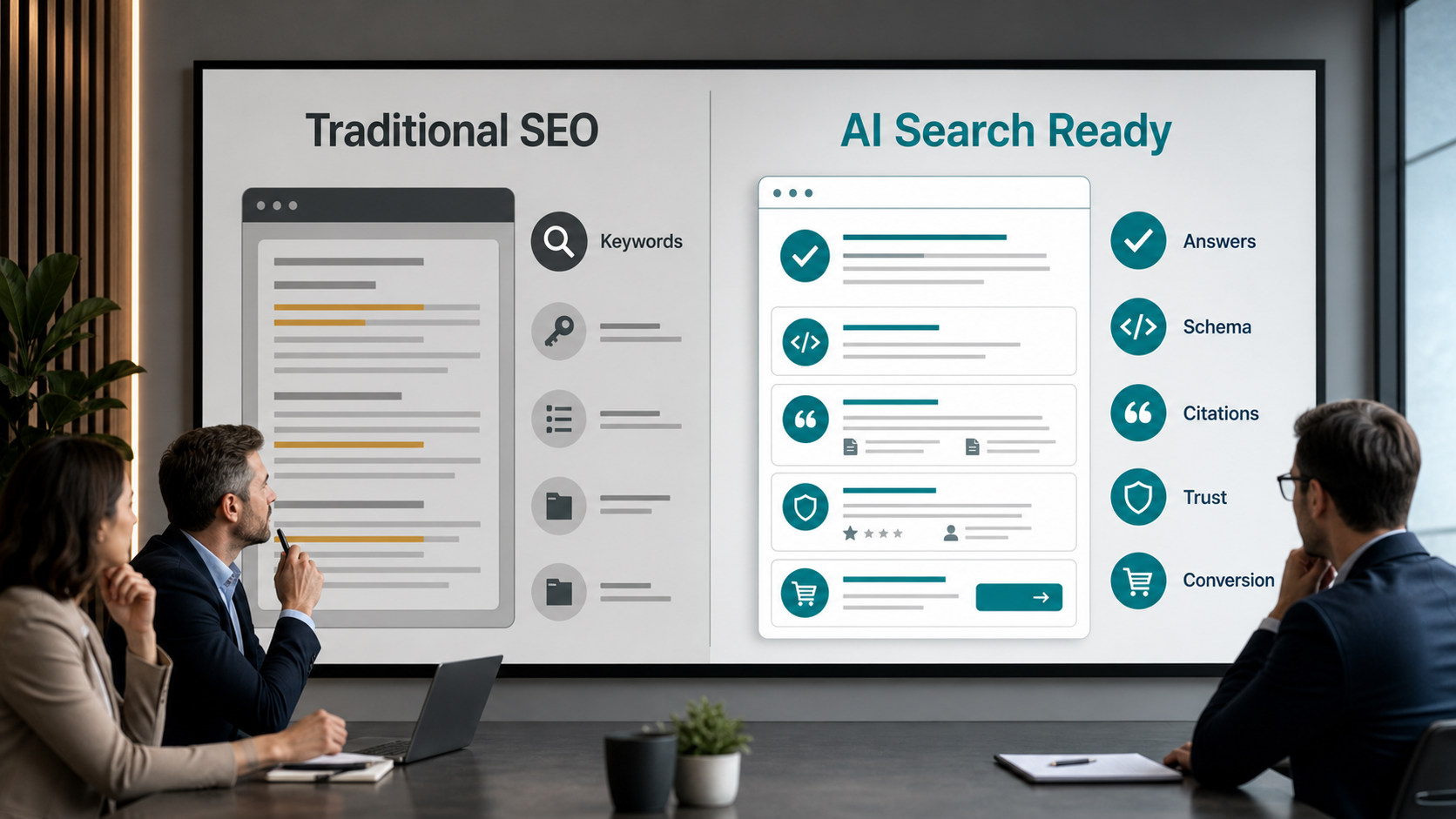
| Website area | Traditional SEO approach | AI search ready approach |
|---|---|---|
| Content | Targets keywords and basic service descriptions | Answers real customer questions with depth and examples |
| Page structure | Uses headings mainly for layout | Uses headings to make meaning and subtopics clear |
| Trust signals | Adds a few testimonials or badges | Shows reviews, proof, expertise, location, process, and outcomes |
| Technical access | Checks only basic indexing | Reviews crawlability, snippets, schema, speed, and bot access |
| Internal links | Links mostly from menus and footers | Connects related service pages, FAQs, guides, and conversion pages |
| Conversion | Uses one contact button across the site | Matches CTAs to search intent, service need, and journey stage |
This table shows why AI search readiness is broader than adding more keywords. A business website needs content that can be retrieved, understood, trusted, and used inside an answer. At the same time, the page still needs to help real visitors take action after they arrive.
Where Business Websites Should Focus First
The first priority is service clarity. If your website does not explain what you offer, who it is for, where you serve, and what outcome customers can expect, AI search will have a weaker understanding of your business. A strong service page should answer the questions a serious buyer would ask before contacting you.
The second priority is the customer journey. Services like AI automation services, AI integration services, and AI CRM development become more powerful when the website routes search visitors into helpful workflows. For example, a visitor who asks about automation should find a clear guide, a relevant service page, a simple contact path, and follow-up that captures the right context.
The third priority is content depth. Related guides such as AI customer experience and contact form to customer workflows help build topical coverage around how customers search, compare, and take action. Because AI search often works across subtopics, connected content can help the whole website become easier to interpret.
Step-by-Step Guide to Prepare Your Website for AI Search
Step 1: List the Questions Buyers Actually Ask
Start by collecting questions from sales calls, contact forms, chat messages, support tickets, reviews, and consultations. These questions reveal how customers think before they buy. Then group them by service, problem, urgency, and decision stage.
Step 2: Build Pages Around Clear Answers
Next, create or improve pages that answer those questions directly. Each page should explain the problem, the solution, the process, common concerns, examples, and the next step. Avoid hiding the answer behind vague slogans or decorative sections.
Step 3: Add Structured Data Where It Fits
Structured data helps search systems understand visible content, but it should match what users can actually read on the page. Use schema for articles, FAQs, services, local business details, breadcrumbs, reviews where appropriate, and organization information. However, do not treat schema as a shortcut for weak content.
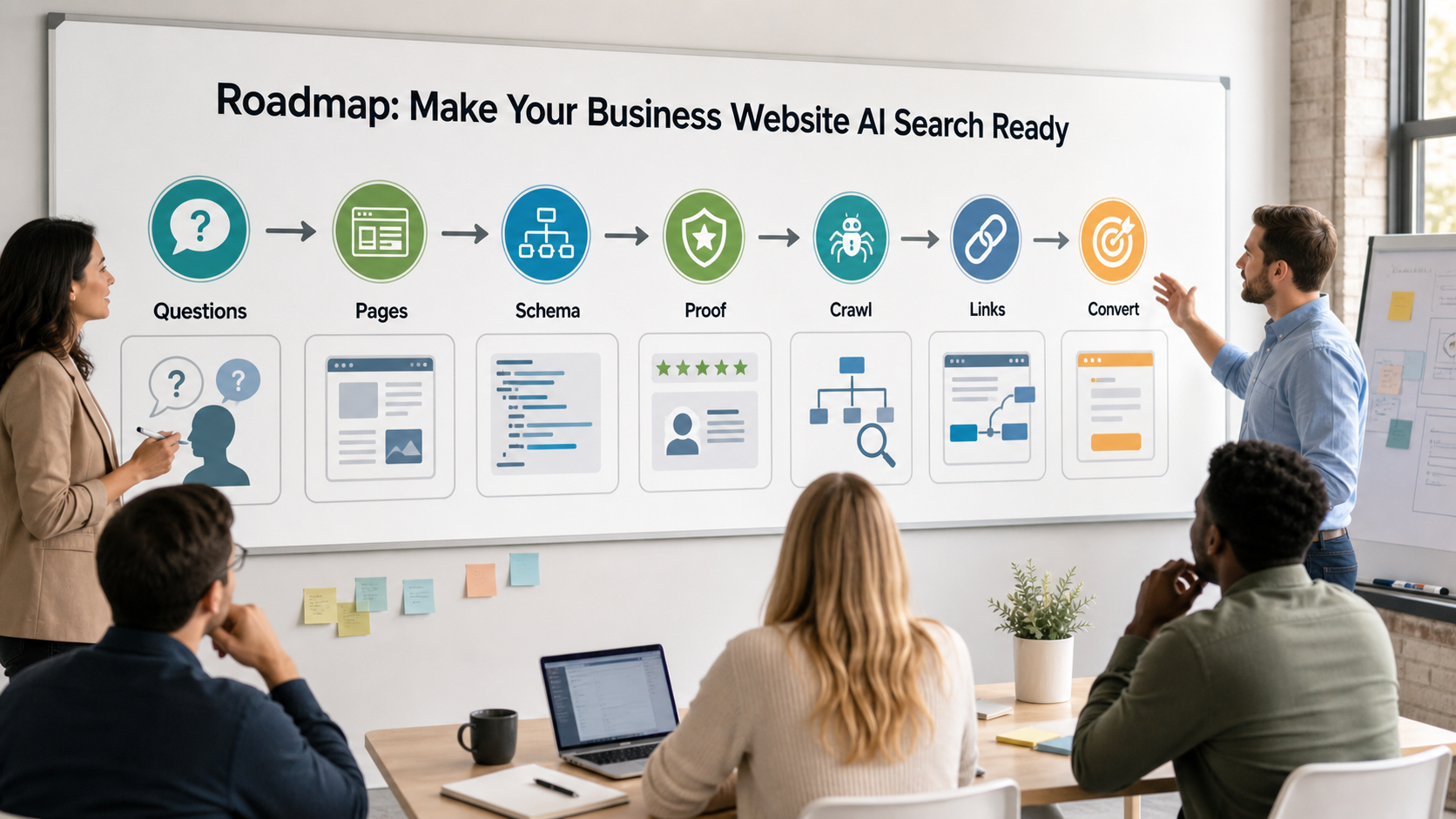
Step 4: Strengthen Trust Signals
After that, make your expertise easier to verify. Add detailed case examples, team or company background, service process, reviews, location information, contact details, and clear policies. Trust signals help both visitors and search systems understand that the business is credible.
Step 5: Review Crawlability and Indexing
Check whether important pages are indexable, load quickly, use visible text, and are not blocked by robots.txt, noindex tags, login walls, or security settings. Also review whether relevant AI and search crawlers can access public pages you want discovered.
Step 6: Improve Internal Links
Connect service pages, blog guides, FAQs, case examples, and contact pages naturally. Internal links help users move through the journey. They also help search systems understand how topics connect across the website.
Step 7: Track Conversions, Not Only Traffic
Finally, measure form submissions, calls, booked meetings, qualified leads, customer questions, and assisted conversions. AI search may change traffic patterns, so conversion quality matters more than raw visit counts alone.
Key Benefits of an AI Search Ready Website
- Better visibility for conversational and complex customer questions
- More useful service pages that help visitors decide faster
- Stronger chances of being cited or linked in AI search experiences
- Clearer website structure for users, search engines, and AI systems
- Improved trust through proof, expertise, reviews, and accurate business details
- Better conversion paths from discovery to contact or booking
These benefits matter because AI search can influence the buyer before they ever land on your website. If your content helps shape the answer, your business has a better chance of being remembered, compared, clicked, and contacted.
Common Mistakes to Avoid
The first mistake is writing only for keywords. Keywords still help, but AI search needs context, examples, and clear answers. A thin page with repeated phrases is not enough.
The second mistake is hiding important content. If key service details appear only inside images, sliders, videos, or scripts that are hard to crawl, search systems may miss them. Use visible, well-structured text for important information.
The third mistake is ignoring trust. Generic claims without proof make the website less persuasive. Add real details, reviews, process explanations, and examples that support your expertise.
The fourth mistake is blocking useful crawlers by accident. Security tools, robots.txt rules, or CDN settings can prevent public pages from being accessed. Therefore, review technical access before assuming content quality is the only issue.
The fifth mistake is forgetting conversion. Visibility is useful only if the visitor can take the next step. Every important page should guide the reader toward a relevant action, such as calling, booking, requesting a quote, or asking for an audit.
How IQBIRDS Helps Your Business
IQBIRDS helps businesses prepare websites for the AI search era with practical strategy, content structure, technical improvements, and automation. We can review your current website, identify unclear service pages, map customer questions, improve internal links, and build content that is easier for people and search systems to understand.
We can also help connect your website to CRM and automation workflows so AI search traffic does not disappear after a form submission. For example, IQBIRDS can help route leads, summarize form details, score inquiries, trigger follow-ups, and create reporting dashboards that show which pages produce real opportunities.
The goal is not to chase every new search feature. The goal is to build a website that explains your value clearly, earns trust, supports discovery, and turns interested visitors into qualified leads.
Frequently Asked Questions
What is AI search?
AI search uses artificial intelligence to understand questions, summarize information, compare options, and provide answers with supporting links or citations. It can appear in search engines, AI assistants, and conversational search tools.
Why does AI search matter for business websites?
AI search matters because customers may see summarized answers before they click a website. If your content is clear, useful, trusted, and crawlable, it has a better chance of supporting those answers and attracting qualified visitors.
Is SEO still important for AI search?
Yes. SEO fundamentals still matter, including crawlability, helpful content, internal links, page experience, structured data, and accurate business information. AI search adds new emphasis on clear answers and trustworthy sources.
How can a website become AI search ready?
A website can become AI search ready by answering customer questions clearly, improving service pages, adding relevant schema, strengthening trust signals, allowing crawl access, improving internal links, and tracking conversions.
Does AI search reduce website traffic?
AI search can change traffic patterns because some answers appear directly in search experiences. However, strong websites can still earn clicks, citations, and better-qualified visitors when their content supports useful answers.
Should small businesses care about AI search?
Yes. Small businesses can benefit because AI search often answers specific questions about services, locations, pricing factors, and comparisons. Clear local and service pages can help small businesses appear in more relevant discovery moments.
How can IQBIRDS help my business?
IQBIRDS can help your business audit your website, improve AI search readiness, structure service pages, add schema, strengthen internal links, connect lead workflows, and turn website visitors into qualified opportunities.
Final Thoughts
AI search is reshaping business websites because search is becoming more answer-driven, conversational, and source-aware. A website that only looks polished may not be enough. It must explain the business clearly, answer real customer questions, prove trust, and give search systems a clean path to understand the content.
For business owners, the next step is practical. Review your service pages, strengthen your content architecture, check crawlability, improve trust signals, and connect search visitors to clear conversion paths. IQBIRDS can help you build a website strategy that is ready for how customers search now and how they will search next.